
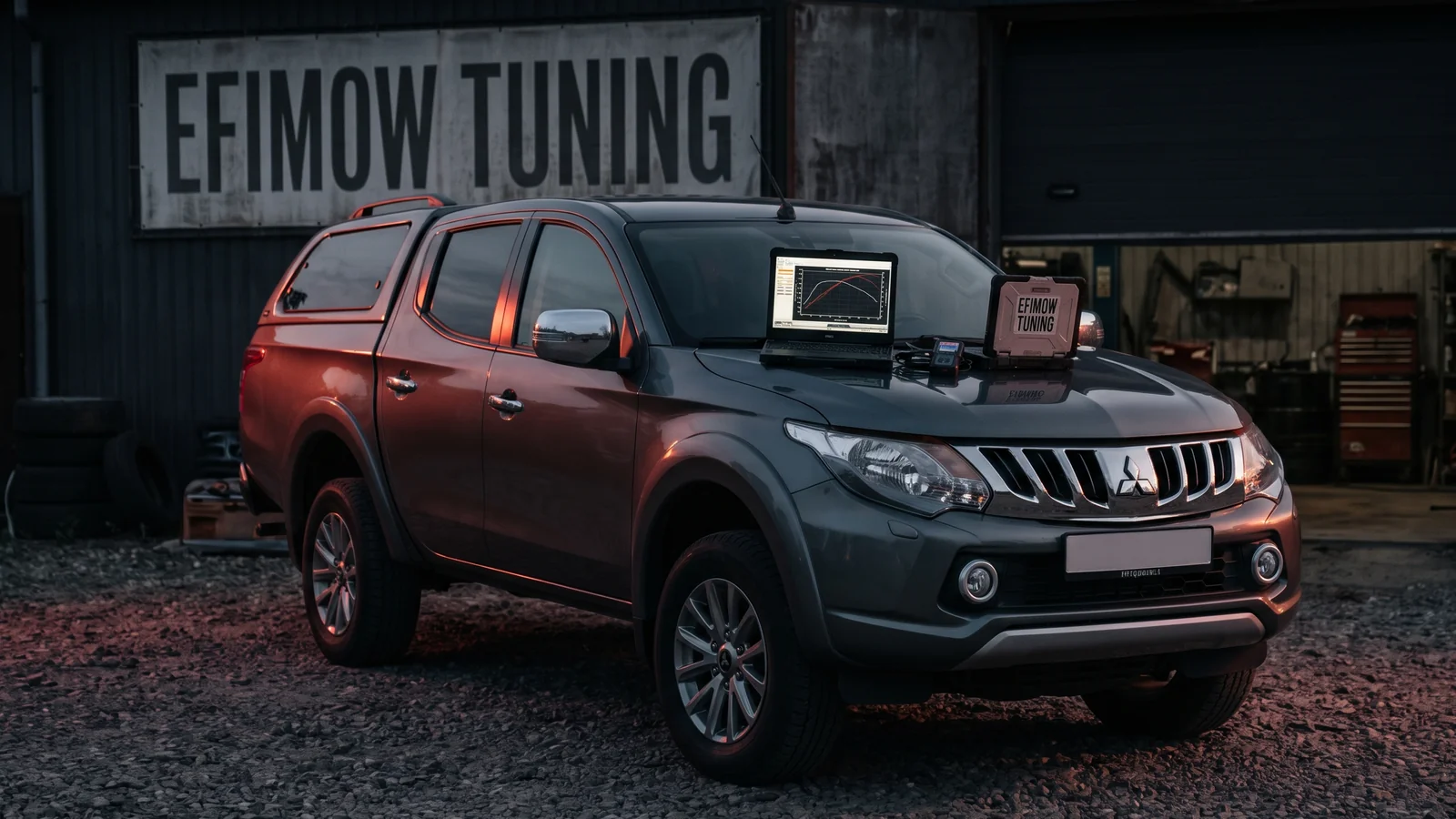
Mitsubishi DI-D: Tuning the Outlander, L200, Pajero and ASX
In-house Denso diesels in the L200 and Pajero, VW and PSA engines in the Outlander: what DI-D means, which ECUs are fitted and what software delivers.
October 25, 2026 by Leo Efimow
At Mitsubishi, "DI-D" stands for the brand's common-rail diesels. Behind the uniform name, though, lies a colourful mix: the L200 and Pajero use Mitsubishi's own diesels with Denso ECUs, while the second-generation Outlander uses engines from the VW Group and PSA. For tuning, that is no minor detail. If you know which engine is actually under the bonnet, you also know which ECU awaits and how much headroom is realistic.
What is behind DI-D
Our catalog lists these DI-D versions:
| Model | Engine | Engine code | Output (catalog) | ECU | Origin |
|---|---|---|---|---|---|
| L200 (IV) | 2.5 DI-D | 4D56 | 136 hp | Denso | Mitsubishi |
| L200 (IV) | 3.2 DI-D | 4M41 | 167 hp | Denso | Mitsubishi |
| Pajero (IV) | 3.2 DI-D | 4M41 | 170 hp | Denso | Mitsubishi |
| Outlander (II) | 2.0 DI-D | BSY | 140 hp | Bosch EDC16U31 | VW Group (unit injector) |
| Outlander (II) | 2.2 DI-D | 4HK | 156 hp | Bosch EDC16CP39 | PSA (2.2 HDi) |
| Lancer (IX) | 2.0 DI-D | 4D69 | 140 hp | Bosch EDC16U31 | VW Group (unit injector) |
| Space Star | 1.9 DI-D | - | 102 / 115 hp | Bosch EDC15C2 | Renault |
We do not currently list the ASX or the third-generation Outlander as separate variants. For these cars, an enquiry is worthwhile so that we can check the ECU and access method in advance.
L200 and Pajero: Mitsubishi diesels with Denso
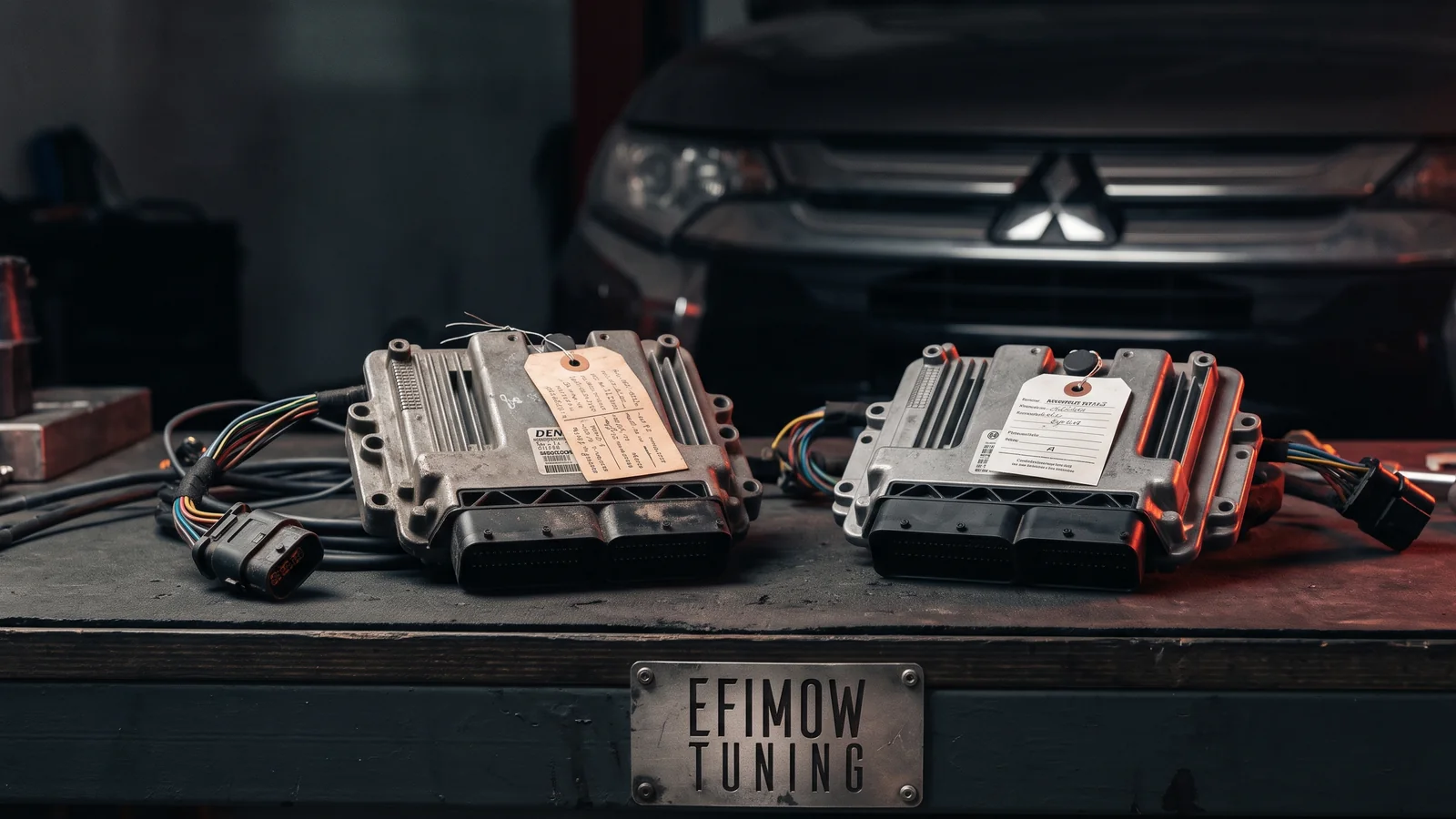
The 2.5 DI-D (4D56) and 3.2 DI-D (4M41) are the brand's classic work engines: robust, torquey and designed for towing and off-road use. They are controlled by Denso ECUs. For the Denso diesel family, our data gives a typical 15–25% more power and 20–30% more torque as a Stage 1 guide value.
With Denso, the rule is: the ECUs were hard to access for a long time, partly encrypted, and tool coverage is patchier than for Bosch. We therefore check whether the specific ECU is readable before making an offer. On an L200 used as a work vehicle, peak power is not what counts anyway. Early torque and controlled exhaust temperatures under load are.
Outlander and Lancer: VW unit injector and PSA HDi
The 2.0 DI-D in the Outlander II and Lancer IX is a unit-injector diesel from the VW Group with a Bosch EDC16U31. For this family, our data gives a typical 25–35% more power and torque, one of the larger margins for diesels of this generation. Unit-injector engines are mechanically demanding, though: camshaft, unit injectors and clutch should be in good order before tuning.
The 2.2 DI-D in the Outlander II is the PSA engine otherwise known as the 2.2 HDi, with a Bosch EDC16CP39. Here our data gives a typical 20–30%.
The older 1.9 DI-D in the Space Star comes from Renault and runs with a Bosch EDC15C2: a typical 15–25% power and 20–30% torque as a guide value.
Options
For the families mentioned, the following are documented alongside Stage 1:
- ECO tuning with more torque in the low and mid range and unchanged peak power, often the better choice for an L200 or Pajero used for towing
- Sharp Throttle for a more direct throttle pedal
- DTC Off only for non-emissions-related fault codes
- Vmax removal: documented for the Bosch families, only partly feasible on Denso and therefore on request; mind the tyre speed rating and registration
Stage 2 with hardware is possible in principle on the Bosch EDC16 families. For a pickup or off-roader, though, a clean Stage 1 is almost always the more sensible solution.
Drivetrain and exhaust aftertreatment
The L200 and Pajero have a robust drivetrain, but the same applies here: clutch and gearbox must cope with the extra torque permanently, especially with frequent towing. On automatic models, a serious calibration builds torque so that the transmission control does not intervene.
The newer DI-D engines have a particulate filter. Disabling the DPF, EGR or catalyst is emissions tampering and illegal on public roads, even on a pickup that spends a lot of time off-road.
Process and prices
We work on Mitsubishi directly at the ECU: on site in Stödtlen at an appointment of your choice or by sending in the removed ECU. The price is the same in both cases, and booking is online.
Under our pricing rules, the L200 2.5 DI-D with 136 hp, the L200 3.2 DI-D with 167 hp and the Pajero IV 3.2 DI-D with 170 hp start from €175 for Stage 1. The Outlander II 2.0 DI-D and the Outlander II 2.2 DI-D start at €200. For the ASX and newer Outlanders, use the enquiry in the configurator.
On the legal side: the software change voids the type approval. The software is intended for motorsport use only (see the motorsport notice).
Common questions from the workshop
My Outlander is a 2.0 DI-D. Does it really have a VW engine? Yes. According to our catalog, the 2.0 DI-D in the second-generation Outlander is a unit-injector diesel from the VW Group with the engine code BSY and a Bosch EDC16U31. The guide values of that family therefore apply, as do the typical maintenance points of unit-injector engines.
What matters on an L200 used as a work vehicle? On a working pickup, durability comes before peak power. We usually recommend a restrained Stage 1 or ECO tuning here: early torque, controlled exhaust temperatures, no experiments. The permitted payload and towing capacity do not change through software.
Can I remove the ECU on the L200 myself? In principle yes, if you have experience with it. Disconnect the battery, release the connectors carefully, pack the ECU antistatically and send it well padded. If unsure, ask a workshop. Because Denso units vary in readability, we check from the ECU identification before shipping whether your unit is supported. We back up the original state before writing.
Conclusion
At Mitsubishi, DI-D is a name for very different engines. The L200 and Pajero with in-house diesels and Denso ECUs offer a typical 15–25% power and 20–30% torque as a guide value, but require a readability check. The Outlander II uses proven Bosch technology with the VW unit-injector engine and the PSA 2.2, with 20–35% headroom. More on the peculiarities of Japanese ECUs in our article on Denso ECUs.