
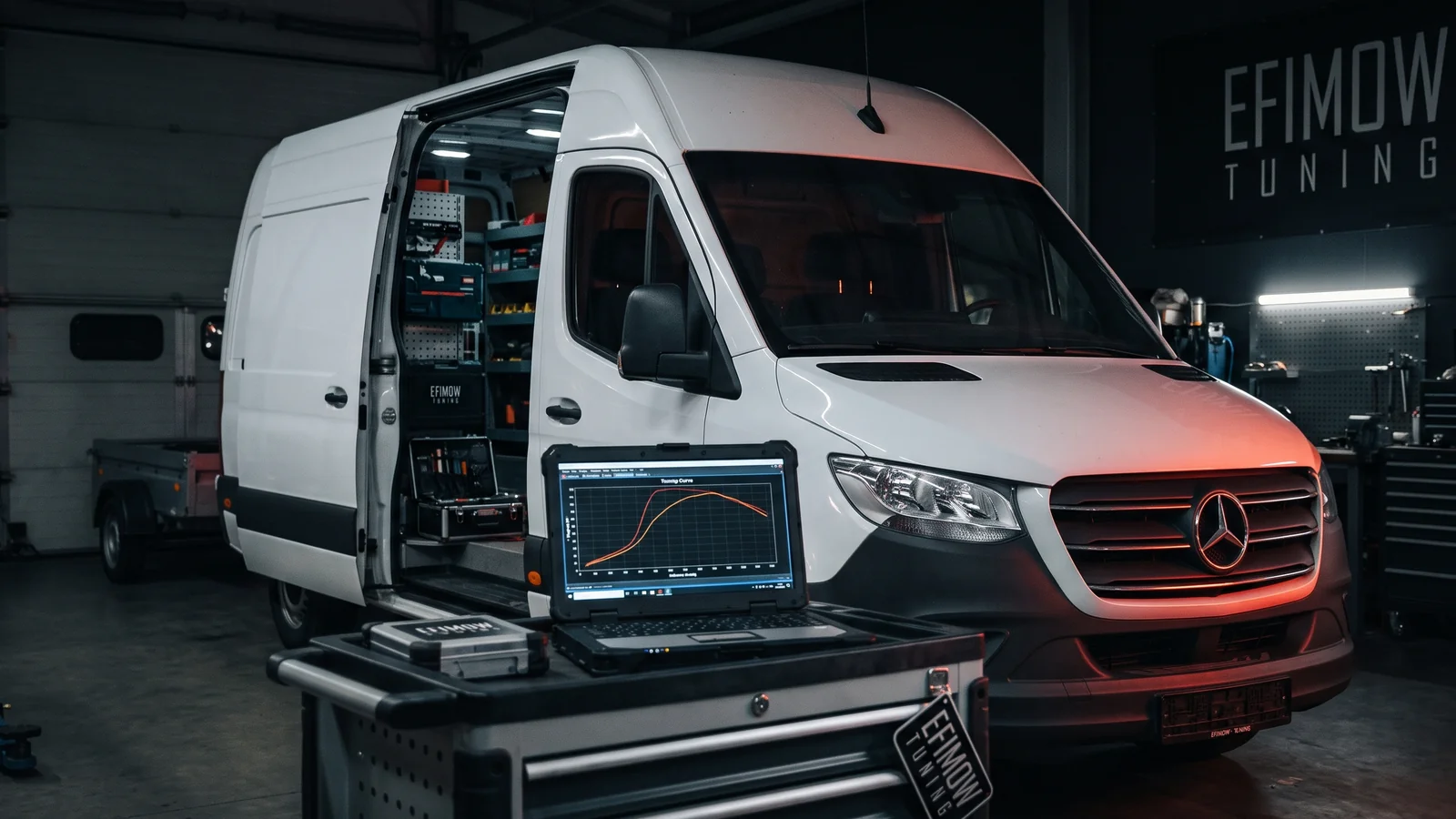
Mercedes Sprinter Tuning: Pulling Power for Vans
Mercedes Sprinter W905 and W906 tuning: OM611, OM646, OM651 and OM642: ECUs, guide values, ECO tuning for fleets, drivetrain load and process.
October 25, 2026 by Leo Efimow
The Sprinter is not a vehicle you tune for fun. It is a work tool: tradesman's van, parcel van, motorhome base, dropside with tow bar. Anyone considering software for a van rarely wants a higher top speed; they want more pull on climbs, more relaxed overtaking with a full load and an engine that does not have to work at full load all the time. For exactly that purpose, a measured calibration makes sense on the Sprinter. The prerequisite is knowing the differences between generations and engines, because under the star, the Sprinter hides very different CDI diesels with very different ECUs.
Generations and engines at a glance
Sprinter W905 (1995–2006): The first generation uses the four-cylinder OM611 (2.2 litres, e.g. 208, 211, 213, 308 to 413 CDI) and the five-cylinder OM612 (2.7 litres, 216, 316, 416 CDI). Both are controlled by a Bosch EDC15C6. There was also the M111 petrol engine as 214/314/414.
Sprinter W906 (2006–2018): The second generation brings three diesel families:
- OM646 (2.2 litres) with Bosch EDC16CP31: 209, 211, 213, 215, 309 to 515 CDI.
- OM651 (2.1 litres, "2.2 CDI") with Delphi DCM3.5 (210, 213, 216, 310, 313, 316, 510, 516 CDI) or with Bosch EDC17 in further applications.
- OM642 (3.0 litre V6) with Bosch EDC16CP31 as 218, 318, 418, 518 CDI, and with Bosch EDC17 in later applications.
On top of that there is the M272 petrol engine (3.5 litre V6) as 224, 324, 424, 524. The current Sprinter of the W907 series is not yet in our catalogue and is handled by request.
What is realistic
Typical Stage 1 guide values depend on the ECU:
| Engine / ECU | Power (guide value) | Torque (guide value) |
|---|---|---|
| OM611/OM612 with EDC15 | 15–25 % | 20–30 % |
| OM646/OM642 with EDC16 | 20–30 % | 20–30 % |
| OM651 with Delphi DCM3.5 | 20–30 % | 20–30 % |
| OM651/OM642 with EDC17 (vans) | 15–25 % | 20–30 % |
These are ranges from our data, not promises. On the Sprinter, however, they are particularly meaningful because many power levels are mechanically identical. A 313 CDI and a 316 CDI with OM651 share the same base engine; the difference lies mostly in the software. That is also why there is noticeable headroom in the base versions, and why the top versions gain less in percentage terms.
What the software changes on a van
The parameters are the familiar ones: torque limiters, injection quantity, rail pressure, boost pressure and smoke limiter. On a van, though, the emphasis shifts. A sensible Sprinter tune focuses on torque between roughly 1,500 and 3,000 rpm, exactly where a loaded van works every day. Peak power at the top end is secondary.
A clean file keeps exhaust temperatures within limits. Under sustained load (motorway with full payload, mountain pass with a trailer), temperature is the limiting factor, not boost pressure. Component protection functions therefore stay active, particulate filter and exhaust gas recirculation keep working unchanged. Disabling DPF, EGR or SCR is emissions tampering and prohibited on public roads, commercial vehicles included.
ECO tuning for fleets
For commercial users, the most interesting option is often not Stage 1 but ECO tuning. It optimises torque in the low and mid-range while peak power stays unchanged. The effect: the driver has to downshift less often and press the pedal less deeply, and the engine spends more time in a favourable load range. How much fuel that saves in an individual case depends heavily on the driving profile and the driver. A blanket figure would not be honest.
ECO tuning is available for all Sprinter ECUs in our data, as are Sharp Throttle for a more direct throttle pedal and Vmax removal. For Vmax: mind the tyre speed rating and registration, and many vans above 3.5 tonnes have a legally required speed limiter that must not be touched anyway.
Special case: motorhome
A large share of Sprinters today do not run as delivery vans but as panel-van campers or as the base for a semi-integrated motorhome. The profile is different: these vehicles are almost always close to their permissible gross weight, have a large frontal area and cover long stretches on motorways and over Alpine passes. Here a torque gain in the mid-range pays off particularly well, because the engine spends less time at its limit and climbs can be taken in a higher gear.
At the same time, the thermal load is higher than with an empty van. A calibration for a motorhome should therefore be on the conservative side, respect exhaust temperatures and suit the gearbox. Converting a van into a motorhome often changes the vehicle class in the papers, by the way. That matters for registering a power increase and should be clarified beforehand.
Load: clutch, gearbox, drivetrain
A van has a different everyday load than a car. This affects three components in particular:
- Clutch and dual-mass flywheel: with manual gearboxes the clutch carries the extra torque. A clutch that is already worn will slip sooner after tuning. If in doubt, have it checked first.
- Automatic gearbox: on vehicles with a torque-converter automatic, the extra torque must suit the gearbox limits. A gearbox oil change makes particular sense after tuning and when towing.
- Rear axle and driveline: on the rear-wheel-drive Sprinter, axle and propshaft are designed for high loads. Here it is usually not the software but the payload that is the critical factor.
The maintenance condition matters too. A Sprinter with 300,000 km, a coked EGR valve and a leaking charge-air path will not get better with a new file, quite the opposite. Fault memory, charge-air hoses, injectors and particulate filter belong on the checklist before the appointment.
Process and prices
We tune the Sprinter directly on the ECU: on site with us in Stödtlen at an appointment of your choice, or by sending in the removed ECU. For fleet operators the on-site appointment is often more practical, because the vehicle is only off the road briefly. The price is the same either way, and you book online.
Under our pricing scheme, Stage 1 costs:
- W905 with EDC15C6, such as the 313 CDI with OM611: from €175.
- W906 with EDC16CP31 or Delphi DCM3.5, such as the 316 CDI with OM651 or the 318 CDI with OM642: from €200.
- W906 with Bosch EDC17: from €300.
Options such as ECO tuning or Sharp Throttle are added at extra cost and shown in the configurator. Legally, the van is no exception: the software change voids your vehicle's type approval; the software is intended for motorsport use only.
Conclusion
On the Sprinter, tuning is a question of emphasis. What counts is not the maximum percentage but stronger, more even torque in the working range and controlled temperatures under sustained load. The ECUs (EDC15, EDC16, Delphi DCM3.5 or EDC17) determine access and price; the maintenance condition determines whether the extra power holds up in the long run. For fleets, ECO tuning is often the more suitable choice than Stage 1.
Which variant is in your Sprinter and what it costs, the configurator will show you.