
Mercedes OM651: The Four-Cylinder Diesel in C, E, Sprinter & Co
Mercedes OM651 tuning: Delphi CRD3, DCM3.5 or Bosch EDC17: why the ECU identification matters, which guide values apply and what the process costs.
October 25, 2026 by Leo Efimow
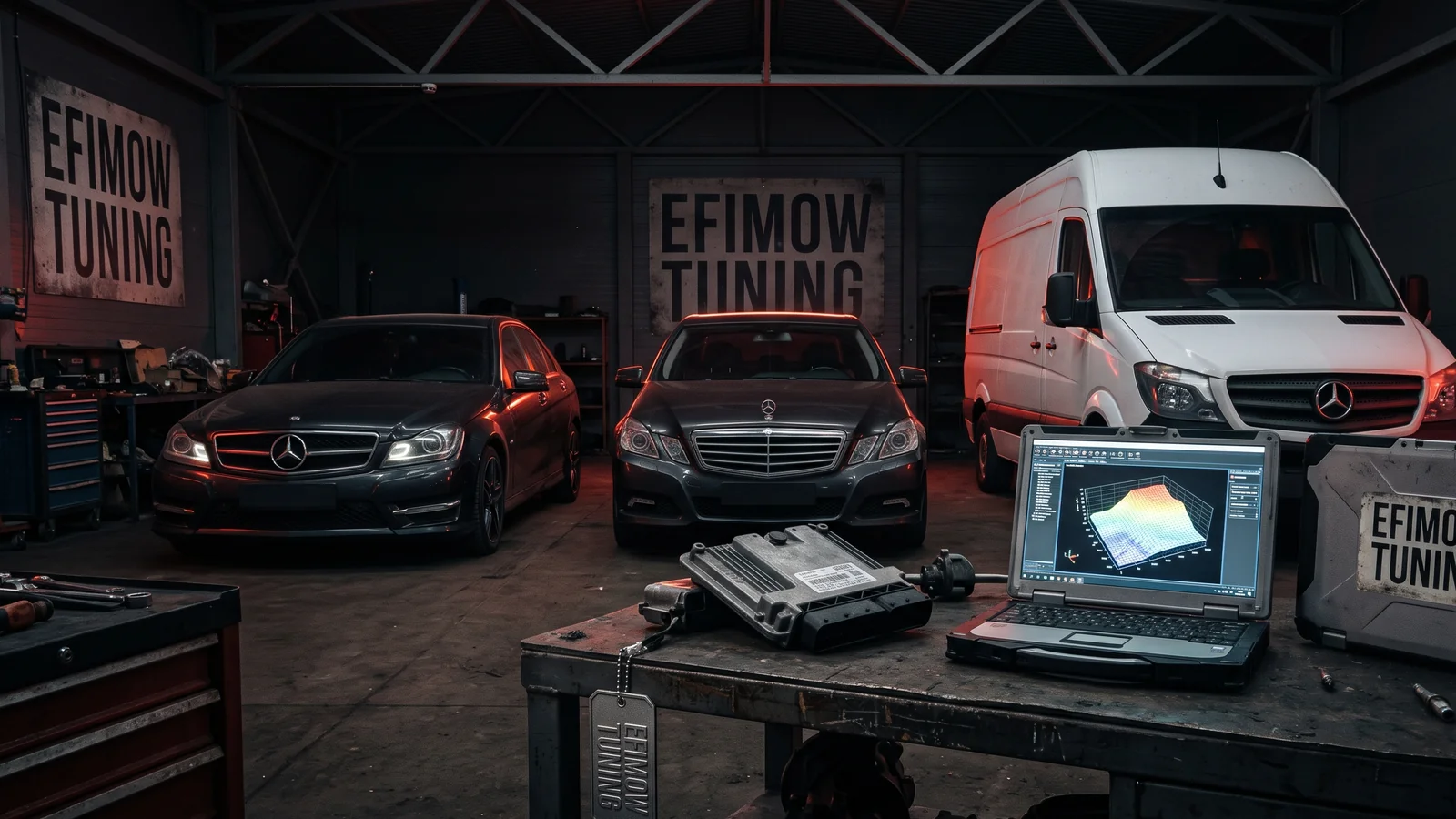
Hardly any Mercedes engine is as widespread as the OM651. The four-cylinder CDI with 1.8 or 2.1 litres displacement (sold as "2.2 CDI") powers the A-Class W176, the C-Class W204, the E-Class W212, the CLA, CLS, GLK, the M-Class W166 and the SLK R172 and, in large numbers, the Sprinter W906, the Vito and the Viano. From the compact A 180 CDI to the van with twin rear wheels: at its core it is the same engine. For tuning, that is good news, because the OM651 is extensively documented. The bad news: behind the same model badge there can be quite different ECUs. And those decide access, options and price.
One engine, three ECU families
For the OM651, Mercedes worked with two suppliers depending on model range, model year and power level:
- Delphi CRD3.x: for example in the A 180 CDI and A 200 CDI (W176), C 200 CDI (W204), CLA 200/220 CDI, E 250 CDI (W212), CLS 250 CDI, ML 250 and SLK 250 CDI.
- Delphi DCM3.5: among others in the C 220 CDI and C 250 CDI (W204), E 200/220 CDI (W212), GLK 200/220 CDI and in many Sprinter variants (210, 216, 316, 516 CDI).
- Bosch EDC17 (C43, CP46, CP57, CP60, C66): in further applications of the GLK, Vito/Viano and Sprinter.
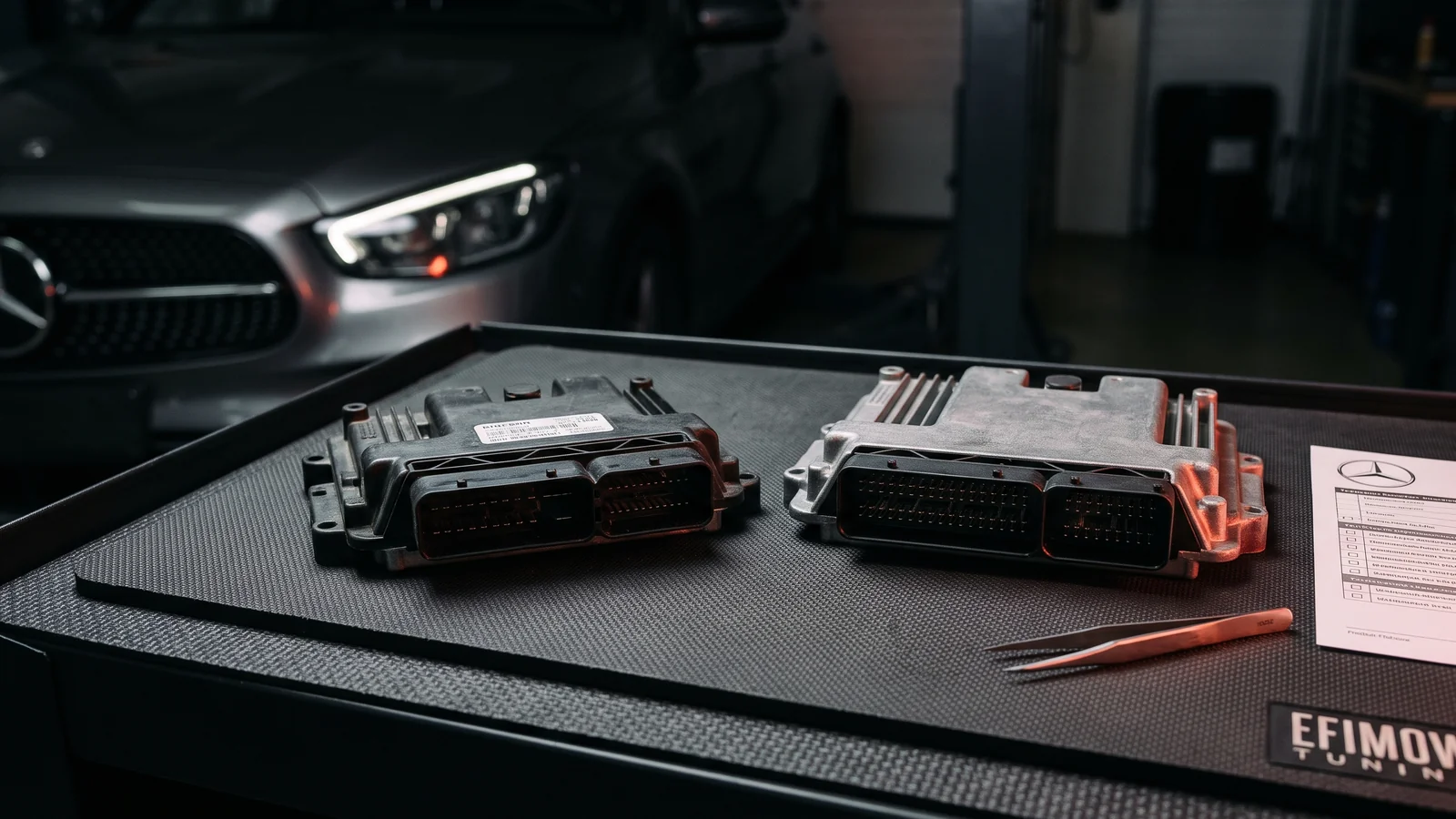
Our data explicitly notes that many OM651 engines have a Bosch ECU instead of a Delphi unit. The model designation is therefore not enough. Before a tuning file is created, the ECU is identified via the label on the housing or by reading out its identification. Skipping this step risks a cancelled appointment at best and, at worst, a file that does not match the hardware.
What the OM651 can do with software
For both Delphi families as well as for Bosch EDC17 on four-cylinder engines, our data gives typical Stage 1 guide values of 20 to 30 percent more power and torque. That is a range, not a promise. An OM651 in its base output, for instance in the Sprinter 210 CDI or the C 180 CDI, is mechanically the same engine as in the stronger versions and is essentially held back by software. In the top versions with 204 PS, the engine already has two-stage turbocharging from the factory and is pushed harder; there the percentage gain tends to sit at the lower end of the range.
A serious calibration changes the familiar diesel parameters: torque limiters, injection quantity, rail pressure, boost pressure and the smoke limiter. Temperature and component protection functions stay active, particulate filter and exhaust gas recirculation keep working unchanged. Disabling DPF, EGR or an existing SCR system is emissions tampering and prohibited on public roads.
Options by ECU
| ECU | Stage 2 | Available options |
|---|---|---|
| Delphi CRD3.x | limited | Stage 1+, Stage 2+, ECO tuning, Sharp Throttle, Vmax, DTC (non-emissions codes only); rev limiter on request |
| Delphi DCM3.5 | limited | same as CRD3.x |
| Bosch EDC17 | yes | additionally Launch Control on request |
Raising the rev limiter rarely makes sense on a diesel. The engine delivers hardly any extra power at the top end. More interesting for many OM651 drivers are ECO tuning and Sharp Throttle. ECO tuning focuses on torque in the low and mid-range with unchanged peak power; Sharp Throttle makes the often sluggish-feeling throttle pedal more direct. Especially in the Sprinter or Vito, where the engine works mostly at part load, this combination is often a better fit than maximum output.
Known quirks of the OM651
The engine is robust if it has been looked after. Before tuning, though, it is worth checking a few points that regularly show up at high mileage:
- Timing chain and tensioner: on the OM651 the chain drive sits at the gearbox end. Noise on cold start is a warning sign that should be cleared up before any power increase.
- Injectors: check return quantities and smooth running. An injector that is already conspicuous in stock form will not get better with more fuel.
- EGR valve and intake tract: carbon build-up is an issue with lots of short trips. A clogged intake costs air mass, and on a diesel, air is the basis of every power gain.
- Particulate filter: frequent regenerations or an unusual differential pressure should be resolved first.
None of these points has anything to do with the software. But they decide whether the engine can handle the additional power in the long run.
Clutch, dual-mass flywheel and automatic
Many OM651 engines run with a manual gearbox, especially in the Sprinter and the smaller passenger-car versions. The dual-mass flywheel and clutch are designed for the stock torque, with a certain reserve. If the clutch is already worn, this shows sooner after tuning because it can no longer transmit the extra torque cleanly. With the automatic versions (7G-Tronic in C- and E-Class, torque-converter automatic in the Sprinter) the gearbox receives the engine torque and has its own limits, which a consistent calibration takes into account.
Before the appointment: what to prepare
A little preparation helps the appointment run smoothly. Note down model, model year, power and (if known) the engine code from the registration document. A photo of the ECU label saves follow-up questions, because it lets us tell Delphi and Bosch variants apart immediately. Have existing faults in the fault memory checked and fixed beforehand if necessary: a boost pressure sensor that already delivers implausible values in stock form distorts any calibration. And if a service is due, the timing is good: fresh oil, new filters and a clean air filter are the best starting point for working on the ECU.
If you send in the ECU, pack it carefully: antistatic bag, sturdy box, plenty of padding. The connectors stay on the vehicle; the ECU travels on its own.
Process and price
We tune Mercedes vehicles directly on the ECU: either on site with us in Stödtlen at an appointment of your choice, or you send us the removed ECU. The price is the same in both cases, and you book online.
For the Delphi variants, Stage 1 starts from €200 under our pricing scheme, for example for the C 220 CDI in the W204 or the E 250 CDI in the W212. For OM651 applications with Bosch EDC17, Stage 1 starts from €300. The Sprinter 316 CDI is also in the catalogue; the configurator shows the exact price for your vehicle once model, engine and power are selected.
Legally: the software change voids your vehicle's type approval; the software is intended for motorsport use only.
Conclusion
The OM651 is an engine with many faces, from sports roadster to van. In software terms it is easy to handle and, depending on the power level, offers noticeable reserves, above all in torque. The most important step before any tuning, however, is not the file but the identification: Delphi CRD3, DCM3.5 or Bosch EDC17 determines what is possible and what it costs. Add to that an honest look at timing chain, injectors, clutch and particulate filter.
Which variant is in your vehicle and which options are available for it, you can see in the configurator.