
Mercedes C-Class W205: Diesel and Petrol Engines Tuning Check
Mercedes C-Class W205 tuning check: M274, M276 and V8 with MED17.7, the OM651 and OM654 diesels: ECUs, typical gains, options and process.
October 25, 2026 by Leo Efimow
The C-Class of the W205 series was built from 2014 to 2021 and is one of the most common premium cars on European roads today, as saloon, estate, coupé and cabriolet. Under the bonnet sits an unusually wide range of engines: four-cylinder turbo petrols, a V6 biturbo, the V8 engines of the AMG models and several CDI diesels. Anyone thinking about software tuning quickly notices that there is no such thing as "the" C-Class. What matters is which engine and, above all, which ECU is fitted. This post sorts the variants, puts the realistic margins into perspective and explains what Stage 1 actually changes.
The petrol engines: M274, M276 and the V8s
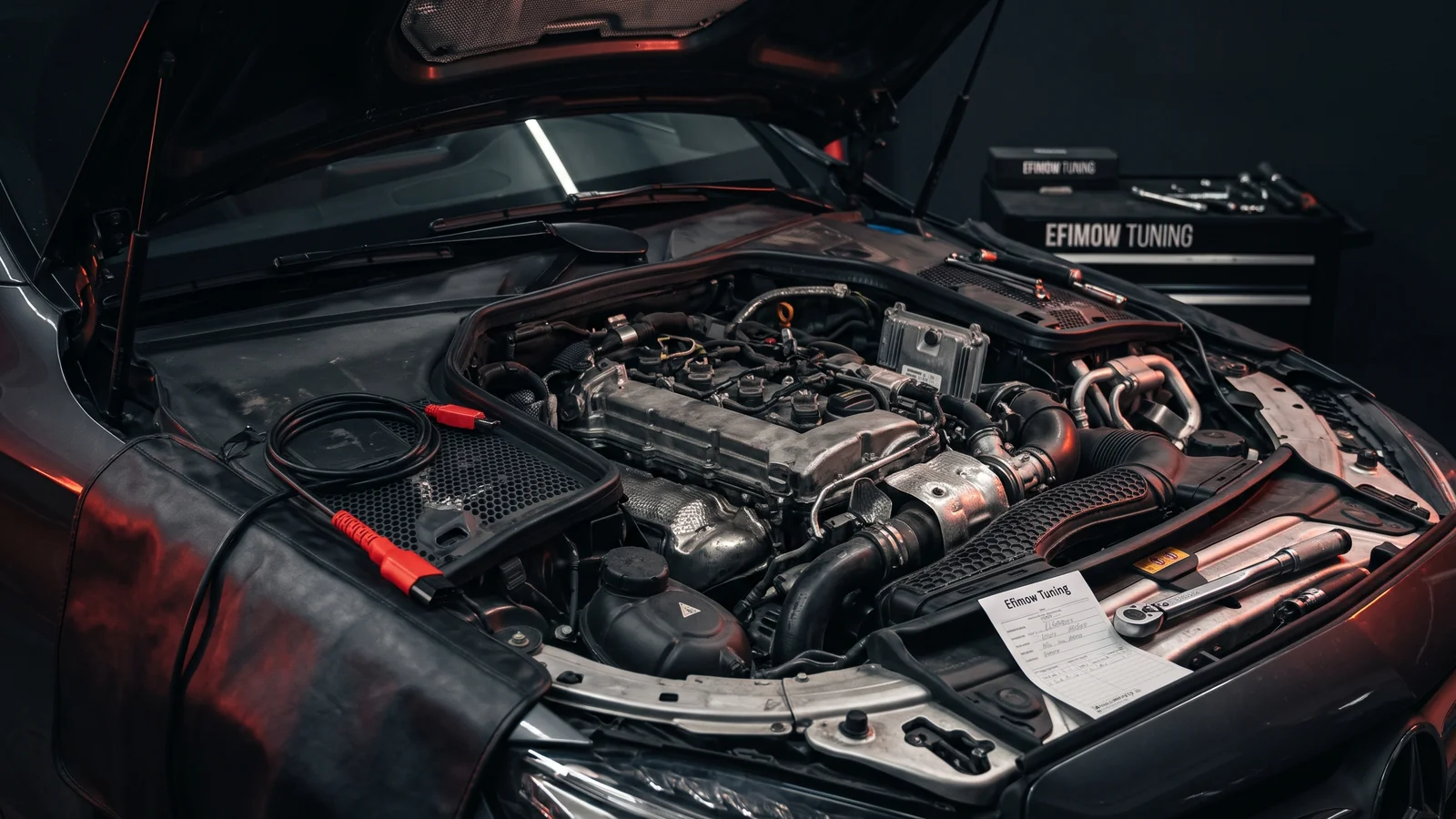
On the petrol side things are clear-cut. Almost all W205 petrol engines are controlled by a Bosch MED17.7:
- M274 (1.6 and 2.0 litre turbo): the four-cylinder in the C 180, C 200, C 250 and C 300. Direct injection, turbocharger, charge-air cooling: a classic downsizing design with noticeable factory reserves.
- M276 (3.0 and 3.5 litre V6): in the W205 mainly as the 3.0 litre biturbo in the C 43 / C 450 AMG.
- M177 / M178 (4.0 litre V8 biturbo): the engine of the C 63 and C 63 S.
For the MED17.7 family, typical Stage 1 guide values for the turbo engines are around 15 to 30 percent more power and torque. That is a range, not a promise: where an individual engine ends up depends on software version, fuel quality, intake air temperature and the condition of the hardware. On the M274 the lever is relatively large, because the engine was sold in several power levels and the weaker versions are essentially limited by software. On the V8 the percentage margin is similar, but the load on gearbox and cooling is in a different league.
One factor many people underestimate is fuel. The factory calibration has to cope with different fuel qualities worldwide. A Stage 1 file designed for 98-octane Super Plus only uses its reserves with that fuel; with 95 octane the knock control intervenes earlier and takes back part of the gain. That is not a fault. It is exactly the protection function that is supposed to remain in place.
The diesels: OM651 and OM654
For the diesels, the W205 is a transitional series. Until the 2018 facelift, the C 200 d, C 220 d and C 250 d still used the well-known four-cylinder OM651; after that the new aluminium four-cylinder OM654 took over. For tuning, this change matters more than any power figure:
- Depending on the application, the OM651 is controlled by Delphi or Bosch ECUs (EDC17). It is well documented, typical guide values are 20 to 30 percent.
- The OM654 belongs to the Bosch MD1 generation. These ECUs are better protected, and access is often no longer possible via classic OBD. Typical guide values here are 15 to 25 percent.
The W205 diesels are not yet listed as separate variants in our vehicle catalogue. That does not mean they cannot be done. You send them as a request through the configurator, and we check from the ECU identification which route fits. For all diesels: DPF, EGR and the SCR system with AdBlue remain fully functional. Disabling these components is emissions tampering and prohibited on public roads.
What Stage 1 changes in the MED17.7
A serious Stage 1 calibration is not a "magic file"; it shifts setpoints in a manageable number of maps. On the Mercedes petrol engines these are mainly:
- Boost targets across rpm and load,
- Cylinder filling and torque request: Mercedes uses a torque-based structure in which the requested output passes through several limiters,
- Ignition timing within the limits allowed by knock control,
- Torque limiters, which also have to be matched to the gearbox.
The protection functions remain active. Knock control still pulls timing when the fuel is not up to it, component protection and temperature models keep working. That is exactly what separates real software tuning from a tuning box that merely feeds the ECU false sensor values.
One point that is often underestimated on the W205 is the gearbox. Most cars run a torque-converter automatic (7G-Tronic Plus or 9G-Tronic). The gearbox receives the current torque from the engine ECU and has its own limits. A consistent calibration keeps the extra torque at a level where shift quality and the clutches inside the gearbox do not suffer.
Options for the MED17.7
For the W205 petrol engines our data lists several additional options beyond the power increase itself:
| Option | Status | Note |
|---|---|---|
| Stage 1+ / Stage 2+ | available | Stage 2 only with matching hardware |
| ECO tuning | available | more torque at part load |
| Sharp Throttle | available | more direct throttle pedal curve |
| Vmax removal | available | mind tyre speed rating and registration |
| Raise rev limiter | available | respect mechanical limits |
| Launch Control | available | - |
| No-Lift-Shift | on request | only useful with a manual gearbox |
| Pops & Bangs, Hardcut, Popcorn limiter | available | motorsport only |
Pops & Bangs, Hardcut and the Popcorn limiter are functions for closed circuits. They significantly increase the load on catalytic converter, turbocharger and exhaust system and are not permitted on public roads. If you are interested, read the motorsport notice first.
Process and prices
We do not tune the C-Class through the remote flashing route we offer for BMW, but directly on the ECU. You have two options: come to us in Stödtlen for an appointment of your choice, or remove the ECU and send it in. The price is the same in both cases, and you book online.
The price depends on ECU generation, power and model year. For the four-cylinder C-Class W205 with M274, Stage 1 starts from €250 under our pricing scheme. For the V6 M276 and the V8 models, the configurator shows the exact price for your car, because power class and model year are part of the calculation.
Before tuning, a quick check is worthwhile: fault memory, spark plugs, charge-air path and (on diesels) the condition of DPF and EGR. An engine that already shows problems in stock form will not get healthier with more power.
Legal and insurance
The C-Class is no exception: the software change voids your vehicle's type approval; the software is intended for motorsport use only. For road use, a power increase would have to be approved and registered with an expert report, and your insurer should be informed. If the car is still under factory warranty or leased, clarify the consequences beforehand. Mercedes can read the software version during diagnostics.
Conclusion
The W205 is a rewarding car to tune if you look at it by engine and ECU rather than by model name. The M274 with the MED17.7 offers a large, well-controllable margin; the V6 and the V8s demand more attention to gearbox and temperatures. On the diesels, the switch from OM651 to OM654 determines access and effort. In every case: guide values are orientation, not a promise, and a clean calibration keeps all protection functions active.
If you want to know what is possible for your C-Class, select engine and power in the configurator. There you will see the available options and the price for your car.