
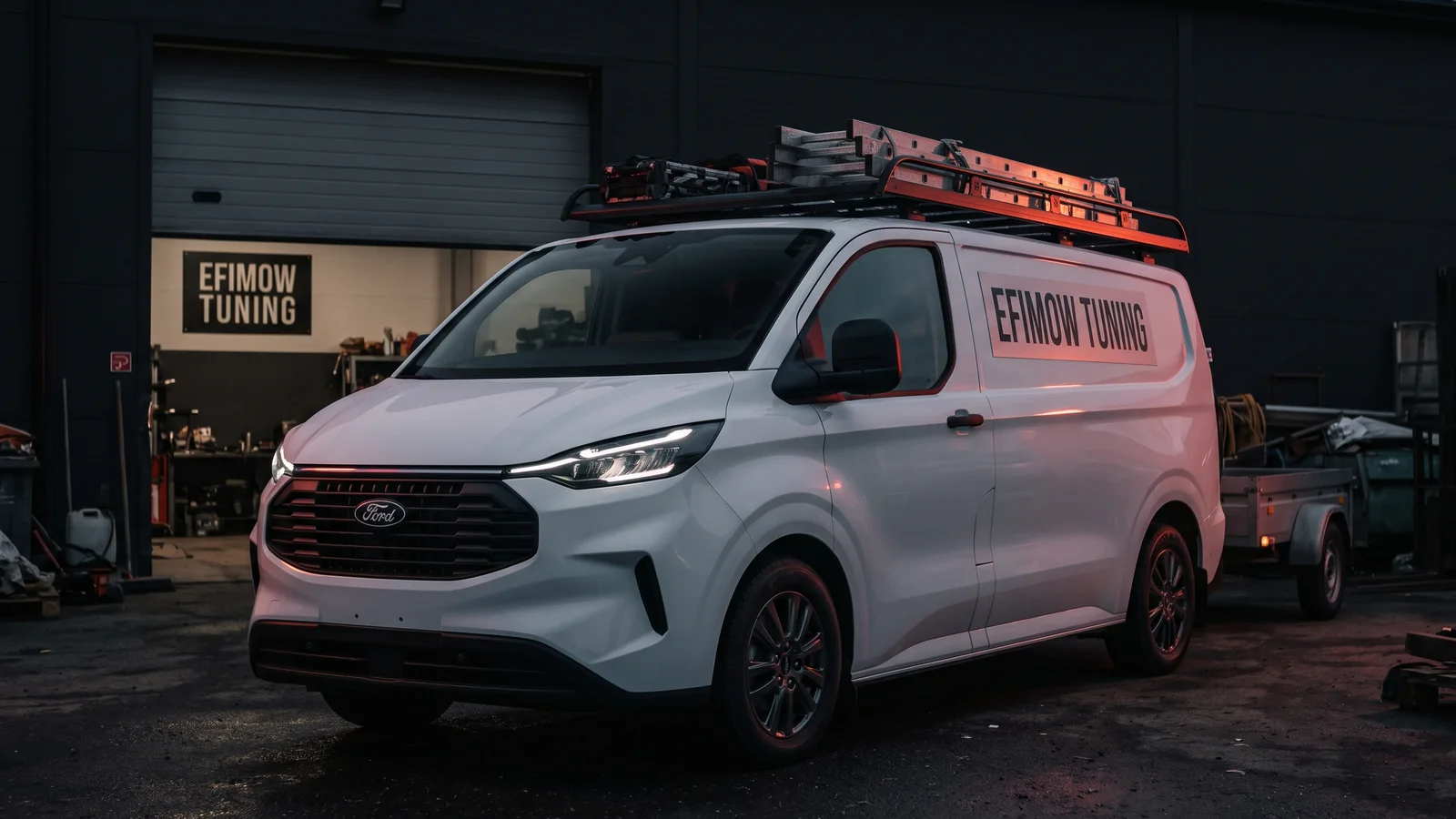
Ford Transit / Transit Custom: Tuning for Trades and Campers
Transit and Transit Custom with TDCi and EcoBlue: what software does for pulling power, towing and fuel use, which ECUs are fitted and what is allowed.
October 25, 2026 by Leo Efimow
The Ford Transit is one of the most widely driven commercial vehicles in Europe, and since 2012 the Transit Custom has been its smaller sibling for tradespeople, delivery services and, more and more often, camper conversions. Both have one thing in common: they rarely travel empty. Tools, materials, shelving, water tank, awning, often a trailer as well. That is exactly when you find out whether the diesel has enough torque: on a motorway gradient, on a mountain pass with a full conversion or pulling away with a trailer. A software adjustment can make a real difference here. But it has to suit the use, and with commercial vehicles a few legal points apply that play no role on a passenger car.
Which engines and ECUs are involved
Ford has used several diesel generations in the Transit over the years. Our vehicle catalog lists, among others:
| Model | Years | Engine | ECU |
|---|---|---|---|
| Transit (TT9) | 2006–2014 | 2.2 / 2.4 / 3.2 TDCi | Visteon DCU102 or Continental SID208 |
| Transit (TTF) | 2012–2016 | 2.2 TDCi | Siemens SID208 |
| Transit (Mk8) | from 2014 | 2.0 diesel | Continental SID211 |
| Transit Connect | 2002–2013 | 1.8 TDCi | Siemens SID206 or Delphi |
The Transit Custom is not yet listed as a separate model in our catalog. Technically it uses the same engine families as the big Transit: first the 2.2 TDCi, from around 2016 the 2.0-litre EcoBlue diesel. For the EcoBlue, our data names ECUs of the Continental SID21x family. Which version is in your Custom is something we clarify from the ECU identification. The enquiry goes through the configurator.
What the software changes on a van
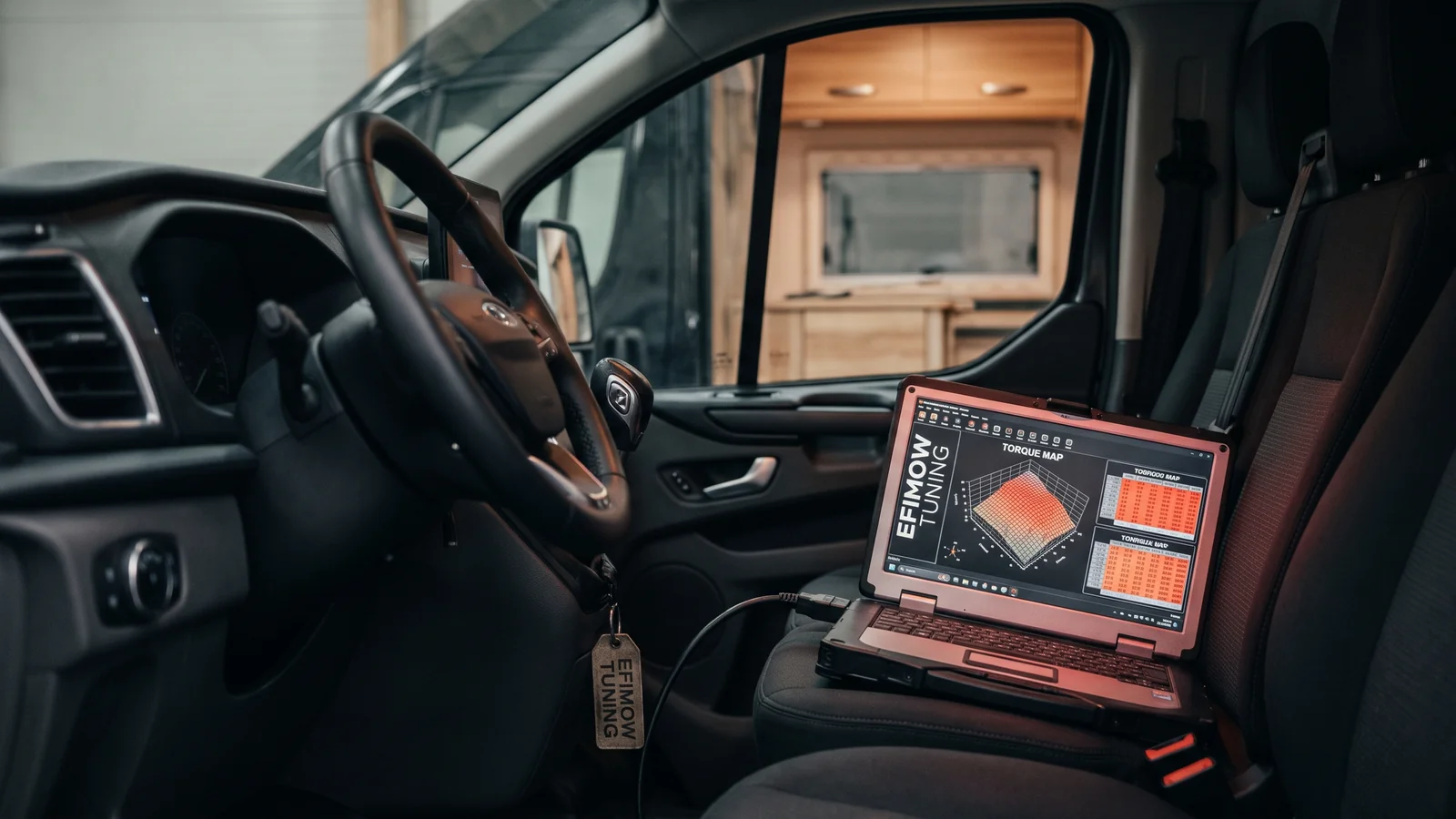
On a commercial diesel, it is not about peak power but about torque between roughly 1,500 and 3,000 rpm, where a loaded van is actually driven. The calibration works with rail pressure, injection quantity, boost, torque limiters and the smoke limiter.
Our data lists these typical Stage 1 guide values:
- Visteon DCU (2.2/2.4 TDCi): 15 to 25 percent more power, 20 to 30 percent more torque
- Continental SID20x/SID21x (2.2 TDCi, 2.0 EcoBlue): 15 to 25 percent more power, 20 to 30 percent more torque
For many van drivers, the real gain is less the number than the feel: fewer gear changes on hills, steadier pulling under load, more relaxed progress in traffic.
ECO tuning: for fleets and high-mileage drivers
Our data lists ECO tuning as a bookable option for the Transit ECUs and explicitly notes that for vans the focus is on torque and ECO. ECO tuning raises torque in the low and mid rev range while peak power stays the same. Whether and how much fuel is saved depends heavily on the driver. Those who shift up earlier and use the extra torque at low revs benefit most. For fleets with changing drivers, this version is often the more sensible choice than maximum power.
Further bookable options are a sharper throttle map (Sharp Throttle), Vmax removal and suppressing individual non-emissions-related fault codes.
Vmax on a van: what to keep in mind
Many vans are delivered with a speed limit from the factory or at the fleet operator's request. Our data notes that removing it is frequently requested on the Transit. Two points belong with that:
- Tyres: the tyres must be rated for the new top speed, and the change has to be registered.
- Vehicles over 3.5 t: commercial vehicles with a gross vehicle weight above 3.5 t are legally required to have a speed limiter. Removing it is not an option there.
Camper conversions and trailers
Camper conversions quickly add several hundred kilos, and many owners add a bike rack or trailer on top. More torque helps in exactly these situations. But it also puts more load on clutch, dual-mass flywheel, gearbox and cooling:
- Clutch and dual-mass flywheel: check beforehand on high mileage. Judder or noises when pulling away are warning signs.
- Cooling: long pass climbs fully loaded in summer are the real test. A moderate calibration keeps exhaust and coolant temperatures in check.
- Towing capacity: the permitted trailer load and gross vehicle weight do not change with software. They are in the vehicle documents.
DPF, EGR and AdBlue stay active
Modern Transit and Transit Custom diesels have a diesel particulate filter and exhaust gas recirculation; the EcoBlue generation also has an SCR system with AdBlue. In short-trip and delivery use in particular, these systems occasionally cause problems. Even so: removing or disabling the DPF, EGR or AdBlue/SCR is emissions tampering and prohibited on public roads, commercial vehicles included. A van with constant regeneration problems needs fault finding before any tuning.
Legally: the software change voids your vehicle's type approval; the software is intended for motorsport use only. For businesses this is especially relevant, because insurance and leasing for fleet vehicles are usually tightly regulated.
Stage 2 on a van?
Our data also lists Stage 2+ for the Visteon DCU and SID20x ECUs, meaning a calibration with additional hardware: a larger intercooler, an exhaust from the turbo back, possibly a larger turbocharger. A modified exhaust is only permitted with catalytic converter and particulate filter and with an ABE or parts certificate.
For most vans, though, Stage 2 is not the right route. A work vehicle above all has to be reliable, every day, over high mileages. Every additional hardware change is another possible source of faults, and the extra power is rarely used in delivery work. A well-calibrated Stage 1 or an ECO calibration usually brings more benefit per euro on the Transit.
Camper conversions that regularly cross Alpine passes heavily loaded can be a different case. Even there, though: check cooling and drivetrain first, then think about more power.
Process and price
The same process applies to the Transit and Transit Custom as to all non-BMW vehicles: you come to us in Stödtlen on a date of your choice or send in the ECU. The price is the same in both cases, and booking is online.
A worked example from the catalog: for the Transit TT9 2.2 TDCi with 140 PS (Visteon DCU102), Stage 1 starts at €300. For the current Transit with the 2.0 diesel and for the Transit Custom, the configurator shows ECU and price after selection or enquiry.
Checklist for tradespeople and campers
- Read the fault memory, especially DPF, EGR and boost entries
- Check regeneration behaviour and keep frequent short trips in mind
- Check clutch and dual-mass flywheel on high mileage
- Know the gross vehicle weight and towing capacity
- For fleet or leased vehicles, clarify consent
Conclusion
The Transit and Transit Custom are workhorses, and that is exactly what a software adjustment is worthwhile for: more torque at low revs, more relaxed driving under load, and, if you want, an ECO calibration for high-mileage drivers. The typical guide values are 15 to 25 percent more power and 20 to 30 percent more torque. What matters is a healthy drivetrain, working exhaust aftertreatment and a calibration that suits the use.
You can see which version you drive and what the calibration costs in the configurator, for the Transit Custom by enquiry.