
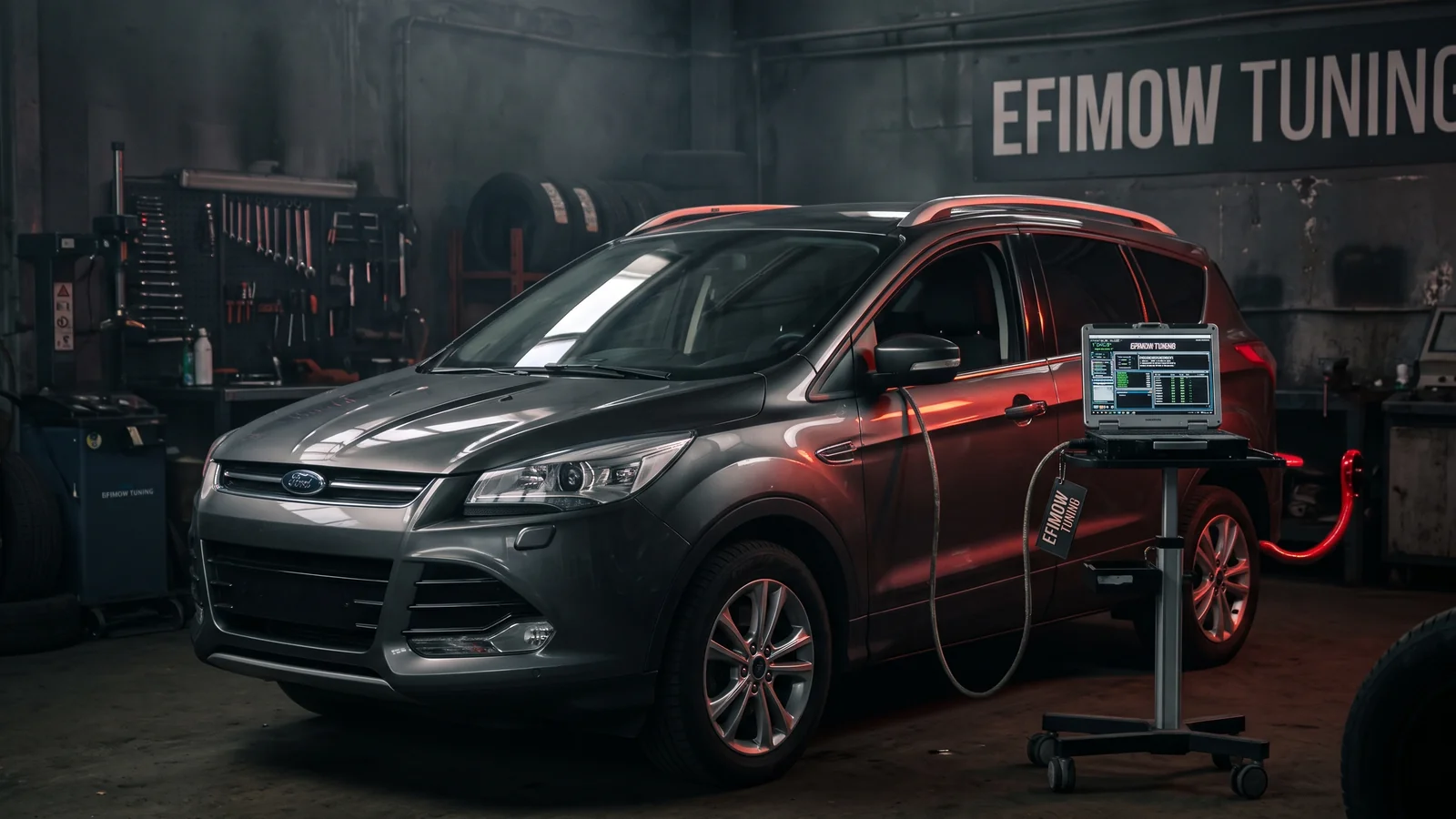
Ford Kuga 2.0 TDCi: Optimising the SUV Diesel
Ford Kuga I and II with the 2.0 TDCi: which ECUs are fitted, what Stage 1 and ECO tuning deliver and why the DPF and EGR must stay active.
October 25, 2026 by Leo Efimow
For many families and high-mileage drivers, the Ford Kuga is the car for everything: commuting, holidays, towing, all-wheel drive in winter. In the first two generations, the 2.0 TDCi was the most popular engine, a common-rail diesel closely related to PSA's 2.0-litre diesel. If you drive a Kuga with this engine and want more pulling power, for example when overtaking with a caravan or on long climbs, you quickly arrive at software. The good news: the 2.0 TDCi responds well to a clean calibration. The important caveat: depending on the year, very different ECUs hide behind the name, and they decide access, price and options.
Kuga I and Kuga II: which versions exist
Our vehicle catalog lists the following versions of the Kuga with the 2.0-litre diesel:
| Generation | Power | Engine code | ECU |
|---|---|---|---|
| Kuga I (2008–2012) | 136 PS | G6DG | Siemens SID803A |
| Kuga I (2008–2012) | 136 PS | UKDA | Siemens SID202 |
| Kuga I (2008–2012) | 140 PS | UFDA | Delphi DCM3.5 |
| Kuga I (2008–2012) | 163 PS | TXDA | Delphi DCM3.5 |
| Kuga II (2012–2019) | 140 / 163 PS | DW10C | Delphi DCM3.5 |
| Kuga II (2012–2019) | 120 / 150 / 180 PS | n/a | Delphi DCM6.x |
The table alone shows that "2.0 TDCi" is not a precise specification. For a reliable statement we need the ECU identification, or at least model year, power and engine code from the vehicle documents.
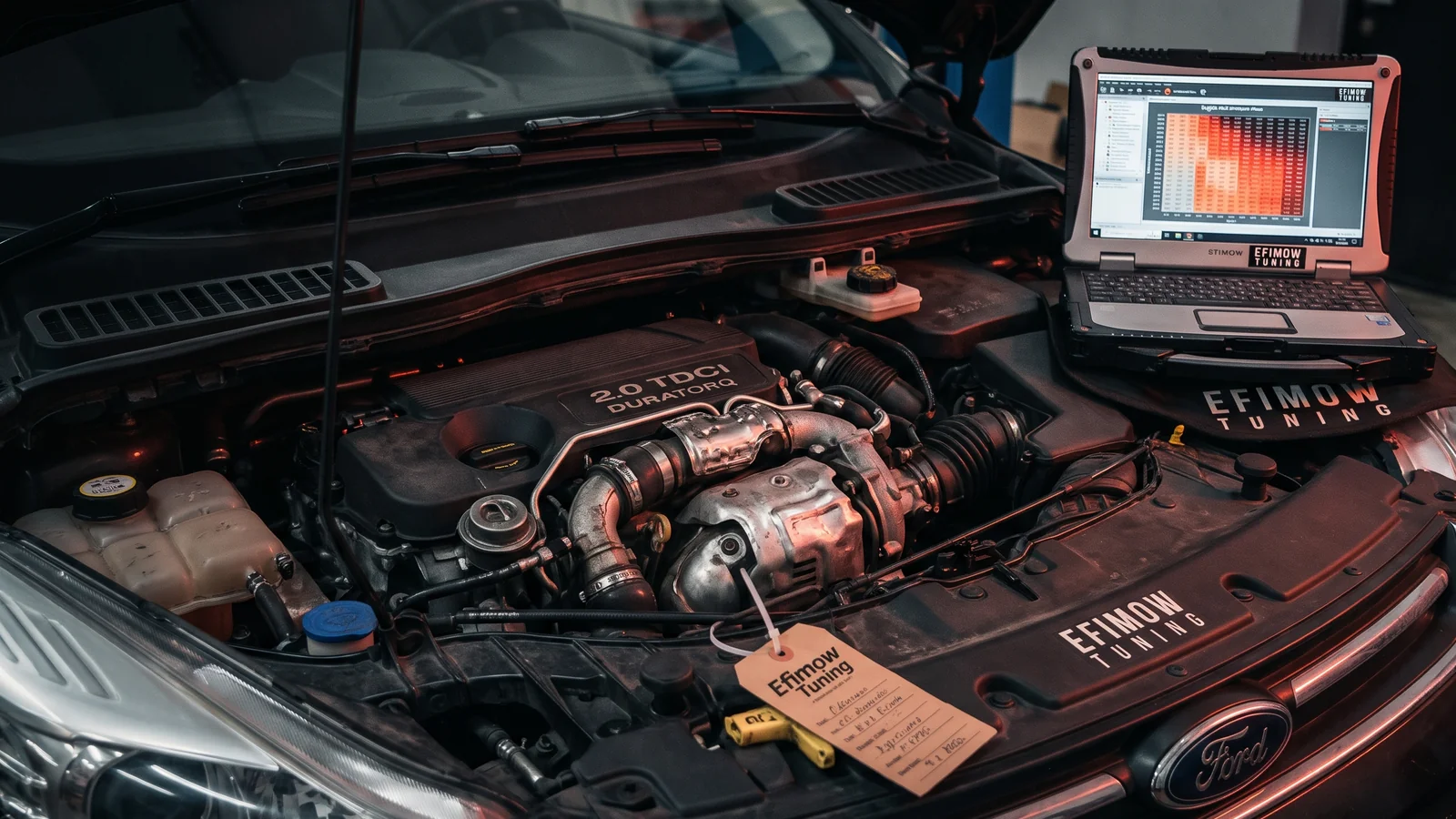
What a Stage 1 calibration changes on a diesel
On a common-rail diesel the calibration works with rail pressure, injection quantity and timing, boost, torque limiters and the smoke limiter. The goal is more torque in the mid-range, where an SUV diesel is actually driven every day. Peak power rises too, but on a diesel it is secondary.
Our data lists these typical Stage 1 guide values:
- Siemens SID803A (SID80x) and Delphi DCM3.5: 20 to 30 percent more power and torque
- Siemens SID202 (SID20x): 15 to 25 percent more power, 20 to 30 percent more torque
- Delphi DCM6.x: 15 to 25 percent more power and torque
These are guide values, not a promise for your car. Mileage, the condition of injectors and turbocharger and the stock power level all play a part. The lower power levels of the same engine family often have more headroom than the strongest version.
ECO tuning: interesting for high-mileage drivers
For all the ECUs mentioned, our data lists ECO tuning as a bookable option. It raises torque in the low and mid rev range while peak power stays unchanged. The idea: if the engine has more pull at low revs, you drive more relaxed in higher gears. How much this affects fuel consumption depends mainly on your driving style. If you use the extra pull to accelerate, you save nothing.
Further options bookable for the Kuga ECUs: a sharper throttle map (Sharp Throttle), Vmax removal and suppressing individual non-emissions-related fault codes. A rev-limiter increase is only possible on request and rarely makes sense on a diesel, because it delivers little power at the top anyway.
Stage 1 or ECO: which calibration suits you?
The choice depends less on the car than on your daily use. A few pointers from workshop practice:
| Use | Sensible choice |
|---|---|
| Lots of motorway, little load | Stage 1: more reserve for overtaking |
| Commuting with an even driving style | ECO tuning: more low-down torque, peak power as stock |
| Regular trailer or caravan | moderate Stage 1, focus on mid-range torque |
| Very high mileage, unknown history | check condition first, then decide |
Stage 2 is possible on the Kuga depending on the ECU, but requires hardware: a larger intercooler, for example, or an exhaust from the turbo back, which then has to include catalytic converter and particulate filter and come with an ABE or parts certificate. For a family SUV that is rarely the sensible route. Most Kuga drivers are better served by a clean Stage 1 or an ECO calibration.
Why the DPF and EGR must stay active
The Kuga with the 2.0 TDCi has a diesel particulate filter and exhaust gas recirculation; depending on the emissions standard, newer versions have further systems for reducing nitrogen oxides. These systems cause trouble on diesels time and again: blocked filters, coked EGR valves. Even so: removing or disabling the DPF, EGR or SCR is emissions tampering and prohibited on public roads. That includes suppressing the related fault codes.
In daily terms: a healthy particulate filter and a working EGR system are a prerequisite for tuning, not an obstacle. A Kuga that regenerates constantly or ends up in limp mode with EGR faults has a technical problem that should be fixed before any power increase. A clean calibration also makes sure soot production does not rise. That is what the smoke limiter is for.
Legally, too: the software change voids your vehicle's type approval; the software is intended for motorsport use only.
AWD, automatic, towing: what to keep in mind
- Towing: more torque is pleasant when pulling, but puts extra load on clutch, gearbox and cooling. If you tow regularly, a moderate calibration is the better choice.
- Clutch and dual-mass flywheel: on manual cars with high mileage, check clutch and dual-mass flywheel. Noises when pulling away or judder are warning signs.
- Automatic gearbox: the gearbox has torque limits too. The calibration has to respect them.
- AWD: the all-wheel-drive control itself is not changed, but it distributes the higher torque.
Access and price
For the Delphi DCM3.5 versions of the Kuga, our catalog lists OBD access. For the newer Delphi DCM6.x, our data notes that write protection is common and that bench or boot access, sometimes with an unlock, is needed. Whether your ECU works via OBD or has to be opened is something we clarify before the appointment.
Two worked examples: for the Kuga I 2.0 TDCi with 163 PS (Delphi DCM3.5), Stage 1 starts at €200; for the Kuga II 2.0 with 150 PS (Delphi DCM6.x) at €300. The difference comes from the ECU generation. You come to us in Stödtlen on a date of your choice or send in the ECU. Same price, bookable online.
Checklist before the appointment
- Read the fault memory, especially DPF, EGR and boost entries
- Check the particulate filter's regeneration behaviour
- Have injectors and turbocharger checked for irregularities
- Check clutch or gearbox
- Maintenance up to date: oil, air filter, fuel filter
Conclusion
The Kuga with the 2.0 TDCi is a rewarding candidate for a software adjustment: more torque for daily driving, holidays and towing, with typical guide values between 15 and 30 percent depending on the ECU. What matters is which ECU is fitted, and that the particulate filter, EGR and the rest of the drivetrain are in good order. Then the solid SUV diesel becomes a noticeably more effortless car.
The configurator shows you which version you drive and what it costs.