
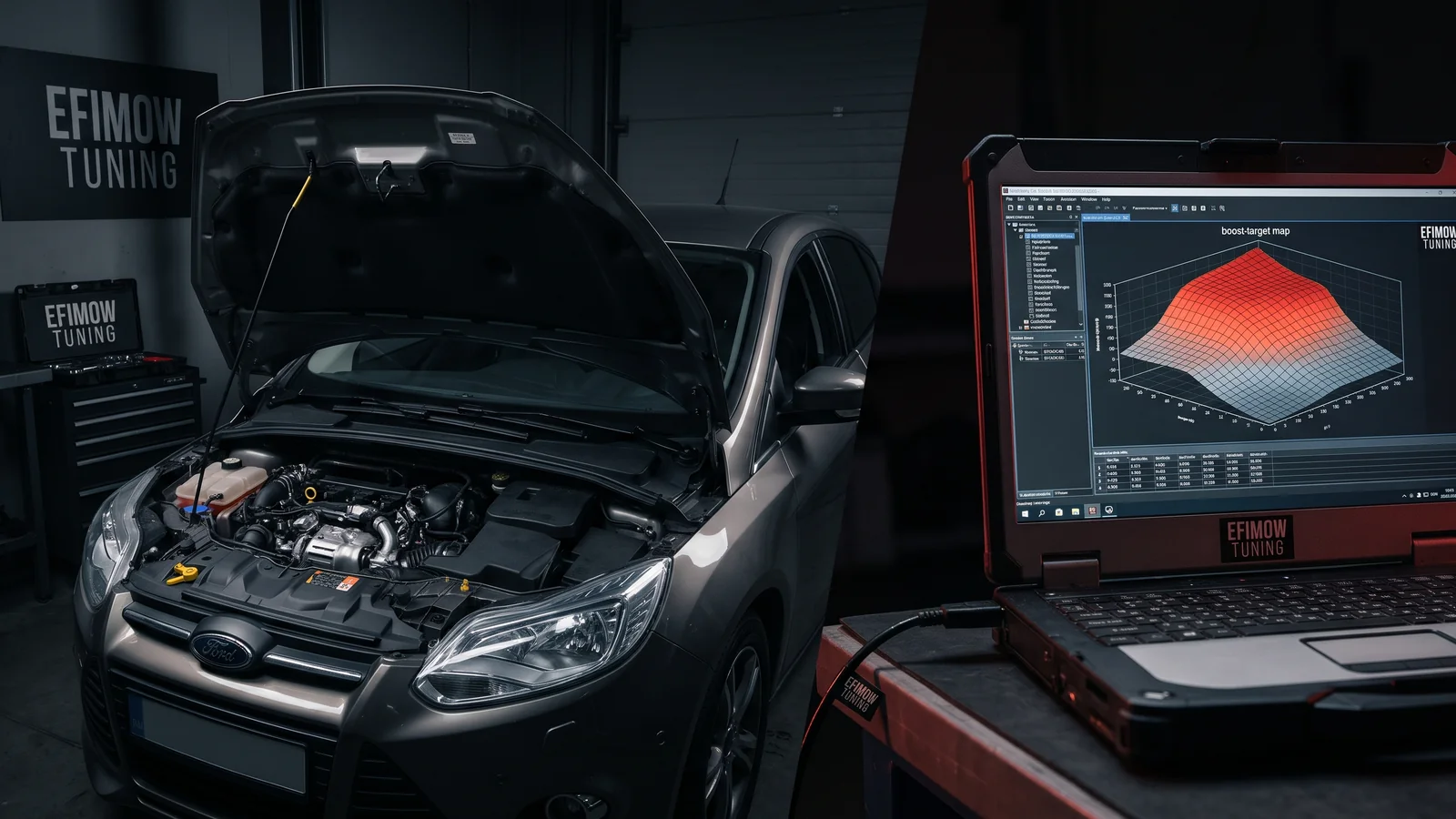
Ford 1.0 EcoBoost: A Three-Cylinder Turbo with Potential?
The 1.0 EcoBoost powers Fiesta, Focus, B-Max and C-Max. What software can do for the small three-cylinder, where the limits are and what to check first.
October 25, 2026 by Leo Efimow
The 1.0 EcoBoost is one of the best engines to explain the downsizing era: just under one litre of displacement, three cylinders, a small turbocharger, gasoline direct injection and, depending on the model, 100 or 125 hp. Ford fitted it for years to the Fiesta, Focus, B-Max and C-Max. For software tuning it is interesting because a large part of its output is defined not by the mechanics but by the calibration in the ECU. That is exactly why an honest look at what a three-cylinder of this size can and cannot do is worthwhile.
One engine, several power levels
The key point first: the 100 hp and 125 hp versions of the 1.0 EcoBoost share essentially the same hardware. The difference lies in the calibration: boost targets, torque limiters and ignition maps. That is not unusual; manufacturers like to separate power levels in software because it is cheaper in production than using different parts.
For you this means: on the weaker version the relative headroom is particularly large, because the factory calibration is deliberately conservative. On the stronger version part of the reserve is already used from the factory. Typical guide values for a Stage 1 calibration on EcoBoost engines are roughly 20 to 35 percent more power and torque. These are ranges for the engine family, not measurements for your car. How much makes sense in an individual case depends on the engine's condition, the gearbox and the fuel you use.
Three ECU generations
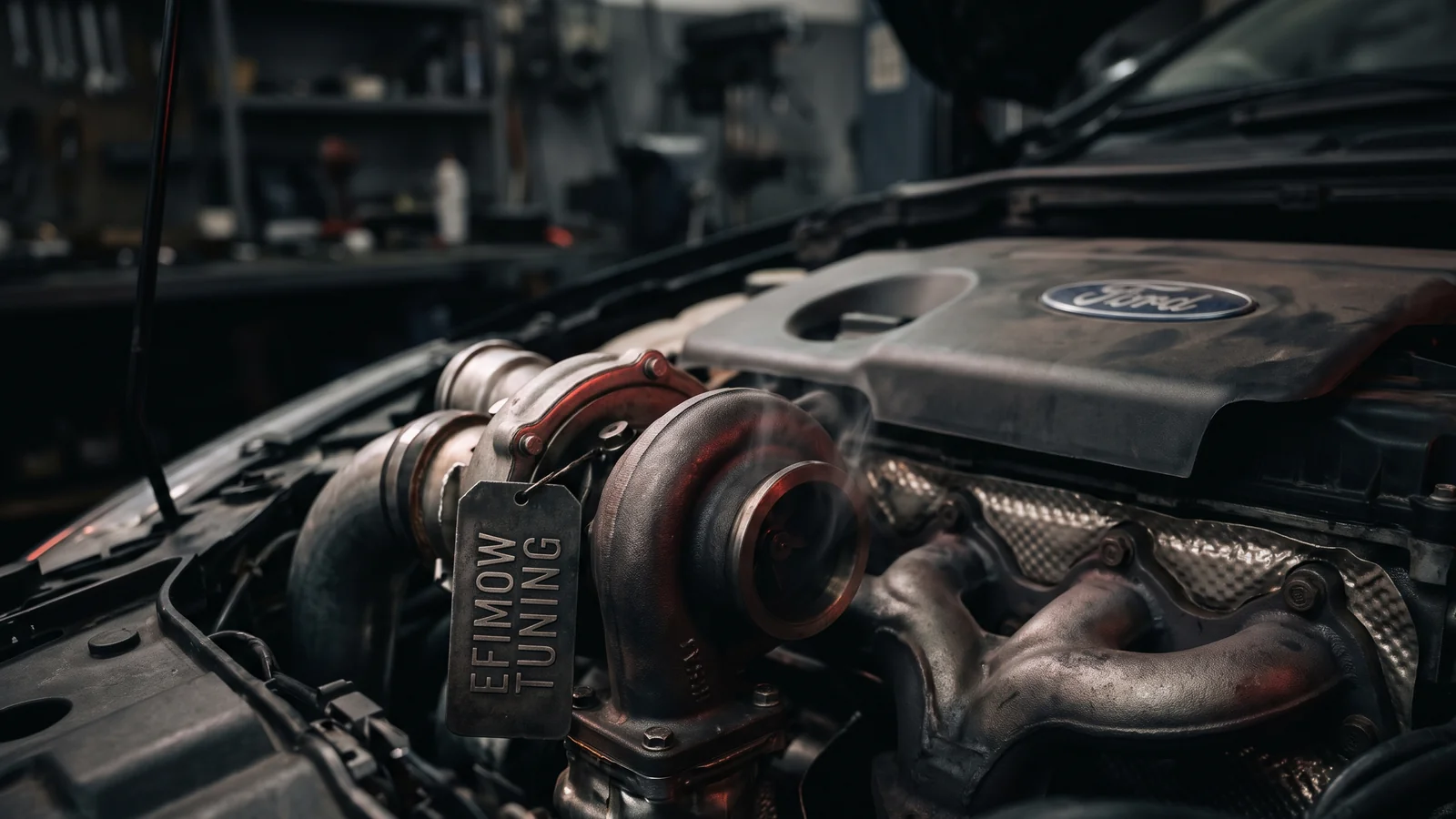
There is no single ECU for the 1.0 EcoBoost. Depending on model year and model you will meet three generations:
| Generation | ECU | Examples in our catalog | Access |
|---|---|---|---|
| until approx. 2015 | Bosch MED17.2 | Focus III, Fiesta VI, B-Max, C-Max II | OBD |
| facelift from 2015 | Bosch MEDG17 | Focus III 1.0 EcoBoost (2015+) | OBD |
| from 2018 | Bosch MG1CS016 | Focus Mk4 1.0/1.5 EcoBoost | OBD (per catalog) |
The MED17 family has been well documented in tuning for many years. The MG1 generation, on the other hand, belongs to the modern, more strongly protected ECUs with secure boot. Access and available options depend more on the tool used and the unlock. So before any calibration is written, the ECU is identified and the original file is backed up completely.
What the software changes on the three-cylinder
A serious Stage 1 on the 1.0 EcoBoost works on the usual parameters of a turbocharged direct-injection engine:
- Boost targets across rpm and load, including wastegate control,
- Air charge and torque structure, so the torque limiters match the new output,
- Ignition timing, matched to knock tendency and fuel quality,
- Injection quantity and lambda targets at full load.
What stays is just as important: knock control keeps working, and component protection for exhaust gas temperature and the turbocharger stays active. On a small, highly boosted engine this is decisive. A one-litre three-cylinder has to build more boost for every additional newton-metre than a large-displacement engine. The thermal load on pistons, turbocharger and manifold rises accordingly. A calibration that ignores this may look good on paper but will not last long in daily use.
You feel the tune mainly in the mid-range: the engine pulls more decisively when overtaking on country roads, needs fewer downshifts and feels less strained in a fully loaded car. If you expect a compact car with a three-cylinder to turn into a sports car, you will be disappointed.
Where the limits are
The 1.0 EcoBoost is not an engine you should push to the edge. Three points deserve attention:
- Maintenance: The engine uses a timing belt that runs in oil. Oil quality, change intervals and the correct oil approval therefore matter more than on many other engines. An engine with an unclear service history should be inspected before tuning.
- Cooling and charge air: Small turbo engines react sensitively to high intake air temperatures. In midsummer and under repeated full load the ECU pulls power. That is intended and stays that way after the tune.
- Fuel: A calibration is designed for a specific octane rating. Running permanently on lower-grade fuel not only costs power but also moves the engine closer to the knock limit.
The gearbox matters too. Manual gearbox and clutch are designed for stock torque; a moderate increase is usually uncritical with a healthy clutch, but a clutch that already slips will not get better with more torque.
Options and Stage 2
For the EcoBoost ECUs of the MED17 family, several extra options are technically feasible besides the power increase: Stage 1+, Sharp Throttle (a more direct pedal map), Vmax removal, a higher rev limit and suppressing individual, non-emissions-related fault codes. Launch Control and ECO tuning depend on the software version and are therefore on request. With Vmax removal, the tyres' speed rating must match and the change must be registered.
Functions such as pops & bangs, hardcut limiter or popcorn limiter are partly possible on the turbo versions, but intended exclusively for motorsport. They have no place on public roads: noise, emissions and the load on catalytic converter and turbocharger all speak against it.
A Stage 2 on the 1.0 EcoBoost only makes sense with hardware: better charge-air cooling, intake and possibly an exhaust from the turbo back, but only with a catalytic converter and certification. On an engine this size, however, the effort is rarely attractive compared with the benefit. For most drivers a clean Stage 1 is the sensible end point.
Legal aspects and emissions control
The software change voids your vehicle's type approval; the software is intended for motorsport use only. If you want to drive a car on public roads, a power increase requires an inspection and registration. Removing or disabling emissions-related systems such as the catalytic converter, lambda control or (on more recent models) a gasoline particulate filter is emissions tampering and prohibited on public roads. A serious calibration leaves these systems fully functional.
Process and price
We do not tune Ford vehicles by remote flashing but directly on the ECU: either on site in Stödtlen at a date of your choice, or you send us the ECU. The price is the same in both cases, and you can book the appointment or the shipment online. For a Ford Focus III 1.0 EcoBoost with 125 hp with Bosch MED17.2, Stage 1 starts at €250 according to our pricing rules. For the Focus Mk4 with an MG1 ECU, the newer ECU generation and the later model year result in a price from €450. For other variants, such as the Fiesta VI 1.0 EcoBoost, the configurator shows you the exact price.
Conclusion
The 1.0 EcoBoost has real potential, especially in the 100 hp version, because Ford separates the power levels largely in software. A well-made Stage 1 makes the three-cylinder more confident in everyday driving without changing its character. At the same time it is a small, highly loaded engine: maintenance, fuel quality and a calibration with active protection functions decide whether the extra power stays enjoyable for long. Background on the engine family is in the glossary under EcoBoost.
If you want to know which options are available for your car, select model and engine in the configurator. You will see price and options there and can book your on-site appointment or the ECU shipment directly.