
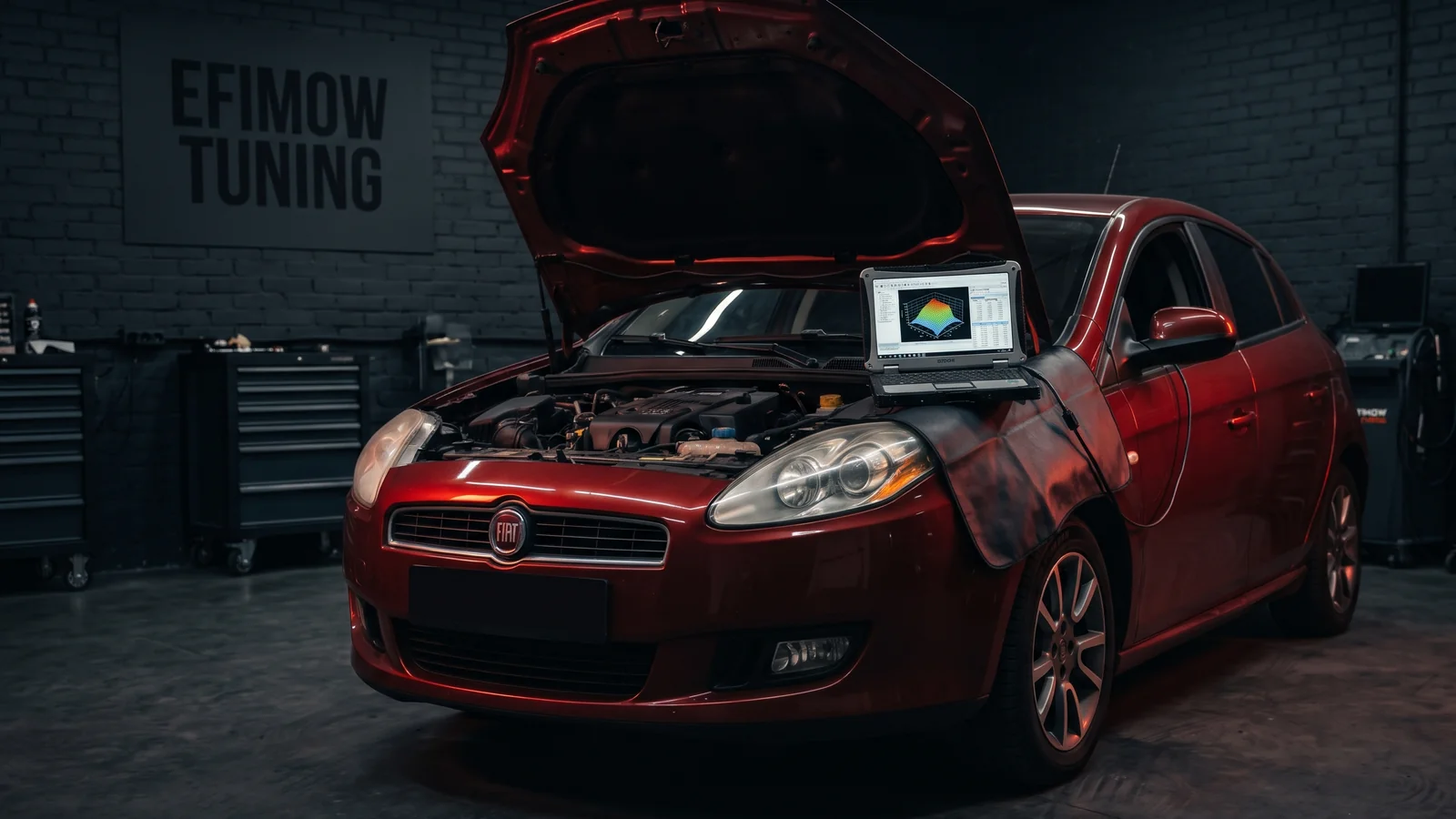
Fiat 1.6/2.0 MultiJet: Optimising Italian Diesels
Bravo, Doblò, 500L, Freemont: what software does for the 1.6 and 2.0 MultiJet, which ECUs are fitted and why MultiJet II is different.
October 25, 2026 by Leo Efimow
Fiat made history with the common-rail diesel: the principle used in practically every passenger-car diesel today was developed in Italy and first put into series production in the late nineties. The MultiJet engines are the evolution of that heritage, with several injections per combustion cycle for quieter running and better emissions. In Fiat's range they power the Bravo, Grande Punto, Doblò, Linea, Sedici, 500L and Freemont, plus Alfa Romeo and Lancia models and, as licensed or cooperation engines, cars from other manufacturers. This article is about the 1.6 and 2.0 MultiJet, the two engines most interesting for tuning.
The versions at a glance
Our catalog lists these 1.6 and 2.0 diesels for Fiat, among others:
| Engine | Output (catalog) | Typical models | ECU |
|---|---|---|---|
| 1.6 16V MultiJet | 90–120 hp | Bravo II, Grande Punto, Punto Evo, Idea, Linea, Doblò II | Bosch EDC16C39 |
| 2.0 16V MultiJet / JTD | 136–165 hp | Bravo II, Sedici | Bosch EDC16C39 |
| 1.6 / 2.0 MultiJet II | depends on version | 500L, Doblò II, Freemont | Bosch EDC17C49 / C69 |
The first 1.6 and 2.0 MultiJet engines use the Bosch EDC16C39, one of the best-documented diesel ECUs of all. MultiJet II brought the Bosch EDC17 in the C49 and C69 versions.
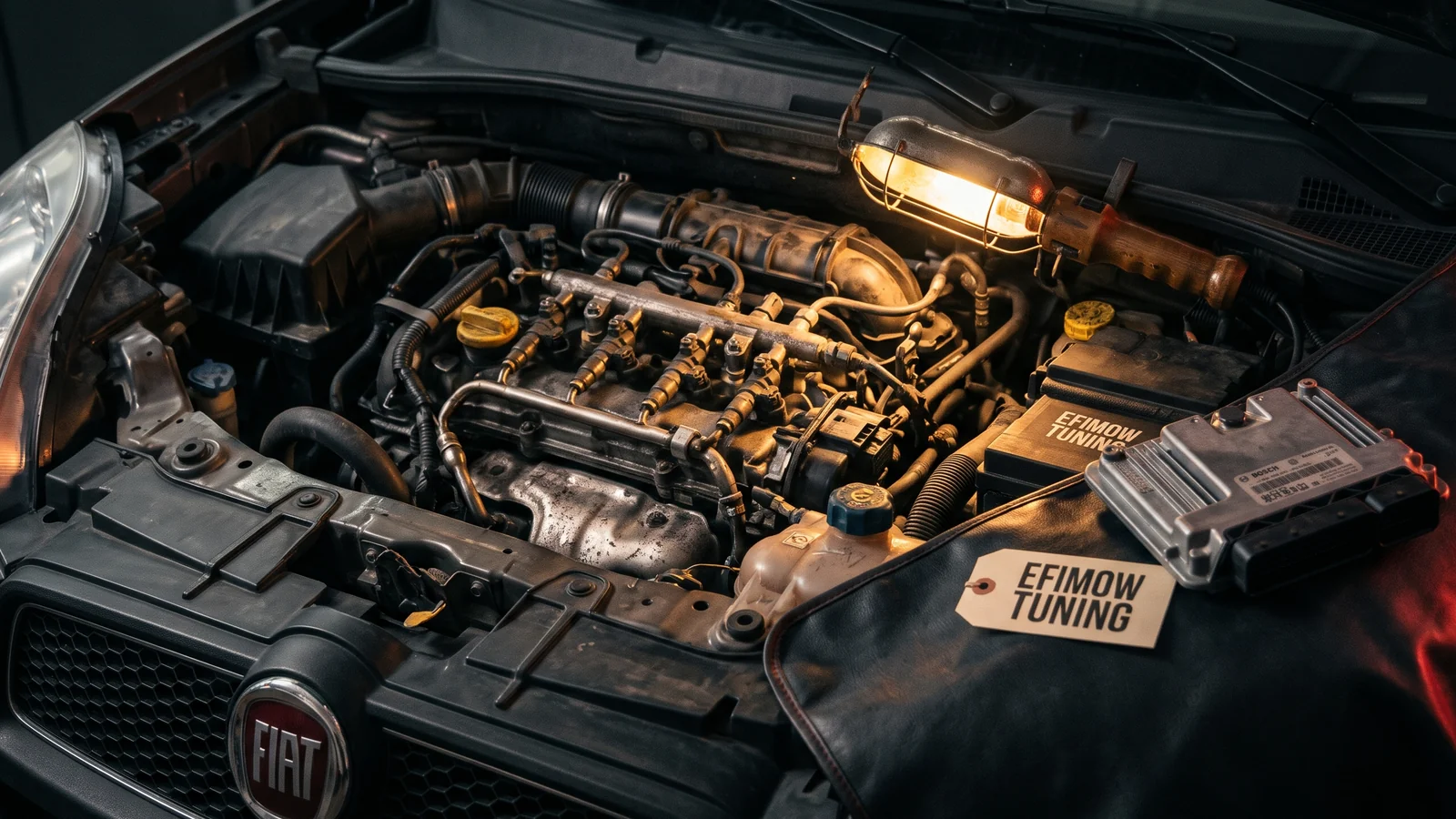
What is different about MultiJet II?
MultiJet II is the second generation with faster injection technology and even more finely divided injections per combustion cycle. More important for tuning is the ECU: the EDC17C49/C69 is a newer Bosch generation with stronger protection. Depending on the software version, it cannot be written via OBD but has to be opened and worked on in boot mode. That is more work, but routine with the right tools. Our pricing rules include a surcharge for it.
What software delivers on the MultiJet
For both ECU families (Bosch EDC16 common rail and Bosch EDC17 outside the VW Group), our data gives a typical 20–30% more power and torque as a Stage 1 guide value for four-cylinder engines. The software adjusts the torque limiter, injection quantity, rail pressure, boost and smoke limiter.
On the 1.6 MultiJet with 90 or 105 hp, the effect in daily driving is particularly clear, because these versions often use the same basic hardware as the 120 hp version. On the 2.0 with 165 hp, the percentage headroom is similar, but more attention needs to be paid to the clutch and dual-mass flywheel.
Stage 2 with hardware (intercooler, exhaust from the turbo with catalyst/DPF and certification) is possible in principle on both families. On everyday vehicles such as the Doblò or 500L, though, we rarely see the point.
Vans: the 2.3 MultiJet in the Ducato
A quick look beyond the passenger cars: the Fiat Ducato uses the 2.3 MultiJet, depending on the version with a Bosch EDC16C39 or a Magneti Marelli MJ8F3. For the Marelli MultiJet family our data also gives a typical 20–30% as a guide value. On motorhomes and vans, ECO tuning is often the better choice: more torque in the low and mid range, unchanged peak power, exactly where a loaded Ducato works on a hill.
Options
For the MultiJet ECUs, the following are documented alongside Stage 1:
- Stage 1+ as a finer calibration step
- ECO tuning for more torque with the same peak power
- Sharp Throttle for a more direct throttle pedal
- Vmax removal (mind the tyre speed rating and registration, especially important on motorhomes)
- DTC Off only for non-emissions-related fault codes
Before you tune
The MultiJet diesels are robust engines, but they too have their maintenance points:
Particulate filter and EGR: many MultiJets from Euro 4/5 onwards have a DPF. A Fiat used mainly for short trips should be checked for DPF load and EGR condition before tuning. Disabling them is emissions tampering and illegal on public roads.
Oil dilution: with frequent DPF regenerations, fuel gets into the engine oil. A rising oil level on a diesel with a particulate filter is a warning sign to take seriously.
Clutch and DMF: at high mileage and when towing, the component that feels extra torque first.
Injectors: a rough idle or smoke under acceleration points to injector problems. These should be fixed before any power increase.
Process and prices
We work on Fiat directly at the ECU, on site in Stödtlen at an appointment of your choice or by sending in the removed ECU. The price is the same in both cases, and booking is online.
Under our pricing rules, the Bravo II 1.6 MultiJet with 120 hp and the Bravo II 2.0 JTD with 165 hp with EDC16C39 start from €200 for Stage 1. The 500L 1.6/2.0 MultiJet II with EDC17C49/C69 comes to €350 including opening the ECU. The Ducato 2.3 MultiJet with 150 hp with a Marelli ECU starts at €200. You will find all other versions in the configurator.
On the legal side: the software change voids the type approval. The software is intended for motorsport use only; see the motorsport notice.
Common questions from the workshop
My Doblò is a commercial vehicle. Does tuning make sense? On loaded commercial vehicles in particular, more mid-range torque helps a lot: fewer gear changes, more reserve on hills. For such vehicles we usually recommend ECO tuning or a restrained Stage 1 that raises peak power only moderately and keeps exhaust temperature in check under sustained load.
How can I tell whether I have a MultiJet II? The model year is a clue: most 1.6 and 2.0 diesels from around 2010 are MultiJet II. Only the ECU gives certainty: a Bosch EDC17C49 or C69 clearly points to the second generation, an EDC16C39 to the first. A photo of the ECU label helps us classify it.
Do injectors wear out faster with tuning? A serious Stage 1 keeps rail pressure and injection quantity within what the system tolerates from the factory. Injectors age mainly through fuel quality, mileage and deposits. If you already have symptoms such as a rough idle or smoke, have them fixed before tuning. The original state of the ECU is backed up before writing.
Conclusion
The 1.6 and 2.0 MultiJet are rewarding diesels for a moderate Stage 1: a typical 20–30% more power and torque as a guide value, with easy access on the EDC16C39 and an opened ECU on MultiJet II. What matters is a healthy particulate filter, intact injectors and a drivetrain that can handle the extra torque. More on the technology behind the name in the glossary under MultiJet.