
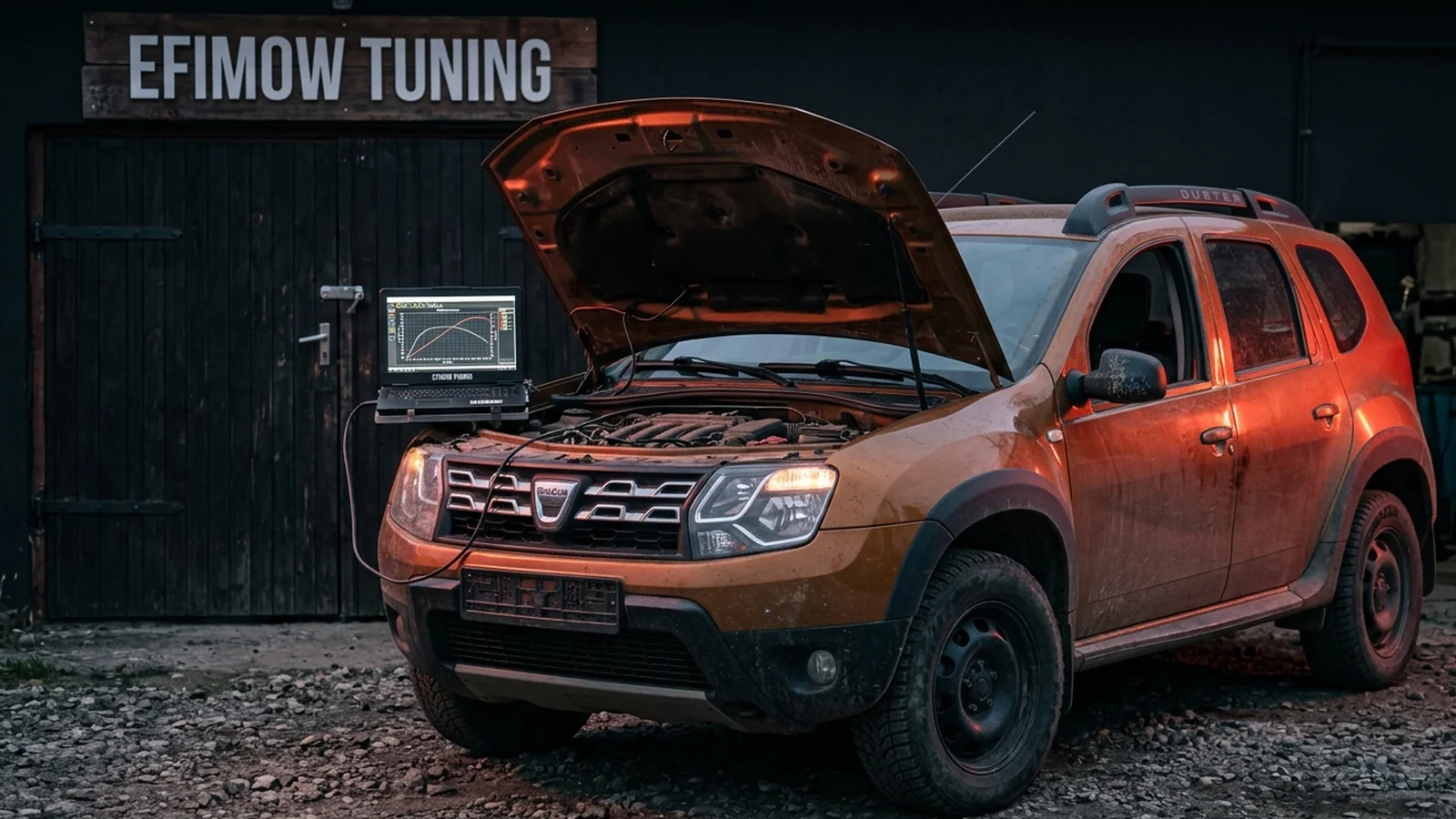
Dacia Duster Chip Tuning: Drive Cheap, Drive Better
1.5 dCi, 1.2 TCe or naturally aspirated: what software really does for the Dacia Duster, which ECUs are fitted and when tuning is not worth it.
October 25, 2026 by Leo Efimow
The Dacia Duster is the opposite of a sports car, and that is exactly why many owners ask about software. Anyone who tows with a Duster, drives it fully loaded or takes it off-road soon notices where the small engines reach their limits. The question is not whether a Duster can be turned into a race car, but whether daily driving becomes more relaxed with a bit more torque. The answer depends heavily on the engine.
The Duster's engines
Our catalog lists these versions for the first-generation Duster (2010–2017) and the second generation (from 2018):
| Engine | Output (catalog) | ECU | Type |
|---|---|---|---|
| 1.5 dCi | 86 hp | Delphi DCM1.2 | Diesel |
| 1.5 dCi | 90 hp | Delphi DCM3.4 | Diesel |
| 1.5 dCi | 105 hp | Siemens SID | Diesel |
| 1.2 16V (TCe) | 125 hp | Siemens EMS | Turbo petrol |
| 1.6 16V | 105–112 hp | Siemens EMS / Valeo V40 | Naturally aspirated |
| 2.0 MPI | 135–141 hp | Valeo V40 | Naturally aspirated |
| 1.5 dCi / Blue dCi (Duster II) | depends on version | Continental SID310 | Diesel |
The diesel: 1.5 dCi
By far the most common Duster engine is the 1.5 dCi from Renault's K9K family. For all three ECU families (Delphi DCM, Siemens SID and Continental SID310), our data gives a typical 20–30% more power and torque as a Stage 1 guide value. On the Duster, torque is what counts: with adapted software, the diesel pulls much more strongly in the mid-range, which you notice when pulling away with a trailer and on gradients.
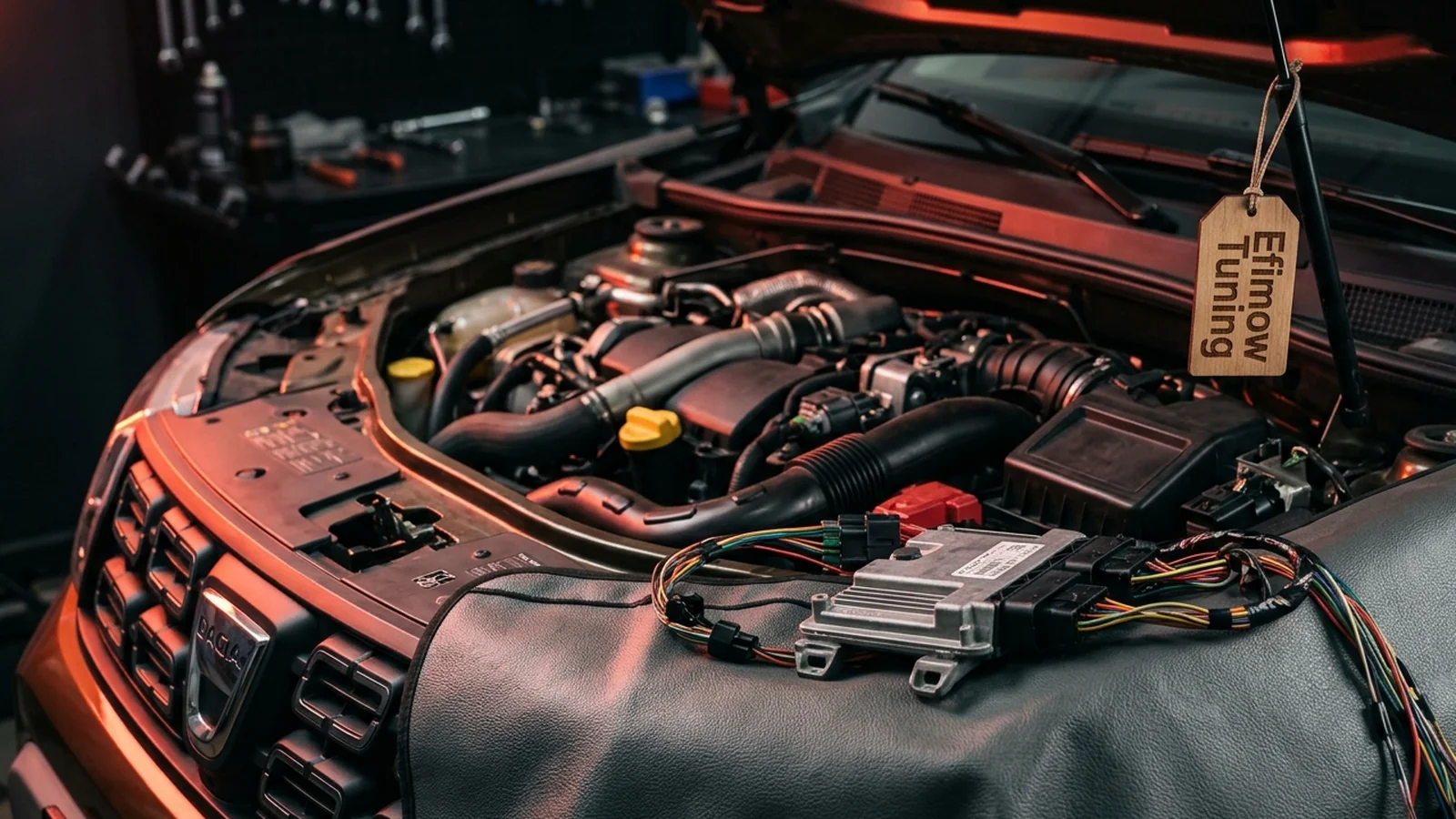
ECO tuning is interesting on the Duster: it raises torque in the low and mid range and leaves peak power unchanged. If you mainly use your Duster as a tow car or for long distances, you are often better off with this than with maximum power. Whether fuel consumption changes ultimately depends on your driving style: fewer gear changes and lower revs help, a heavy right foot does not.
The turbo petrol: 1.2 TCe
The 1.2 TCe with 125 hp is the Duster petrol engine where software pays off. As a turbo engine, it responds clearly to adapted boost and ignition timing. For forced-induction engines in this Siemens/Continental family, our data gives a typical 15–30% more power and 20–30% more torque as a guide value. The prerequisite is a healthy engine with a working ignition system. On a small turbo petrol, spark plugs and oil level are not a side issue.
The naturally aspirated engines: honestly, hardly worth it
It is a different story with the naturally aspirated 1.6 16V and 2.0 MPI. Without a turbocharger, the most important lever software can use is missing: boost pressure. For naturally aspirated engines in these ECU families, our data gives only around 3–8%. You will barely feel that in daily driving. On these engines, options such as a more direct throttle pedal (Sharp Throttle) are the more interesting part. If you want real extra power from a naturally aspirated engine, you have to change the mechanics, and that rarely makes sense on a Duster.
Options for the Duster
For the Duster's diesel ECUs, the following are documented alongside Stage 1:
- ECO tuning (see above)
- Sharp Throttle for a more direct response
- Vmax removal: make absolutely sure the tyre speed rating and registration match, especially with all-season or off-road tyres
- DTC Off strictly for non-emissions-related fault codes
Stage 2 makes only limited sense on the 1.5 dCi; turbo and injectors are designed for the small power class.
Before tuning: particulate filter, EGR, clutch
Many Dusters are used as inexpensive daily cars and driven accordingly: short trips, little care. Before the software is adapted, these points should be in order:
Particulate filter and EGR: a clogged DPF or a coked EGR valve should be repaired. Disabling or gutting them is emissions tampering and illegal on public roads, on a Duster just as on any other vehicle.
Clutch: on manual cars, especially when towing, the clutch is the first component to feel the extra torque.
Servicing: the K9K diesel is considered sensitive to overly long oil-change intervals. A well-maintained engine is the basis for any power increase.
Process and prices
We work on the Duster directly at the ECU: either on site in Stödtlen at an appointment of your choice, or you send us the removed ECU. The price is the same in both cases, and booking is online.
Under our pricing rules, the Duster 1.5 dCi with 90 hp (Delphi DCM3.4) starts from €200 for Stage 1, the 86 hp version with DCM1.2 from €175. The Duster 1.2 TCe with 125 hp starts at €150. The Duster II with 1.5 Blue dCi comes to €350 because of the newer ECU generation and model year. The configurator shows the price for your version.
On the legal side: the software change voids the type approval. The software is intended for motorsport use only; more in the motorsport notice.
Common questions from the workshop
Does tuning help a Duster 4x4 off-road? Off-road, torque at low revs is what counts. On the 1.5 dCi, a good calibration raises exactly this range, so the engine is less likely to stall at low speed and pulls better on slopes. Do not expect miracles, though: off-road ability depends just as much on tyres, ground clearance and driving technique.
My Duster tows a caravan: Stage 1 or ECO? For towing, ECO tuning is often the better fit. It raises torque where you drive when towing and leaves peak power unchanged. That also keeps thermal load in check on long climbs. If you would rather have a little more reserve for overtaking, choose Stage 1.
What does removing the ECU cost me if I send it in? You or your workshop handle the removal; the price for the software work is the same whether you send it in or come on site. Important: disconnect the battery, release the connectors carefully, pack the ECU antistatically and send it well padded. We back up the original state of the ECU before writing.
Conclusion
On the Duster, the engine decides whether tuning makes sense. The 1.5 dCi and the 1.2 TCe gain noticeably, with typical guide values of 20–30% and 15–30% respectively, exactly where the Duster needs strength in daily use. On the naturally aspirated engines the gains are so small that we honestly advise against it. If you mainly use a diesel Duster for towing, take a closer look at ECO tuning. More on the diesel in our article on the Renault 1.5 dCi and in the glossary under dCi.