
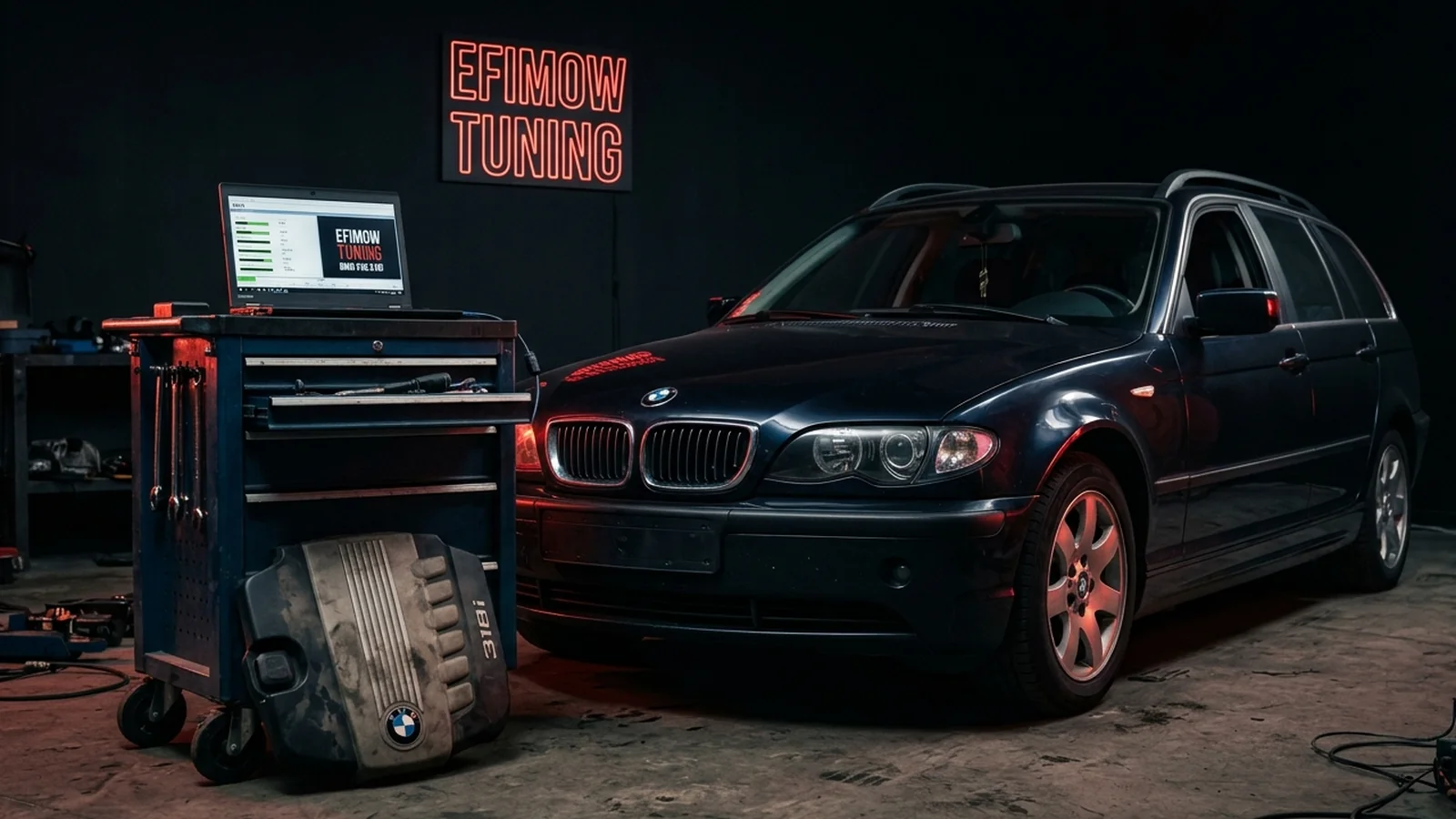
Bosch ME9: The N42/N46 Four-Cylinders with Valvetronic
The Bosch ME9.2 controls the Valvetronic four-cylinders N42 and N46 in the E46, E87 and E90. What software brings and what to check before tuning.
October 26, 2026 by Leo Efimow
In 2001, BMW put a technology into series production in the 316ti Compact that still defines the company today: Valvetronic. The engine was the four-cylinder N42, controlled by a Bosch ME9.2. A little later came the further developed N46, which for years was the standard four-cylinder in the E46, the 1 Series E87, the 3 Series E90 and other series. Today these cars are often second cars or entry-level cars with high mileage. Whether software is worthwhile here is a fair question, and the answer is different from a turbo engine.
Which cars are affected
The N42, with 1.8 and 2.0 litres, is found mainly in the E46: in the 316i and 318i saloon and touring and the 316ti and 318ti Compact. The N46 replaced it from around 2004 and was used much more widely: in the late E46, the 118i and 120i (E87), the 318i and 320i (E90), the X3 E83 2.0i and the Z4 2.0i, to name a few. Later N46 versions partly already have a control unit of the successor generation; which unit is fitted is shown by the diagnosis.
| Car | Engine | Stock | Stage 1 (reference) |
|---|---|---|---|
| 316i (E46) | N42B18A / N46B18A | 115 hp / 175 Nm | approx. 123 hp / 193 Nm |
| 318i (E46), 118i (E87) | N42B20 / N46B20B | 143 hp / 200 Nm | approx. 153 hp / 220 Nm |
| 320i (E90), 120i (E87) | N46B20B | 170 hp / 210 Nm | approx. 182 hp / 231 Nm |
The values come from the product pages and are calculated reference values, not dyno measurements.
How Valvetronic works and what the ME9.2 does
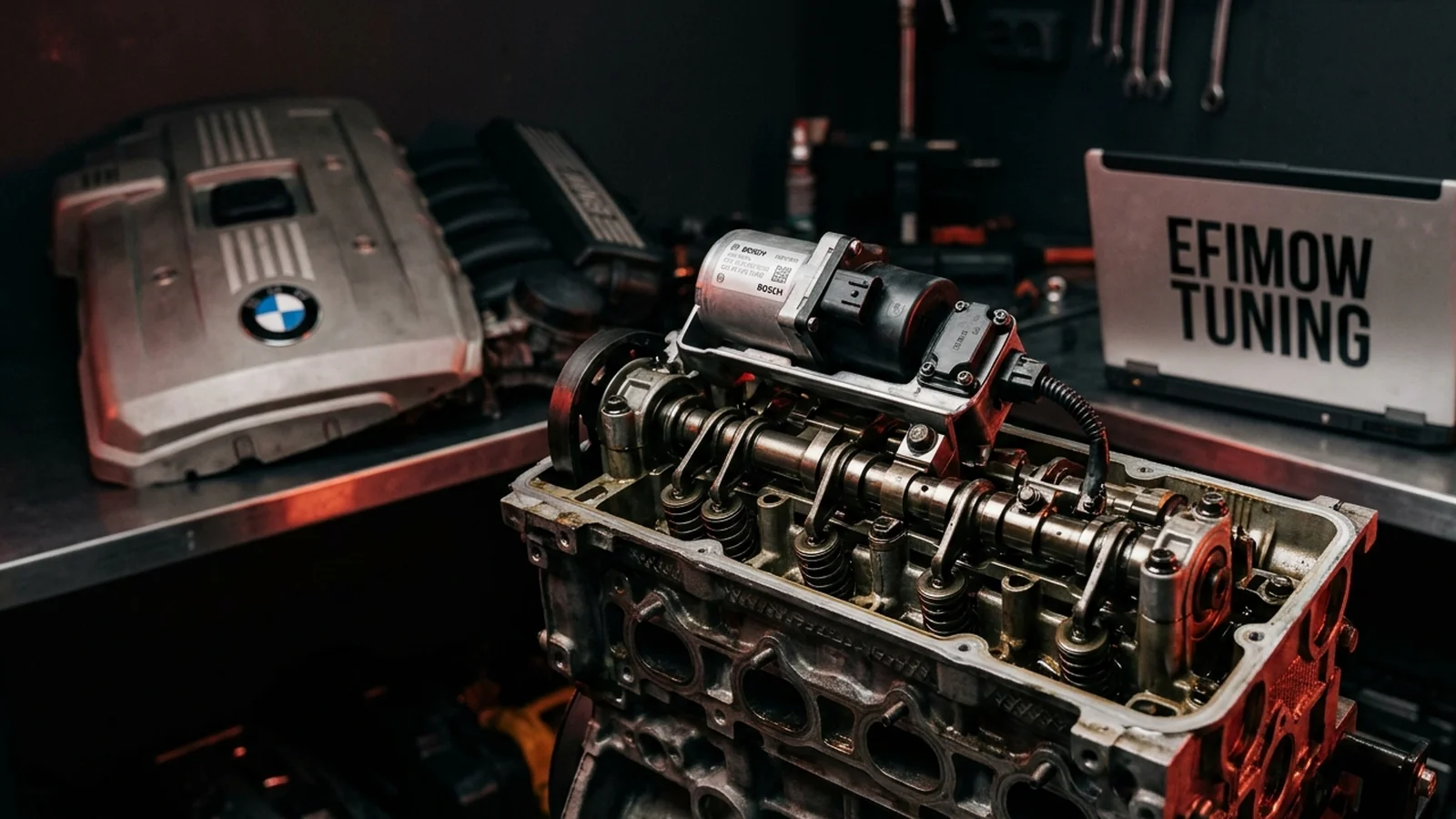
On a classic petrol engine, the throttle valve controls how much air the engine draws in. That costs energy at part load, because the engine has to work against the vacuum behind the flap. Valvetronic avoids this: an electric motor rotates an eccentric shaft that continuously varies the lift of the intake valves via intermediate levers. Little lift means little air, lots of lift means lots of air. In normal operation the throttle stays almost open and only maintains a slight vacuum, for example for crankcase ventilation.
The ME9.2 coordinates:
- valve lift via the actuator motor and eccentric shaft sensor,
- double VANOS for the timing of the intake and exhaust camshafts,
- port injection with lambda control,
- ignition angle with knock control,
- the torque structure with electronic throttle.
Because charge comes from three control variables (lift, intake timing and exhaust timing), calibrating a Valvetronic engine is more involved than a throttle engine. But the basic principle remains: without forced induction, intake, combustion chamber and exhaust determine the maximum amount of air that gets into the cylinder.
What software brings on the N42 and N46
In practice, the power gain is around 7 percent and torque rises by about 10 percent: on the 320i E90, from 170 to approx. 182 hp. Honestly, that is not the main reason to calibrate an N46. Other points are more noticeable:
- Throttle response: The pedal map is designed for economy and comfort from the factory. A more direct curve makes the engine feel more awake in everyday driving.
- Mid-range: Timing and ignition can be tuned so that the engine pulls more evenly, which is noticeable when overtaking on country roads.
- Limiters: Rev and speed limiters are parameters; when changing them, observe the tyre speed rating and registration requirements.
On these engines, Stage 2 means hardware: headers and/or a 200-cell sports catalytic converter. According to the product page, the reference value for the 320i E90 is then approx. 190 hp. Exhaust parts need approval or an expert report.
Before tuning: typical N42/N46 points
Many of these engines have high mileage behind them. Software does not replace a repair, and calibrating an engine with faults achieves nothing. We frequently see these points in practice:
- Oil consumption: The N42 and N46 are known for increased oil consumption, often caused by aged valve stem seals. An engine that burns a lot of oil cokes up valves and plugs.
- Valvetronic actuator motor and eccentric shaft sensor: Faults in the Valvetronic system cause rough running or limp mode. Related fault entries should be fixed.
- Crankcase ventilation: A faulty ventilation valve causes unmetered air and idle problems, particularly noticeable on a Valvetronic engine with its low intake vacuum.
- Timing chain and tensioner: Rattling on a cold start points to wear.
- Ignition coils and plugs: Fix misfires beforehand.
Typical questions from the workshop
Does the engine save fuel after tuning? With the same driving style, consumption hardly changes. Part-load operation, where Valvetronic plays to its strengths, remains the goal of the calibration.
Do I need premium fuel? The calibration is designed for high-octane fuel. With a lower octane rating, knock control intervenes earlier, and part of the gain is lost.
Is it worth it at 300,000 kilometres? If the engine is healthy, yes, as fine-tuning. If it burns oil or has faults in the Valvetronic system, repair it first. Software cannot compensate for a mechanical defect.
Is the Valvetronic switched off? No. It stays in operation; what is adjusted are the targets with which the DME combines valve lift, timing and ignition.
Can I go back to stock? Yes, at any time, with the backed-up original file.
Process and price
For the E-series, you read out the original file with a K-DCAN cable and upload it in the customer portal. Today you pay only for hardware and a €5 deposit; we do the calibration by hand, usually within 48 hours. You pay for the software only once it is finished and then flash it yourself via OBD.
According to the product pages, software for the ME9.2 costs from €170 for Stage 1 and €220 for Stage 2, for example on the BMW 318i (E46) or the BMW 320i (E9x). The price for your configuration is shown in the configurator.
Legally: the software change voids your vehicle's type approval; the software is intended exclusively for motorsport (motorsport notice).
Conclusion
The ME9.2 was the control unit with which BMW brought Valvetronic into mass production. On the N42 and N46, software is above all fine-tuning: more direct response, more even pull and a few extra horsepower. If you have a healthy engine with well-maintained oil consumption, you get a noticeably livelier car. If you expect big jumps, you need a turbo engine. How the ME9 fits into the line of BMW control units is shown in the overview of DME generations.