
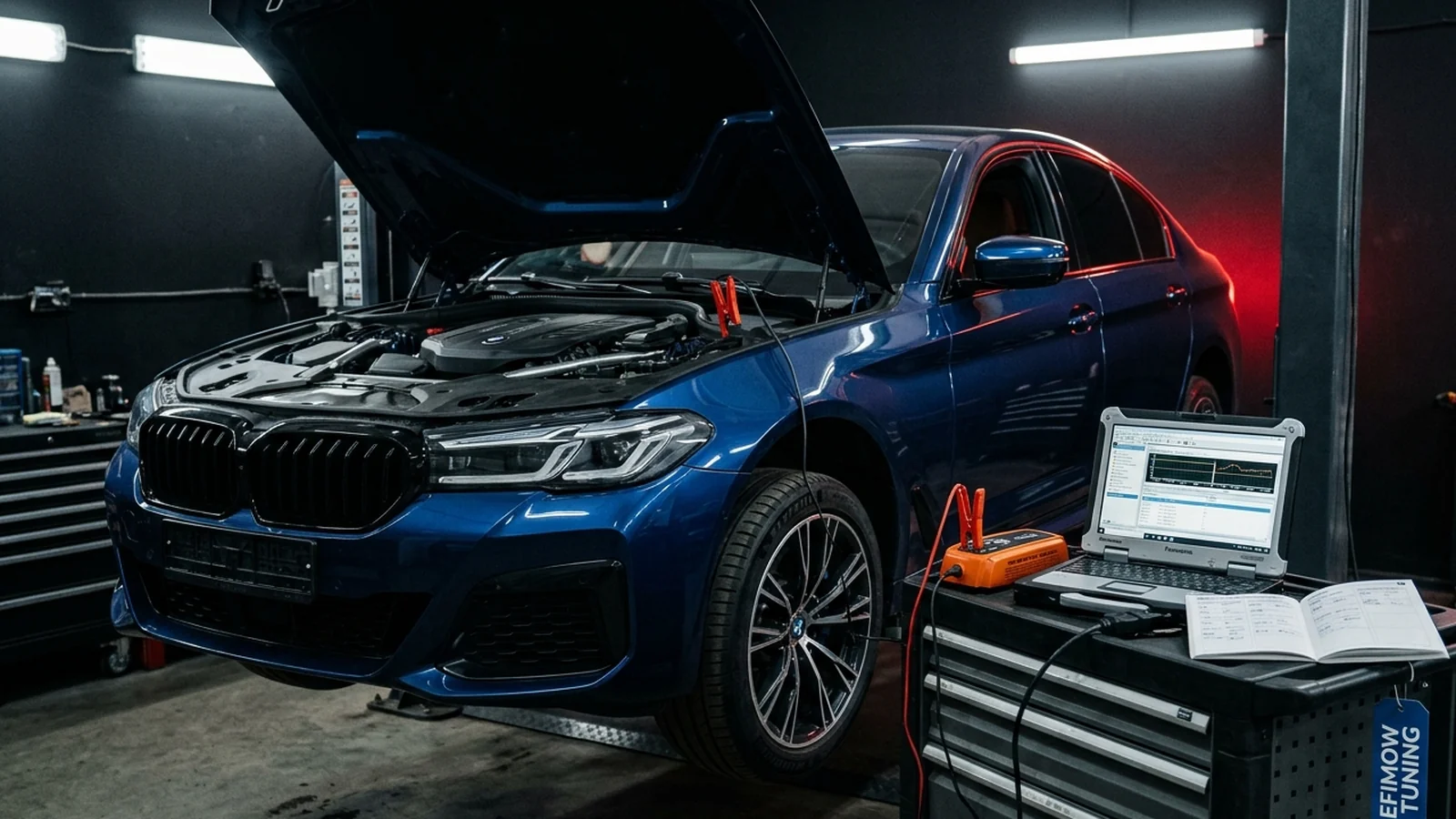
Workshop update after tuning: what happens to the software?
Service, recall, software update: what happens to your modified software when the workshop programs control units, and how to prepare.
October 26, 2026 by Leo Efimow
You've had your BMW tuned, everything runs cleanly, and then the service is due. At the workshop the car is hooked up to the diagnostic system, and afterwards the invoice says "vehicle programmed" or "software updated". What happened to your modified software? The short answer: in many cases it's gone. This article explains factually when workshops install software, what happens to the tune and how best to prepare.
When workshops install software
Software updates are part of everyday workshop life today. Typical occasions are:
- Inspection and service: With many brands, the workshop checks whether newer software is available for the vehicle and installs it.
- Recalls: When a manufacturer fixes a fault via software, the control unit is reprogrammed as part of the recall campaign.
- Technical campaigns: Smaller improvements, for example for cold start, smoothness or fault memory entries, are often done during a visit that's planned anyway.
- Repairs: After replacing a control unit or certain components, software is installed or adapted.
- Over-the-air updates: Some newer vehicles receive updates via an online connection. Which control units are affected depends on manufacturer, model and scope of the update.
At BMW this is done with the ISTA workshop system. The car is often brought to a new integration level, a matched software state for all control units. That can include the engine and transmission control units.
What happens to the modified software
If the engine control unit is reprogrammed, the workshop writes a stock software version from the manufacturer. Your modified software is overwritten. Afterwards the car runs at stock power on the new software version.
Several situations are possible:
| Situation | What happens | What you should do |
|---|---|---|
| Engine ECU is updated | Tune overwritten, stock power | Let us know, have the modification carried over to the new version |
| Only the transmission ECU is updated | Gearbox calibration overwritten, engine stays modified | Report promptly: the gearbox no longer knows about the higher torque |
| No update to engine or gearbox | Tune stays in place | Nothing, but check the invoice |
| Workshop detects modified software | Depending on manufacturer and diagnostic system, a note or a query | Talk openly with the workshop |
The second case is often underestimated. Engine and gearbox communicate via torque. If the engine runs modified software but the gearbox is back on stock, the original limits apply there. That can show up as throttled power, harsher shifts or, in the worst case, clutch slip. Why that is so is covered in DSG/Steptronic TCU on BMW.
Why the old file doesn't simply fit again
The obvious idea is to simply reinstall the old tuning file after the update. That's not a good idea. The modification was created for the old software version. The new version may be structured differently, contain new functions or changed protection mechanisms. That's exactly why the manufacturer released it. Writing the old file back would also remove the improvements of the update.
The clean route is therefore: read again and carry the modification over to the new version. More on this principle in Same car, different software.
Before the workshop visit: say so openly
The most important advice is simple: tell the workshop that your ECU has been modified. That has several advantages:
- The workshop can tell you in advance whether a software update for engine or gearbox is planned.
- You can decide whether a non-urgent update should be postponed to a later date.
- For faults and diagnostics, the workshop knows where it stands. That saves time and misunderstandings.
There's one exception for recalls: officially monitored recalls aren't optional. If you don't have them carried out, you risk trouble with the registration authority. Have such campaigns done and get in touch with us afterwards.
Also let us know when a workshop visit is coming up. Then we can assess what the update means for your modification.
After the update: how it continues
If the software was overwritten, it usually goes like this:
- Check what was programmed: The invoice or workshop report usually says which control units were updated.
- Read again: With BMW, you read the ECU via OBD just like the first time. For other brands, this happens at our site in Stödtlen or by mail-in.
- Have the modification carried over: The modification is created from the new software version. The original file from the first read remains important as documentation; the new stock version becomes the new way back.
- Don't forget the gearbox: If the transmission control unit was updated too, it's part of the job as well.
How the process works through your customer account is described in From upload to download: the customer portal explained. What's possible for your car is shown on the respective product page, for example for the BMW 320d (G20/G21).
What you shouldn't do
- Don't install a third-party or old file that doesn't match the current software version.
- Don't interrupt an update. An interrupted programming process can leave the control unit unable to start. That's the responsibility of the workshop performing the update.
- Don't leave the workshop in the dark. Openness is the simplest way to avoid misunderstandings and follow-up faults.
Common questions from the workshop
Can the workshop tell that my ECU has been modified? Depending on manufacturer and diagnostic system, that's possible. That's another reason why informing the workshop openly is the better route anyway.
Do I automatically get a new file after the update? No, for that the ECU has to be read again and the modification carried over to the new version. Get in touch and we'll sort it out for your car.
Is the car back to stock after the update? In terms of software, yes, provided the engine and transmission control units were updated. Hardware changes are of course unaffected.
And the type approval? The software change has voided the type approval; the software is intended for motorsport use only (motorsport notice). The legal background is explained in Germany's § 19 StVZO: when does a tune void your vehicle's road approval?.
Conclusion
A workshop update usually overwrites the modified software. That's not a defect but the normal result of a programming process. What matters is that you say so beforehand (to the workshop and to us), have recalls carried out, and after the update don't install an old file but have the modification carried over to the new software version. More on warranty, leasing and dealer service in Premium cars and tuning.