
Sharp Throttle: A More Direct Throttle Pedal Without a Pedal Box
Why many cars feel sluggish on the throttle, how Sharp Throttle changes the pedal map inside the ECU and why that is cleaner than a pedal box.
October 25, 2026 by Leo Efimow
You press the throttle and at first not much seems to happen. Only when the pedal is a good way down does the engine really get going. Many people take that as a lack of power. In reality it is almost always a question of calibration: between your foot and the throttle there is no cable any more, but a map inside the ECU. And from the factory that map is often deliberately conservative. Sharp Throttle works right there.
Drive-by-wire: the pedal is just a sensor
For many years practically every car engine has used an electronic throttle pedal. The pedal is a position sensor with two redundant tracks. The ECU reads the pedal position, combines it with engine speed and sometimes with gear or drive mode, and calculates a torque request from it. Only that request is turned into a throttle plate position (petrol) or an injection quantity (diesel).
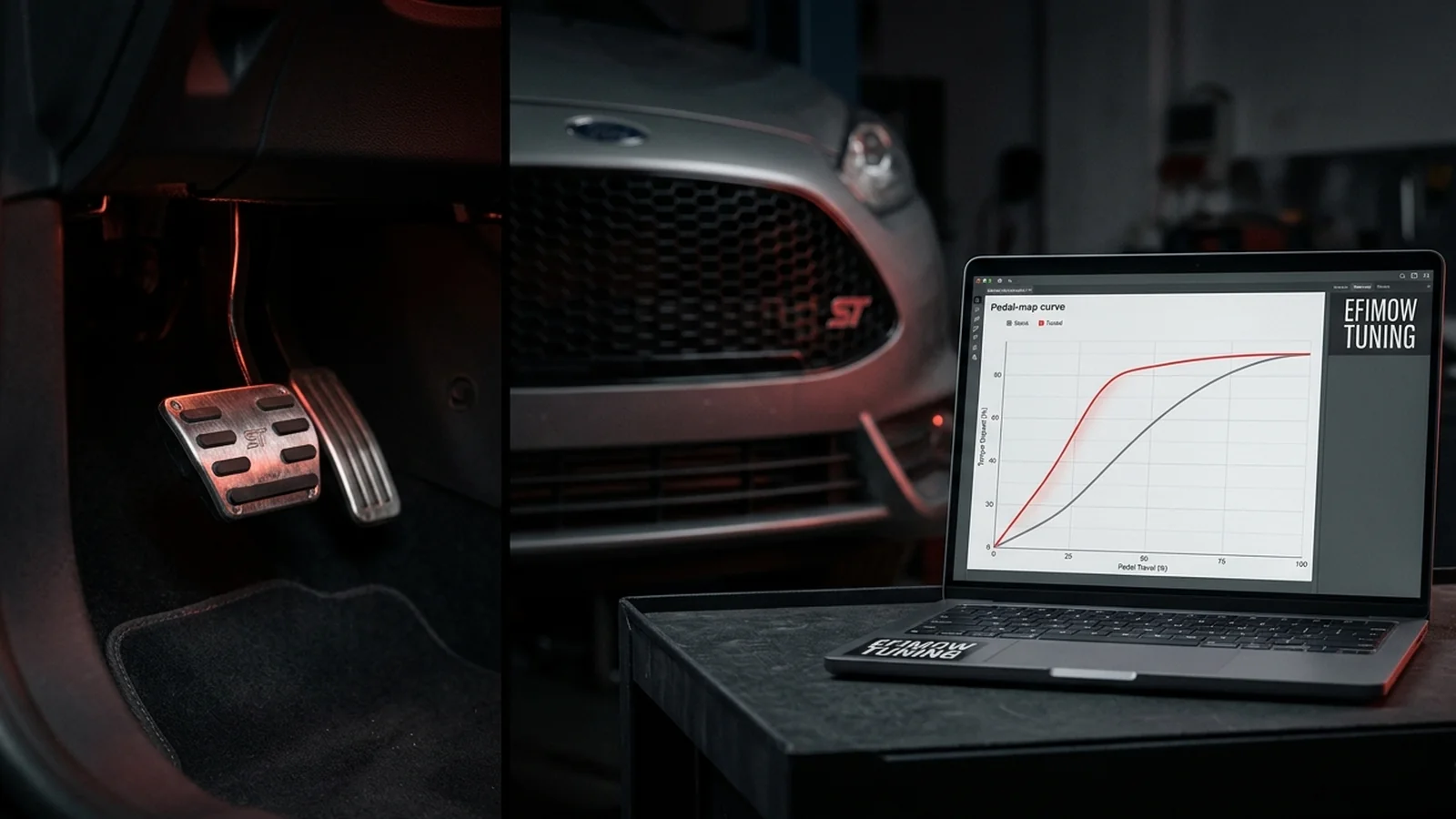
The table that translates pedal position and rpm into a torque request is called the pedal map. It decides how much of the available torque is requested at 10, 20 or 50 percent pedal travel. It has nothing to do with maximum power: at full throttle every pedal map requests full torque.
Why manufacturers make the pedal "soft"
There are understandable reasons why many cars feel sluggish in the first third of pedal travel:
- Comfort: a flat map at the bottom makes pulling away and stop-and-go smooth, even for inexperienced drivers.
- Load changes: gentle torque build-up spares engine mounts, drivetrain and clutch.
- Fuel consumption and emissions: fewer sudden load peaks in part load help in the test cycles.
- Model differentiation: maps often differ per drive mode: Comfort tame, Sport sharper.
The result is a pedal that is good-natured in daily driving but makes the engine feel weaker than it is.
What Sharp Throttle changes
Sharp Throttle is an adjustment of exactly this pedal map. The curve becomes steeper in the lower and middle pedal travel: at the same pedal position the software requests more torque than from the factory. The engine responds earlier and more directly, and the car feels more alert.
What does not change: peak power, maximum torque, protection functions. At full throttle you end up exactly where you would have without Sharp Throttle. It is purely about the distribution across pedal travel. That is why Sharp Throttle can run on its own but is often combined with a Stage 1 calibration, so the extra torque is noticeable at half pedal already.
A good calibration keeps the drive mode logic where the ECU knows it, and does not make the curve so steep that the car jerks when manoeuvring. "More direct" does not mean "on/off": a pedal where the first two centimetres already request half the torque is tiring in everyday driving.
Sharp Throttle or pedal box?
Pedal boxes are sold for the same effect: small modules plugged in between pedal and wiring harness. The difference is fundamental:
| Sharp Throttle (software) | Pedal box | |
|---|---|---|
| Where it acts | pedal map inside the ECU | falsifies the pedal signal before the ECU |
| Calibration | per rpm, sometimes per mode | usually a flat factor |
| Plausibility | ECU knows the real pedal position | ECU receives a manipulated signal |
| Extra hardware | none | module and adapter plugs |
| Extra power | none | none |
A pedal box can only fake "more pedal". It knows nothing about rpm, gear or load and passes on the amplified signal the same everywhere. The ECU in turn works with a pedal position you did not actually press. With Sharp Throttle the sensor signal stays genuine; only its interpretation changes, at the point where the manufacturer defines it too.
How it feels in daily driving
The difference is noticeable mainly in three situations. When pulling away, the car gets moving with less pedal travel. That is pleasant on a hill or with a trailer, but in a traffic jam also something you need to get used to. In a mid-range sprint, for example when merging onto the motorway, the engine responds without the perceived moment of hesitation. And when overtaking on country roads you no longer need to floor it to bring the engine into its strong range.
What you will not feel: a higher top speed or stronger pull at full throttle. If you put the car on a dyno after the change, you see the same curve as before, provided Sharp Throttle was calibrated on its own.
On a diesel the change works similarly, except that injection quantity follows instead of the throttle plate. Especially on diesels with automatic gearboxes that respond very softly from the factory, the effect is often particularly clear. On naturally aspirated petrol engines it is smaller, because there is less low-end torque reserve that could be called up earlier.
One point belongs to honesty: a more direct pedal tempts you to drive more briskly. Constantly requesting more torque also means using more fuel. With the same driving style, however, Sharp Throttle changes little in consumption, because only the mapping of pedal to torque shifts.
Which vehicles it applies to
Because almost every modern engine ECU has a pedal map, Sharp Throttle is feasible in our classification on nearly all ECU families: petrol and diesel, Bosch EDC17 and MED17 as well as MG1, MD1, Simos or Delphi. On some older families it is only partly possible, for example older Delphi diesel pump systems or early Bosch Motronic generations. There we clarify it from the file. One example where the option can be booked directly is the Ford Fiesta ST Mk7 with MED17.2.
What the option costs
For cars of other brands, on site in Stödtlen or via a shipped-in ECU, Sharp Throttle costs €25 as an option added to the calibration, where it is approved for the ECU. With BMW you order online and flash yourself; which extras are available and what they cost is shown in the configurator as you select them.
Legal framework
Even a pure pedal map change is a change to the engine software. The type approval (Betriebserlaubnis) lapses, and our software is intended exclusively for motorsport. What that means in practice is explained in the motorsport notice.
Conclusion
A sluggish throttle pedal is rarely a power problem; it is a curve. Sharp Throttle makes that curve steeper in the lower and middle pedal travel without touching peak power or protection functions. That is cleaner than a pedal box, because the ECU keeps working with real signals. More background is in the glossary under pedal map; whether the option can be booked for your vehicle is shown in the configurator.