

Porsche Cayenne Diesel: Tuning the Sport SUV
Porsche Cayenne Diesel 957 and 958 with 3.0 V6 TDI and 4.2 V8 TDI: Bosch EDC17, typical guide values, Tiptronic, towing, options and process.
October 25, 2026 by Leo Efimow
For a long time, a Porsche with a diesel engine was unthinkable. With the Cayenne Diesel, Porsche changed that and built one of the most sensible sport SUVs available: long-distance range, towing capacity, all-wheel drive and the chassis tuning of a Porsche. Under the bonnet, though, there is no Porsche-developed engine but a V6 or V8 TDI from the Volkswagen Group. For tuning, that is an advantage: the engines and their ECUs are extensively documented. This post shows which variants exist, what is realistic and what to watch for on a heavy SUV with plenty of torque.
The diesel variants at a glance
Our vehicle catalogue lists the Cayenne diesels in three generations:
| Generation | Engine | Power | ECU |
|---|---|---|---|
| Cayenne 957 (2007–2010) | 3.0 V6 TDI | 240 PS | Bosch EDC17CP14 |
| Cayenne 958 (2010–2017) | 3.0 V6 TDI | 211, 239, 240, 245 PS | Bosch EDC17CP44 or CP14 |
| Cayenne 958 (2010–2017) | 4.2 V8 TDI | n/a | Bosch EDC17CP44 |
| Cayenne (2014–2018) | 3.0 V6 TDI | 250, 262 PS | Bosch EDC17CP44 |
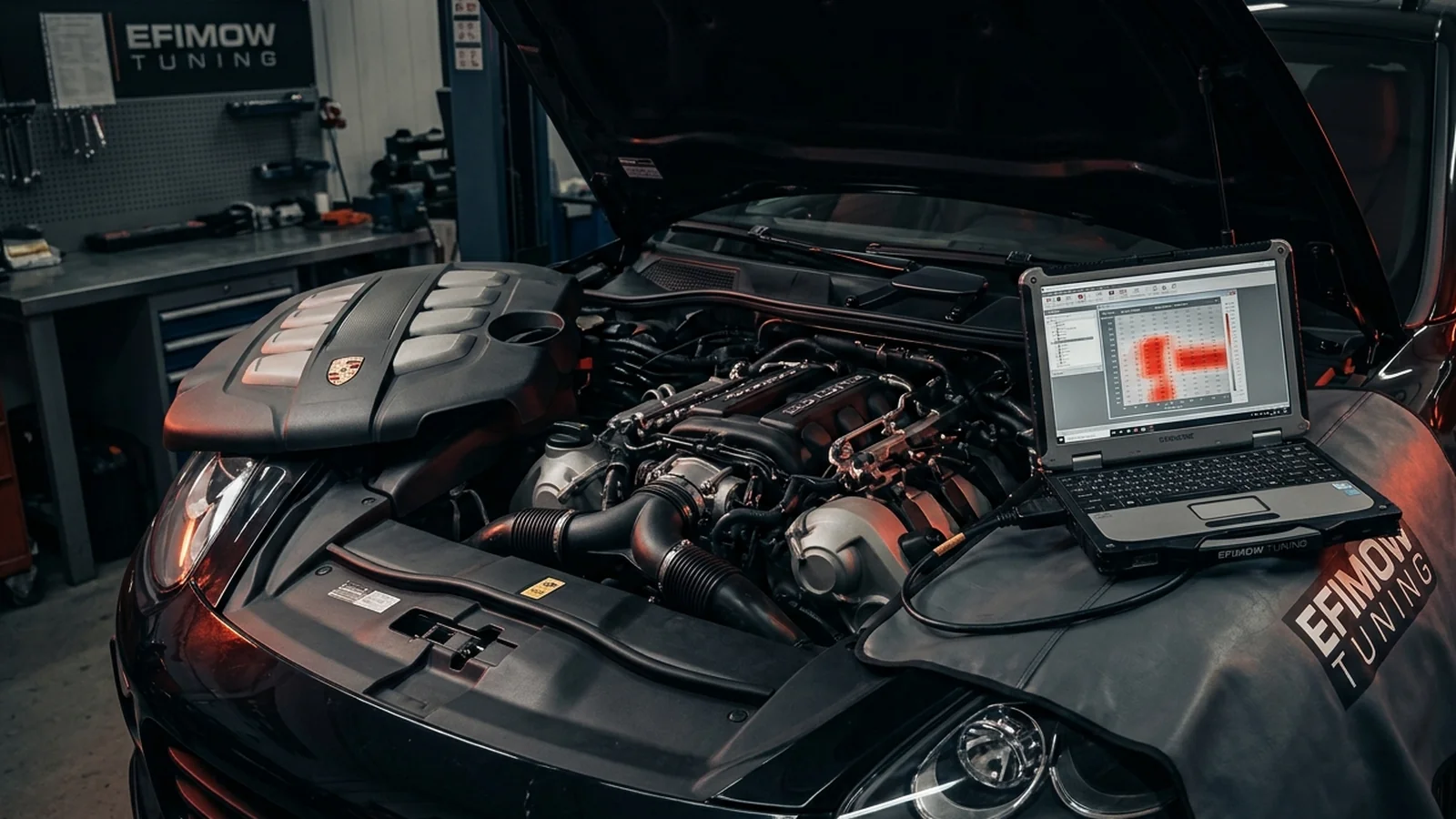
All variants run a Bosch EDC17 from the VW Group family. The V6 uses common-rail injection, one turbocharger and charge-air cooling; the V8 TDI has two turbochargers. Access is usually possible via OBD; for the 958 variants this is explicitly recorded in our data. The current Cayenne generation E3 no longer offers a diesel.
What is realistic
For the EDC17 in the VW Group environment, our data gives typical Stage 1 guide values for V6 and V8 TDI engines of 15 to 25 percent more power and 20 to 30 percent more torque. These are orientation values, not promises; software version, mileage and engine condition all play a part.
The power levels are worth a look: the 3.0 V6 TDI was offered in the Cayenne with 211 to 262 PS. The differences lie mostly in software and peripherals; the base engine is closely related. Variants at the lower end of the range therefore tend to have more headroom than the strongest versions. On the Cayenne, a diesel tune is noticeable above all in the mid-range: when overtaking, accelerating up a motorway slip road and under load on climbs.
What the software changes
The parameters are those of a modern TDI:
- Torque limiters and driver torque request,
- Injection quantity and injection timing,
- Rail-pressure targets,
- Boost targets and turbocharger control,
- Smoke limiter as a function of air mass.
Component protection functions (exhaust temperature, turbo temperature, torque limits) remain active and are matched to the new load points. Particulate filter, exhaust gas recirculation and, on later models, the SCR system with AdBlue keep working unchanged. Disabling these systems is emissions tampering and prohibited on public roads.
A note on the software version: many Cayenne models with the 3.0 V6 diesel received a software update as part of officially ordered recalls. A calibration always builds on the software version actually running in the vehicle. It is read out and backed up before tuning.
Gearbox, all-wheel drive and towing
A Cayenne Diesel is heavy, and it is often used for jobs other SUVs avoid: horse trailers, caravans, boat trailers. That changes how you should look at tuning.
Tiptronic S: The Cayenne diesels use an eight-speed torque-converter automatic. The gearbox knows the engine torque and has its own limits for shift pressure and converter lock-up. A consistent calibration keeps the extra torque within a range the gearbox can handle in the long term. A gearbox oil change is advisable anyway for vehicles that tow, all the more so after tuning.
All-wheel drive: transfer case and axles on the Cayenne are robustly designed, but they are wear parts too. Unusual noises or jerking while manoeuvring should be cleared up before the appointment.
Towing: under sustained load, exhaust and gearbox oil temperatures rise significantly. If you tow heavy loads regularly, you are better served by a calibration that places the torque gain mainly in the low and mid-range and consistently respects the temperature limits. The permissible towing load stated in the vehicle documents does not change with tuning.
Check before the appointment
Many Cayenne Diesels have high mileage by now. Before the software is adapted, a few points are worth checking:
- Fault memory of engine, gearbox and all-wheel drive: existing entries should be explained and fixed.
- Charge-air path: hoses and connections at the intercooler start leaking with age. A leak prevents the target pressure from being reached.
- Particulate filter and differential pressure sensor: frequent regenerations or warning messages point to a problem that must be solved before tuning.
- EGR valve and cooler: carbon build-up costs air mass, exactly the basis a diesel calibration builds on.
- Injectors: check smooth running and return quantities.
This list has nothing to do with the software itself. But it decides whether the engine handles the additional torque well in the long run, and whether the result arrives the way the file intends.
Options
For the EDC17 in the VW Group environment, our data lists the following options:
- Stage 1+ and Stage 2+: Stage 2 only with matching hardware,
- ECO tuning: torque in the low and mid-range, peak power unchanged,
- Sharp Throttle: more direct throttle pedal curve,
- Vmax removal: mind tyre speed rating and registration,
- DTC adjustment: only for non-emissions-related fault codes,
- Rev limiter and Launch Control: on request.
ECO tuning in particular is worth considering on the Cayenne Diesel if the car covers a lot of long distances and tows.
Process and price
We tune Porsche vehicles directly on the ECU: on site with us in Stödtlen at an appointment of your choice, or by sending in the removed ECU. The price is the same in both cases, and you book online.
For the 3.0 V6 TDI, Stage 1 starts from €300 under our pricing scheme, for example for the Cayenne 958 3.0 V6 TDI with 245 PS or the later Cayenne 3.0 V6 TDI with 262 PS. For the V8 TDI, the higher power class feeds into the price; the configurator shows you the exact amount.
Legally: the software change voids your vehicle's type approval; the software is intended for motorsport use only.
Conclusion
The Cayenne Diesel is a rewarding candidate for a measured software optimisation. The EDC17 is easy to handle, the reserves lie mainly in torque, and that is exactly where the gain shows in everyday driving. What matters is looking at the vehicle as a whole: gearbox, all-wheel drive, towing and exhaust aftertreatment determine how far a calibration should sensibly go.
Which variant is in your Cayenne and what it costs, you can see in the configurator.