
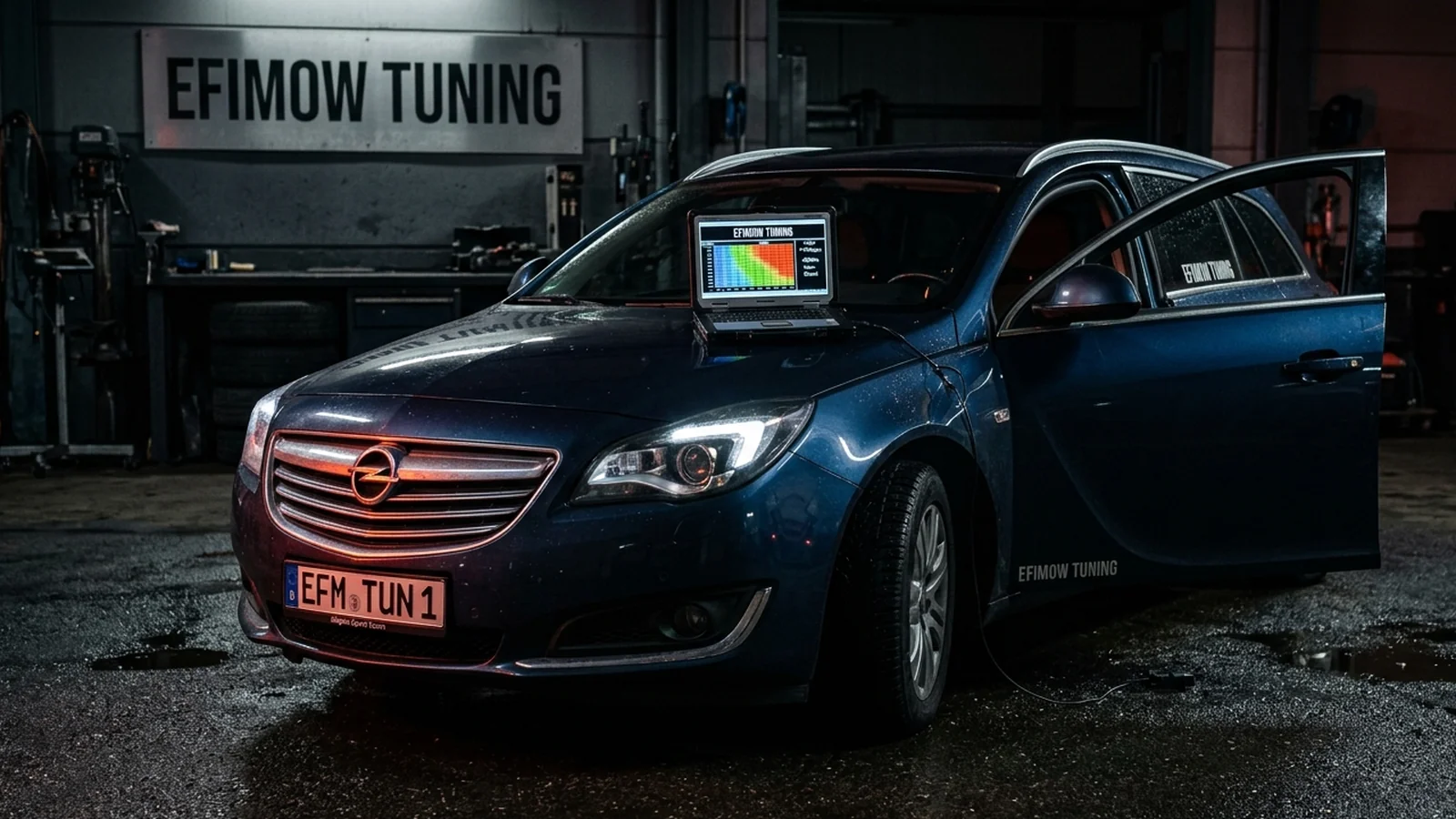
Opel Insignia 2.0 CDTI: More Pull for High-Mileage Drivers
110, 130 or 160 hp: the 2.0 CDTI in the Insignia A has reserves. Which ECU it uses, what software delivers and when the unit has to be opened.
October 25, 2026 by Leo Efimow
The first-generation Opel Insignia is a classic high-mileage car: lots of space, calm straight-line stability and, in most cases, the 2.0 CDTI under the bonnet. On long journeys, towing or fully loaded, though, the 110 or 130 hp version quickly feels strained. Software can compensate for a lot here, provided you know which ECU is fitted and how to access it.
The engine versions
Our catalog lists the 2.0 CDTI in the Insignia A (2008–2017) in three power levels:
| Engine code | Output (catalog) | ECU |
|---|---|---|
| A20DTC | 110 hp | Bosch EDC17C19 |
| A20DTJ | 130 hp | Bosch EDC17C19 |
| A20DTH | 160 hp | Bosch EDC17C19 |
There is also a combined entry for the 2.0 CDTI with Bosch EDC17C18, C19 or C59, where the ECU has to be opened for writing. The three power levels largely share the same hardware; the differences lie mainly in software, turbo specification and injection quantities. That is exactly why the small 110 hp engine is such a rewarding tuning candidate.
We do not list the 2.0 BiTurbo CDTI or the Insignia B from 2017 as separate variants. For these cars, an enquiry through the configurator is worthwhile so that we can check the ECU and access method in advance.
What the Bosch EDC17C19 allows
The EDC17C19 belongs to the large Bosch EDC17 family outside the VW Group. For four-cylinder engines in this family, our data gives a typical 20–30% more power and torque as a Stage 1 guide value. The software works on the familiar diesel maps:
- Torque limiter: it defines how much torque the engine may deliver in which gear and at which rpm
- Injection quantity and rail pressure for the additional fuel
- Boost targets and the control of the variable-geometry turbo
- Smoke limiter, so that combustion stays clean and the particulate filter is not loaded with extra soot
The smoke limiter matters especially on a high-mileage diesel. A calibration that only adds fuel produces more soot, more frequent DPF regenerations and, over time, problems. A clean software raises boost and fuel quantity so that the air-fuel ratio stays right.
OBD or open the ECU?
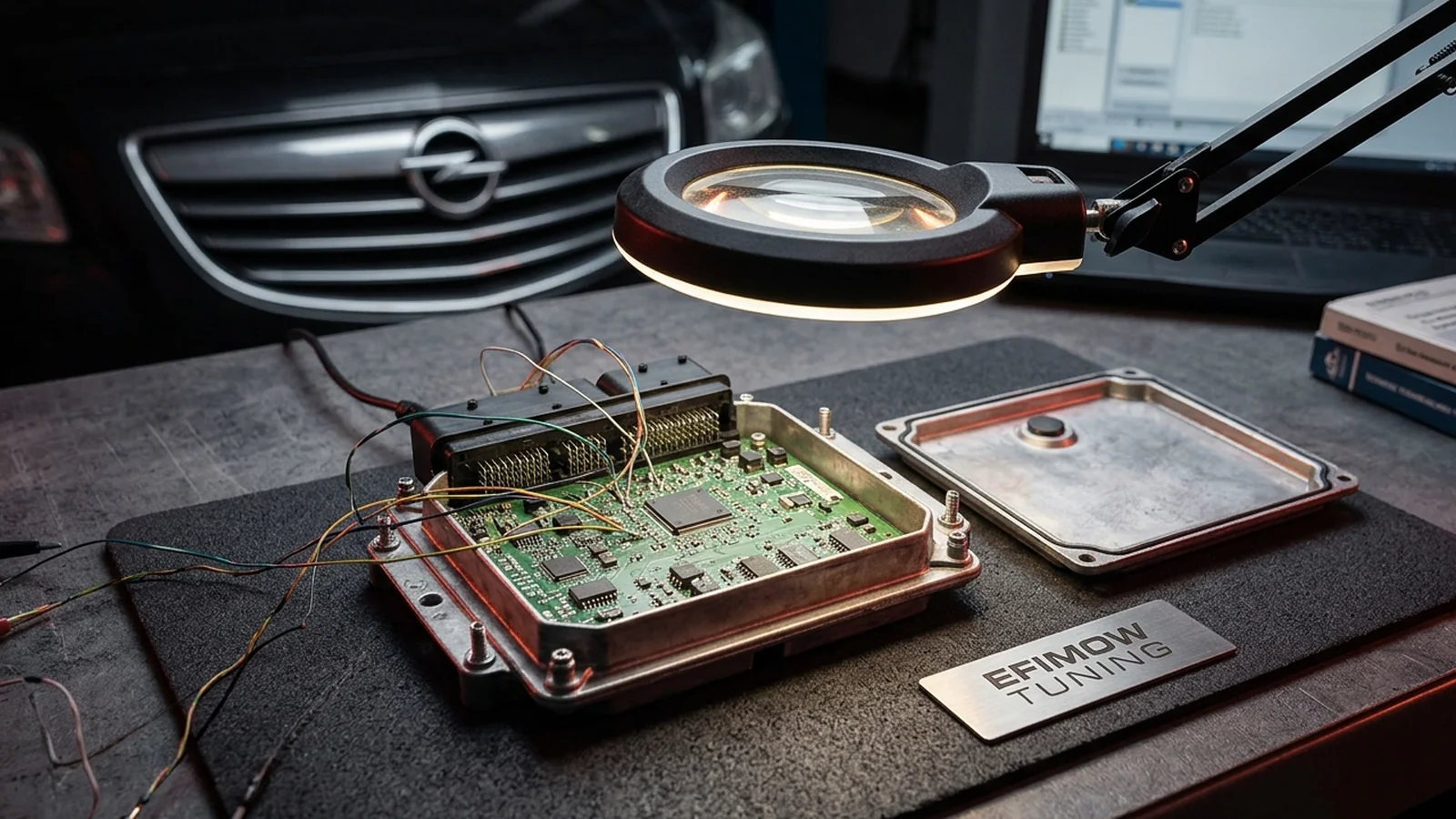
On the EDC17C19, access depends on the software version. Many units can be read and written on the bench; on others, the housing has to be opened and the board accessed directly in boot mode. That is not a problem when done properly, but it adds work, which is why our pricing rules include a surcharge for opening the ECU. We can see which route your Insignia needs from the ECU identification.
Options
For the EDC17 family, the following are documented alongside Stage 1:
- ECO tuning: more torque in the low and mid range, unchanged peak power; often the better choice for high-mileage drivers with a steady motorway profile
- Sharp Throttle for a more direct throttle pedal
- Vmax removal (mind the tyre speed rating and registration)
- DTC Off only for non-emissions-related fault codes
- Stage 2 with hardware such as an intercooler and an exhaust from the turbo with catalyst/DPF and certification
On a diesel, launch control can only be implemented as a standstill rev limit and puts heavy load on the dual-mass flywheel and clutch. On an Insignia used as a touring car we rarely see the point.
Mechanics: what matters on the 2.0 CDTI
Insignias with the 2.0 CDTI often have six-figure mileages. Three points should be checked before tuning:
Dual-mass flywheel and clutch: on manual cars, the component that feels extra torque first. A DMF with play or noise should be replaced beforehand.
Automatic gearbox: torque-converter automatics have their own torque limits. The software should build torque so that the transmission control does not intervene.
Exhaust aftertreatment: particulate filter and EGR must work. If your Insignia does a lot of short trips, have the DPF load checked first. Disabling it is emissions tampering and illegal on public roads.
Process and prices
We work on Opel directly at the ECU: on site in Stödtlen at an appointment of your choice or by sending in the removed ECU. The price is the same in both cases, and booking is online.
Under our pricing rules, the Insignia 2.0 CDTI with 130 hp and the Insignia 2.0 CDTI with 160 hp with EDC17C19 start from €300 for Stage 1. If the ECU has to be opened, as with the combined 2.0 CDTI entry with EDC17C18/C19/C59, €50 is added. The configurator shows the exact price for your car.
On the legal side: the software change voids the type approval. The software is intended for motorsport use only. More in the motorsport notice.
Common questions from the workshop
Is it more worthwhile on the 110 hp Insignia than on the 160 hp model? In percentage terms the guide values are similar, but in daily driving the gain often feels bigger on the small engine. The reason: the weaker versions largely share their hardware with the 160 hp engine and are limited mainly by software. On the big engine, the margin to the mechanical limit is smaller.
What about the dual-mass flywheel? On the manual 2.0 CDTI, the DMF is a wear part that is often worn out at high mileage. Typical signs are rattling at idle, vibration when pulling away or a metallic noise when switching off. If you have such symptoms, have the DMF replaced before tuning, because a worn DMF ages faster with more torque.
How does opening the ECU work? With boot access, the housing of the removed ECU is opened and the programmer is connected directly to the board. The housing is then properly closed again. For you, the process hardly changes: whether on site or by sending it in, the original state is backed up before writing.
Conclusion
The 2.0 CDTI in the Insignia A is an engine with shared hardware across three power levels, which creates ideal conditions for a Stage 1 with a typical 20–30% more power and torque as a guide value. What matters is the right access to the EDC17C19, a healthy drivetrain and a calibration that respects the smoke limiter. For high-mileage drivers, ECO tuning is a worthwhile alternative. More on the engine name in the glossary under CDTI.