
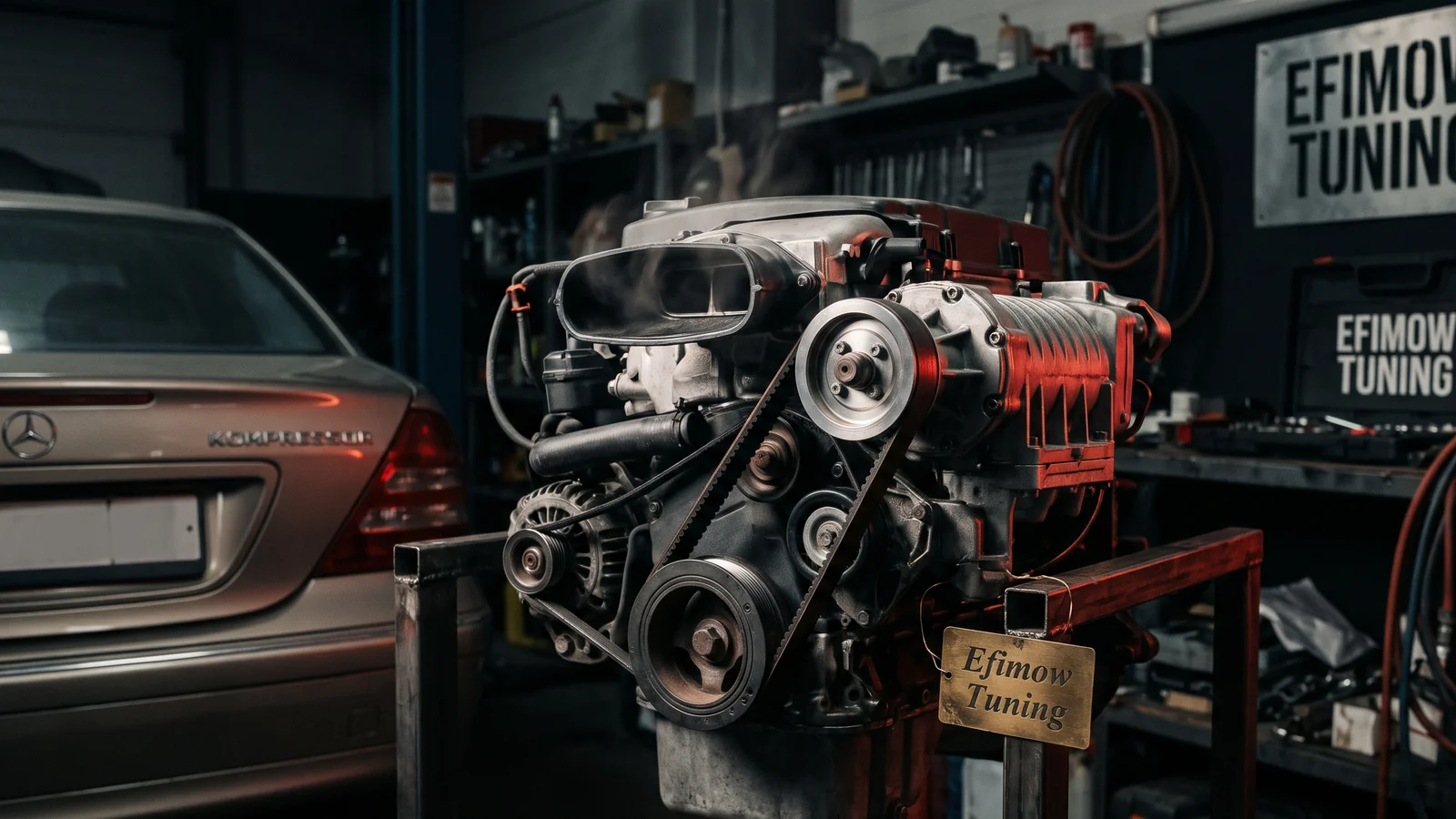
Mercedes Kompressor Engines (M271): Tuning with a Belt-Driven Supercharger
Mercedes M271 Kompressor tuning: why software alone does little on a belt-driven supercharger, what a pulley changes, timing chain, SIM4LKE and the M271 EVO.
October 25, 2026 by Leo Efimow
For years, the "Kompressor" badge on the boot lid was a fixture of the Mercedes model range. Behind it there is usually the M271, a 1.8 litre four-cylinder with a mechanical supercharger, fitted in the C-Class W203 and W204, the CLK, the E-Class W211, the SLK R171 and the CL203 Sportcoupé, from 122 to 192 PS depending on the version. Anyone wanting to tune such an engine runs into a question that hardly matters on a turbo: how much can software actually achieve when boost pressure is determined not by the ECU but by the belt drive? The answer is more sobering than for many turbo engines, but it is worth understanding.
How a supercharger makes boost
A turbocharger is driven by the exhaust flow. How much pressure it generates is controlled by the ECU via wastegate or variable turbine geometry. More boost is therefore essentially a software question, as long as the turbo can keep up.
A supercharger is different. It is connected directly to the crankshaft via a ribbed belt. Its speed is fixed to engine speed, and the ratio results from the pulley diameters. That means maximum boost is also essentially fixed mechanically. The ECU can reduce pressure via a bypass flap, for example at part load to save fuel, but it cannot raise it beyond what the supercharger delivers at a given engine speed.
This leads to a clear distinction:
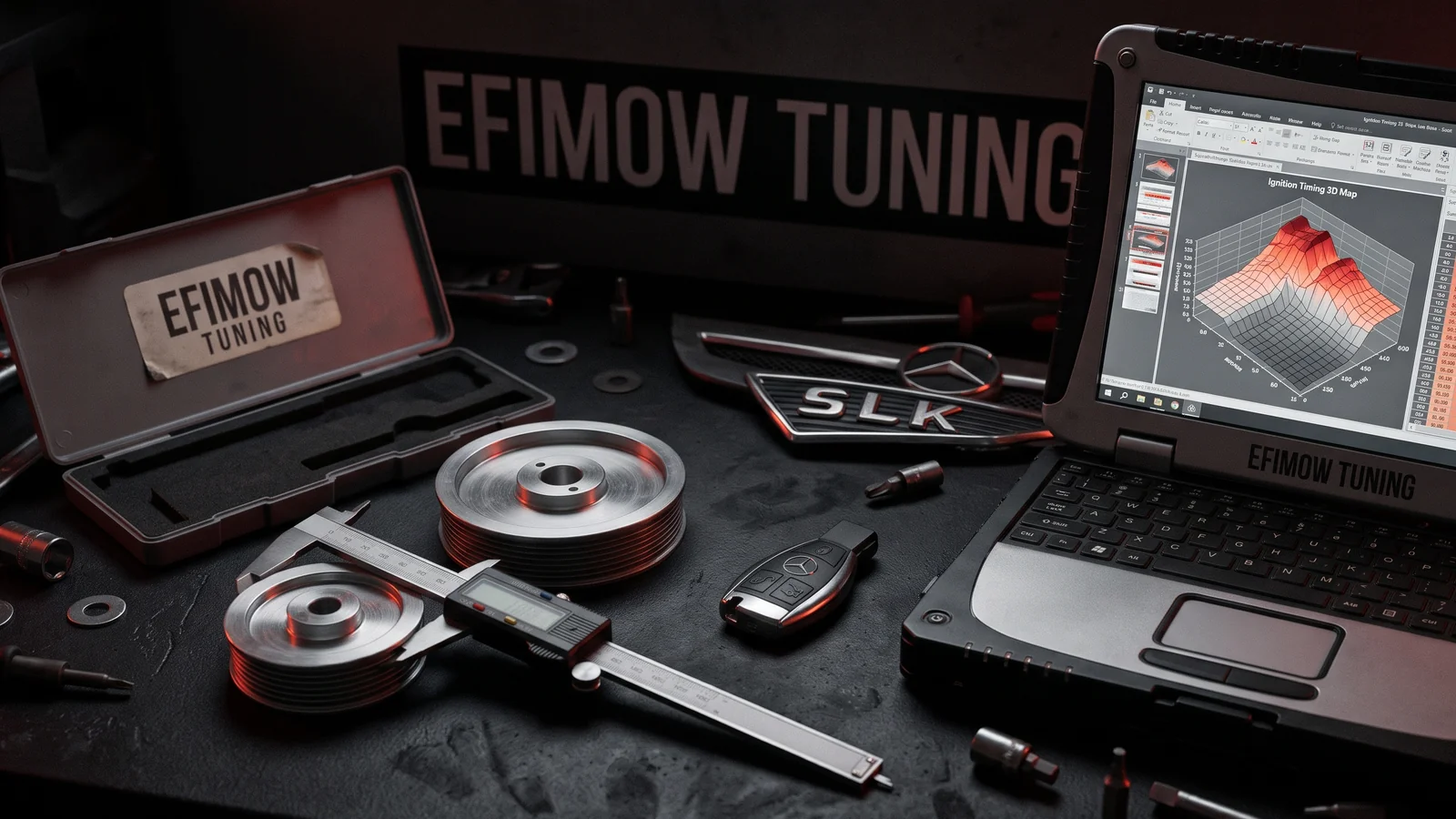
- Software alone can change ignition timing, cylinder filling, torque limiters, the bypass strategy and the throttle pedal curve.
- More boost is only possible with a smaller pulley on the supercharger, in other words, with hardware.
What is realistic
For the Siemens SIM4LKE ECUs that control the M271 Kompressor, our data gives typical Stage 1 guide values of 8 to 15 percent more power and 10 to 15 percent more torque. More is only possible in combination with a smaller pulley. The consensus among specialists is clear: software alone achieves comparatively little on the M271.
That is no reason to skip tuning, but it is a reason for realistic expectations. A good calibration is noticeable mainly in throttle response and a more even torque curve. The bypass strategy and the throttle pedal curve in particular decide how direct the engine feels in everyday driving. The weaker versions (such as the C 160 or C 180 Kompressor) tend to benefit more, because they share the same base mechanics as the stronger variants.
The advantage you should not tune away
For all the restraint on power gains, the supercharger has a quality many M271 drivers appreciate: it responds without delay. Because the supercharger runs mechanically with the engine, boost is available at low rpm, and there is no turbo lag in the classic sense. A good calibration preserves exactly this directness. It does not make the throttle pedal nervous; it ensures the available torque arrives linearly and predictably.
At the same time, the supercharger itself costs power, because it has to be driven by the crankshaft. The bypass flap reduces this loss at part load by letting the supercharger "idle". Changing the bypass strategy therefore affects not only throttle response but also fuel consumption, a point an everyday-friendly file keeps in mind.
Pulley and Stage 2
If you want more, you end up at Stage 2: a smaller pulley plus adapted software. The smaller pulley spins the supercharger faster and boost rises. But intake air temperature, knock tendency and the load on the belt drive rise as well. Our data therefore lists Stage 2+ for this ECU only as "on request", only with a pulley and matching software.
Three points are mandatory with a pulley conversion:
- Software adaptation: ignition timing and filling must suit the higher pressure. A smaller pulley without adaptation is an invitation to knock.
- Belt and tensioner: the belt drive transmits more power to the supercharger. An old belt or a weak tensioner will slip.
- Fuel: with more boost, high-octane fuel becomes mandatory.
The timing chain: the real issue on the M271
Before you think about power, you should know the condition of the timing chain. The M271's timing chain issue is well known: chain stretch, worn guide rails and camshaft adjusters show up as rattling on cold start and as camshaft position fault messages. This is not a tuning problem, but a power increase will not improve an existing defect.
Sensible before tuning:
| Check point | Why |
|---|---|
| Cold-start noise | hint of chain stretch or adjuster wear |
| Fault memory | camshaft/crankshaft correlation |
| Spark plugs and ignition coils | basis for clean ignition timing |
| Belt drive | belt, tensioner, idler pulleys |
| Charge-air path | leaks cost pressure |
Options and the M271 EVO
For the SIM4LKE our data lists, besides Stage 1+, Sharp Throttle, Vmax removal, raising the rev limiter and suppressing non-emissions-related fault codes. ECO tuning is possible on request. Hardcut and Pops & Bangs (on request) are motorsport functions and not permitted on public roads.
A special case is the M271 EVO: in the C-Class W204 and E-Class W212, the engine came from around 2009 with a turbocharger instead of a supercharger and with a Bosch MED17.7. The rules of a turbo engine apply to it: typical guide values there are 15 to 30 percent, and the ECU determines boost pressure. The name is similar, the tuning logic completely different.
Process, price and legal
We tune Mercedes vehicles directly on the ECU: on site with us in Stödtlen at an appointment of your choice, or by sending in the removed ECU, at the same price. For the M271 Kompressor with SIM4LKE, Stage 1 starts from €150 under our pricing scheme, for example for the C 200 Kompressor in the W203 or the SLK 200 Kompressor in the R171. The M271 EVO with turbo in the W204 with the MED17.7 starts from €250.
The software change voids your vehicle's type approval; the software is intended for motorsport use only.
Conclusion
With the M271 Kompressor, honesty matters more than percentages. Software improves throttle response, torque curve and pedal feel, but boost is determined by the belt drive. If you want significantly more, you need a smaller pulley, and a healthy timing chain is the prerequisite for everything else on this engine anyway. More on the technology of mechanical supercharging can be found in the glossary. Which version is in your car and what it costs, the configurator will show you.