
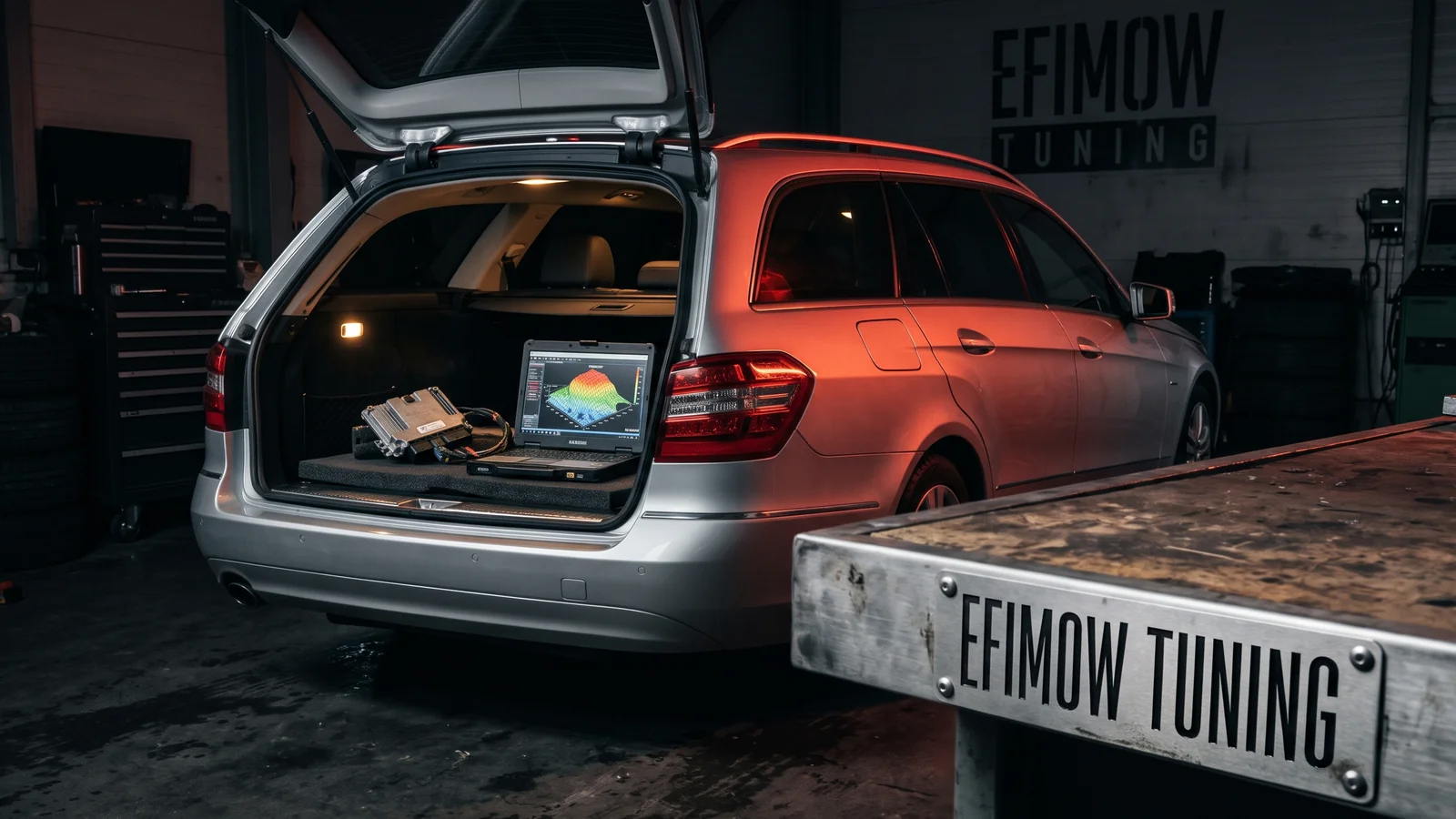
Mercedes E 350 CDI (W212, OM642): V6 Diesel Tuning
Mercedes E 350 CDI W212 with OM642: what the V6 diesel can do with software, which ECUs are fitted and what to watch with 7G-Tronic and BlueTEC.
October 25, 2026 by Leo Efimow
For many drivers, the E 350 CDI of the W212 series is the epitome of the effortless long-distance diesel: six cylinders, torque-converter automatic, plenty of torque just above idle. Under the bonnet works the OM642, a 3.0 litre V6 CDI that Mercedes used in almost every model range for nearly two decades, from E- and S-Class to ML, GL and R-Class and on to the Sprinter. Exactly this spread makes the engine interesting for tuning: it is well documented, its weak points are known, and the factory reserves are noticeable. At the same time, a V6 diesel is not a four-cylinder where you simply raise the boost. This post shows what really counts on the OM642 in the W212.
The OM642 at a glance
The OM642 is a V6 with a 72-degree bank angle, common-rail injection, a variable-geometry turbocharger and charge-air cooling. Mercedes built it in many power levels; in the W212 it was offered as the E 350 CDI and later as the E 350 BlueTEC. The power levels differ mainly in software and in details of the peripherals; the base engine is the same.
For tuning, the ECU generation is what matters most:
- Bosch EDC16CP31: in the older applications, for example the W211 (E 280 CDI, E 320 CDI), ML W164, GL X164, R-Class and Sprinter W906.
- Bosch EDC17 (CP01, CP10, CP46, CP57): in the later applications. The OM642 engines of the W212 era belong to this generation.
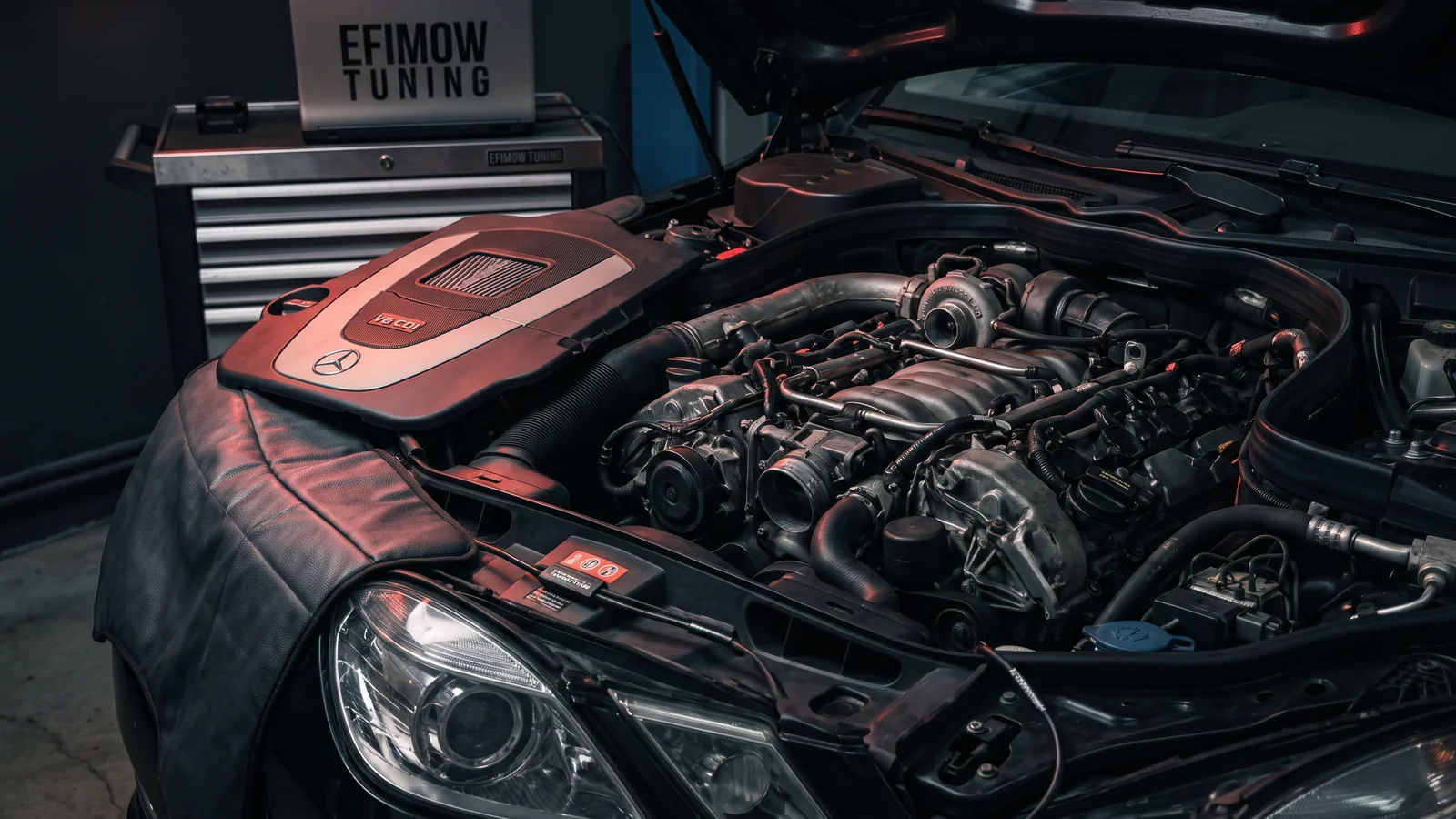
Our vehicle catalogue currently lists the W212 with the four-cylinder diesels and the petrol engines, but not the E 350 CDI as a separate variant. For the OM642 with EDC17, other model ranges are listed, for example the S-Class W221 with 3.0 V6 CDI. You can submit your E 350 CDI as a request through the configurator; what ultimately counts is the identification on your ECU.
What is realistic for the V6 diesel
For Bosch EDC17 ECUs outside the VW Group, our data gives typical Stage 1 guide values for V6 and V8 engines of 15 to 25 percent more power and 20 to 30 percent more torque. For the OM642 with EDC16, the guide values are 20 to 30 percent. These ranges are orientation, not a promise. Engine condition, mileage and software version all play a part.
You feel the difference mainly in the mid-range. A well-calibrated V6 diesel pulls noticeably more willingly when overtaking on country roads and during motorway bursts, without its character changing. Peak power at the top end is secondary on a diesel anyway.
A typical use for the E 350 CDI is towing: caravans, horse trailers, boat trailers. This shows why a measured calibration makes more sense than maximum output: under sustained load on a climb, exhaust and gearbox oil temperatures rise far more than during a short burst of acceleration. If you tow heavy loads regularly, you are better served by a file that builds torque mainly in the low and mid-range and consistently respects the temperature limits. On paper that costs a few percent, but it brings relief exactly where the engine works in everyday use.
What the software actually changes
A serious Stage 1 calibration for the OM642 works on the usual diesel maps:
- Torque limiters: the torque the ECU allows in the first place,
- Injection quantity and start of injection,
- Rail-pressure targets, so the additional fuel is atomised cleanly,
- Boost targets and the control of the VTG turbocharger,
- Smoke limiter, which caps injection quantity depending on the available air mass.
The smoke limiter in particular is where good files differ from bad ones. Adding fuel without the air to match produces soot, high exhaust temperatures and a particulate filter that constantly has to regenerate. A clean calibration keeps the air-fuel ratio within limits and leaves temperature and component protection functions active.
Gearbox, particulate filter and BlueTEC
There are three topics you should know about before tuning an E 350 CDI.
7G-Tronic: The W212 uses the seven-speed torque-converter automatic. The gearbox knows the engine torque via the CAN bus and has its own limits for shift pressure and converter lock-up. The engine calibration must be designed so that the additional torque suits the gearbox. A regular gearbox oil change (which Mercedes specifies rather generously from the factory) makes particular sense after tuning.
DPF: Every OM642 in the W212 has a diesel particulate filter. The filter of course stays fitted and active. An engine that already regenerates frequently in stock form because of short trips or faulty sensors should be checked before tuning.
BlueTEC and AdBlue: The later versions use an SCR catalytic converter and AdBlue injection. This system remains unchanged. Disabling DPF, EGR or SCR is emissions tampering and prohibited on public roads. A power increase does not change that. Also important: many OM642 engines received a software update as part of officially ordered recalls. Tuning always builds on the vehicle's current software version.
Check known weak points before tuning
The OM642 is considered robust, but it has quirks you should know:
| Component | What to look for |
|---|---|
| Oil cooler seals in the V | oil loss in the engine V, typical at higher mileage |
| Charge-air path | leaks cause power loss and fault codes |
| Swirl flaps / intake manifold | actuator wear, fault messages |
| Injectors | check return quantities, especially at high mileage |
| DPF differential pressure sensor | wrong readings trigger unnecessary regenerations |
These points have nothing to do with tuning, but they decide whether the extra power arrives cleanly. A leak in the charge-air path, for instance, prevents the ECU from reaching the target pressure. Software cannot fix that.
Process and price
We tune Mercedes vehicles directly on the ECU, not via the online flashing route we offer for BMW. You come to us in Stödtlen for an appointment of your choice, or you remove the ECU and send it in. The price is the same in both cases, and you book online.
The price depends on ECU generation, power and model year. Under our pricing scheme, an EDC17 diesel of this generation starts at €300 for Stage 1; older OM642 engines with EDC16CP31, such as the E 320 CDI in the W211, from €200. The configurator shows you the exact price for your car.
Available options for the EDC17 family include Stage 1+, ECO tuning, Sharp Throttle and Vmax removal. Here too: the software change voids your vehicle's type approval; the software is intended for motorsport use only.
Conclusion
The OM642 in the E 350 CDI is a rewarding engine for a moderate software optimisation. The reserves are mainly in torque, and that is exactly where a cleanly calibrated V6 diesel makes itself felt in everyday driving. More important than the last percentage point are a healthy base engine, a tight charge-air path, a working particulate filter and a gearbox that suits the additional torque.
You can find more about the CDI abbreviation and the ECUs behind it in the glossary. If you want your E 350 CDI assessed, send a request through the configurator.