
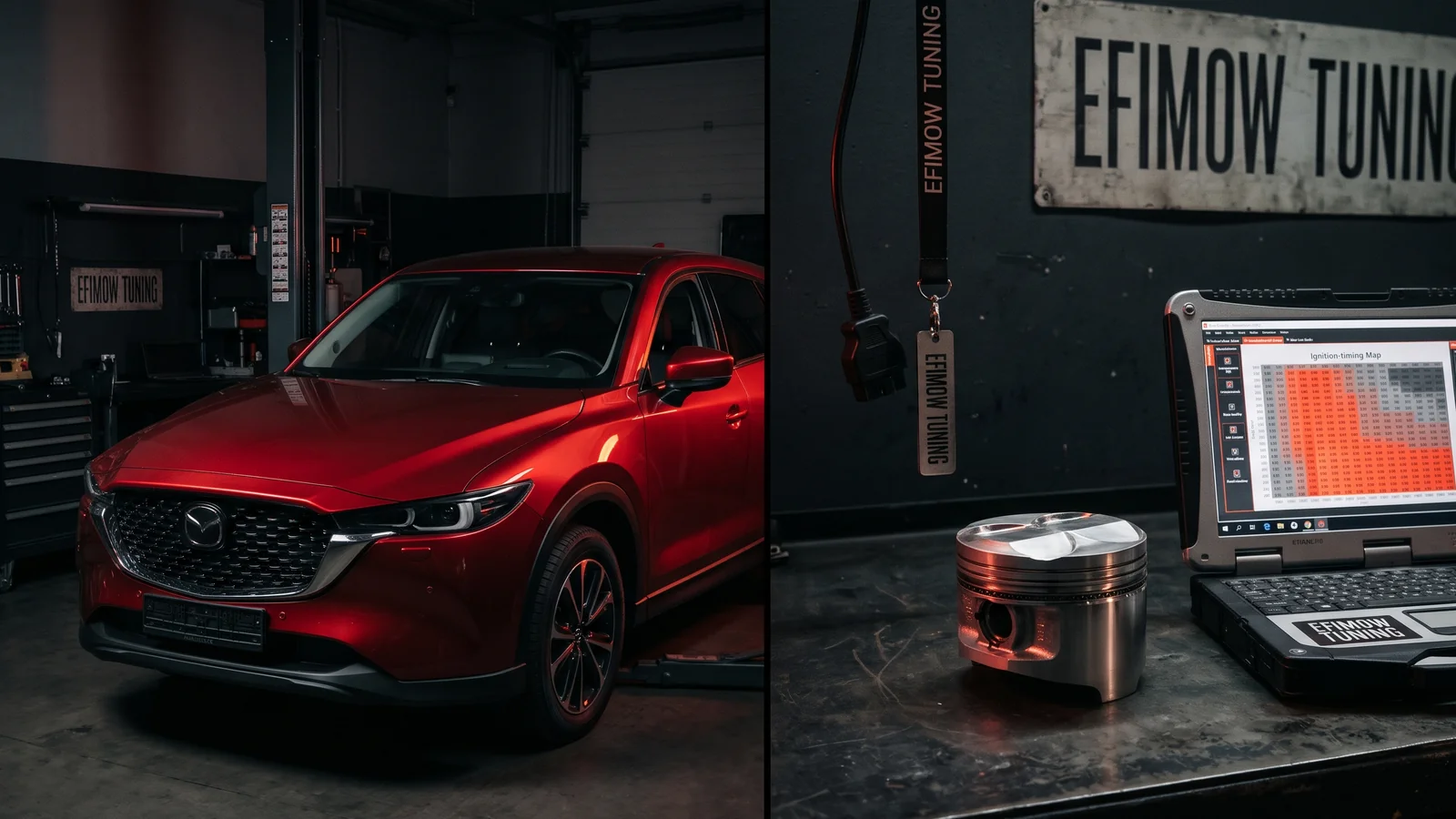
Mazda Skyactiv-G and -D: What Works on High-Compression Engines
Tuning Mazda's Skyactiv-G petrol and Skyactiv-D diesel engines: why high or low compression defines the headroom and what software realistically delivers.
October 25, 2026 by Leo Efimow
Mazda went its own way with Skyactiv. While almost every manufacturer moved to small turbocharged gasoline engines, Mazda stayed with naturally aspirated engines with very high compression and at the same time built diesels with unusually low compression by diesel standards. Both concepts have consequences for software tuning, and they work in opposite directions. If you want to optimise a Mazda 3, Mazda 6, CX-5 or MX-5, you should know these differences before setting expectations. This article explains the technology behind them, which ECUs are fitted and what is realistic.
Two concepts, two extremes
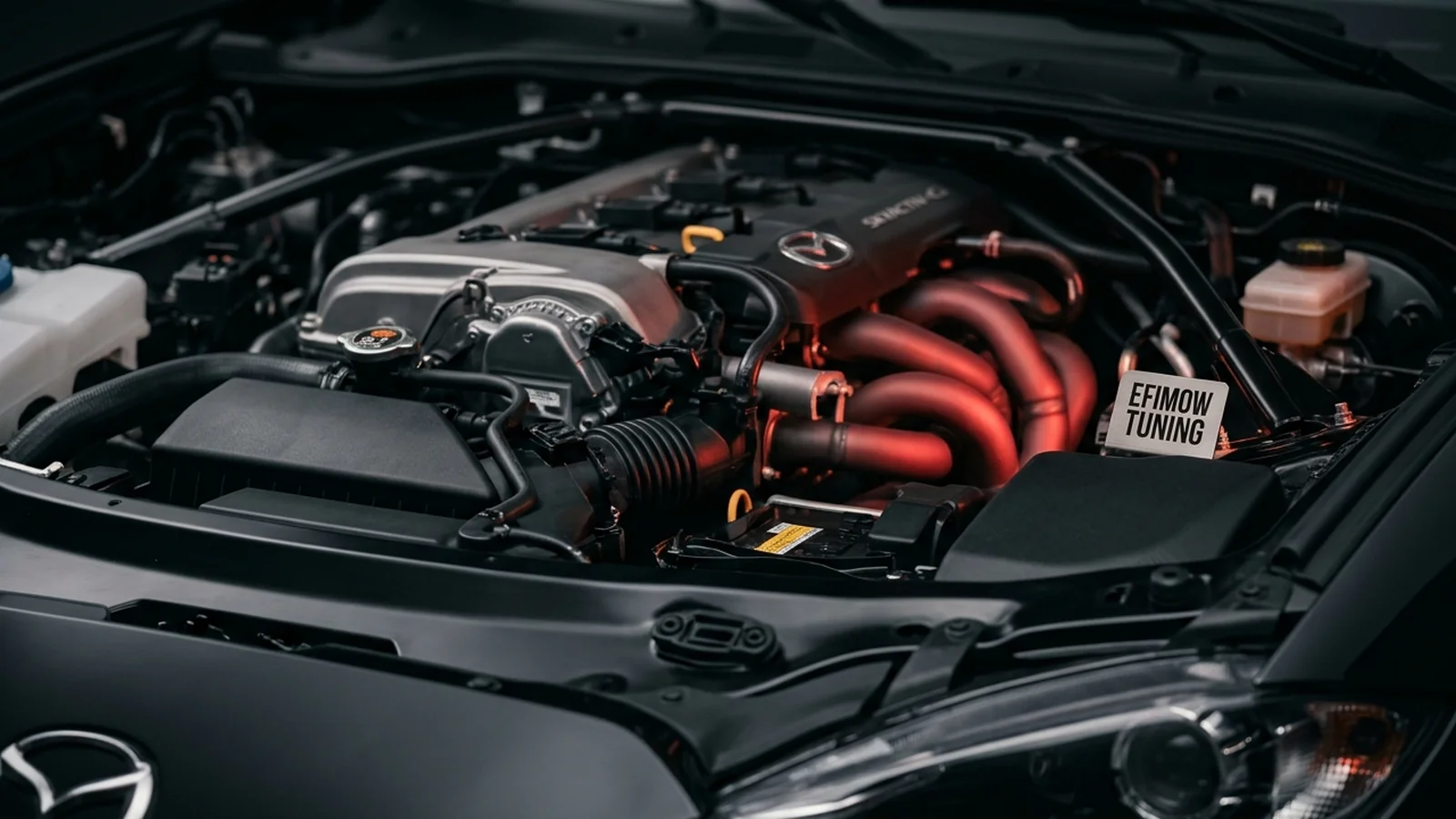
The Skyactiv-G gasoline engines (1.5, 2.0 and 2.5 litres, engine codes P5, PE and PY) run a compression ratio that is very high for a production naturally aspirated engine. That improves efficiency but increases knock tendency. Mazda counters this with, among other things, a long 4-2-1 exhaust manifold that keeps residual gas out of the combustion chamber, and with precise control of injection and ignition.
The Skyactiv-D diesels (1.5, 1.8 and 2.2 litres) take the opposite route: their compression is low for a diesel. That lowers combustion peaks and nitrogen oxides but requires very precise control at cold start and elaborate charging. The 2.2 uses two-stage turbocharging.
For tuning this means: on the gasoline engine there is no boost to raise without forced induction, and the high compression leaves little room in ignition timing. On the diesel, on the other hand, the usual parameters of a turbocharged engine are available.
ECUs: Denso and Mitsubishi
Mazda mainly uses ECUs from Denso, on some Skyactiv-G engines also from Mitsubishi. Denso ECUs were long considered hard to access; some generations are encrypted, and coverage by tuning tools is patchy. So on a Mazda in particular: before a price or an option is confirmed, we check whether the specific ECU can be read and written.
| Engine | Examples in our catalog | ECU | Stage 1 from |
|---|---|---|---|
| 2.0 Skyactiv-G, 160 hp | MX-5 (ND) | Denso | €300 |
| 1.5/2.0/2.5 Skyactiv-G | Mazda 3 (BM), Mazda 6 (GJ), CX-5 (2012–2017) | Mitsubishi or Denso | €250 |
| 2.2 Skyactiv-D, 150/175 hp | CX-5 (2012–2017), Mazda 6 (GJ) | Denso SH1/SH12 | €300 |
| 1.5 Skyactiv-D, 105 hp | Mazda 2 (DJ), Mazda 3 (BM) | Denso S5 | €300 |
The prices follow from our pricing rules by ECU generation and model year; newer models from model years 2015 and 2019 receive the corresponding surcharges. For variants with encrypted Denso ECUs or for the models from 2019, the configurator shows you the exact price.
Skyactiv-G: honest expectations for a naturally aspirated engine
For Denso gasoline ECUs on naturally aspirated engines, our data gives typical Stage 1 guide values of around 3 to 8 percent more power and 5 to 8 percent more torque. That is deliberately sober, and it is realistic. A high-compression naturally aspirated engine already runs close to its knock limit from the factory; more ignition advance brings little there and increases the risk.
What software can still improve on the Skyactiv-G is the driving feel:
- a more direct pedal map (Sharp Throttle), because many factory calibrations make the pedal deliberately soft,
- an adapted rev limiter, which is technically possible on these engines,
- a more harmonious torque curve in the areas where the factory calibration is conservative for fuel economy or noise reasons.
On the MX-5 in particular, many drivers appreciate exactly that: not more peak power, but more immediate response. If you want significantly more power, a naturally aspirated engine needs mechanical changes or forced induction, and that is a separate project with certification. A Stage 2 on the Skyactiv-G engines therefore only makes sense with mechanical changes.
Skyactiv-D: more headroom, but with care
The diesel is a different story. For the Denso diesel ECUs our data gives typical Stage 1 guide values of around 15 to 25 percent more power and 20 to 30 percent more torque. The calibration works with injection quantity, rail pressure, boost pressure and torque limiters; on the 2.2 with its two-stage charging, the interplay of the two turbos is part of it too.
The low compression, however, makes the Skyactiv-D more sensitive than some classic diesels. You should have two points checked before tuning:
- Oil level and oil dilution: With a lot of short trips and frequent regenerations of the diesel particulate filter, fuel can get into the engine oil and the oil level rises. A rising oil level is a warning sign, not a trivial matter.
- DPF and injectors: A heavily loaded DPF and unevenly working injectors should be checked first, so the calibration meets a healthy engine.
What about the newer Skyactiv variants?
Mazda has extended the Skyactiv family over the years, among others with the Skyactiv-X with compression ignition on a gasoline engine and with turbo gasoline engines for individual markets. These variants are currently not listed as separate entries in our catalog. If you drive such a car, enter it via the request in the configurator. We then check ECU, access and software version before making any statement on options or price. For the models from model year 2019 with Skyactiv-G and Skyactiv-D, a prior check is worthwhile too, because the ECU generation and protection mechanisms have changed.
Options
For the Denso diesel ECUs our data lists Stage 1+ and Stage 2+, ECO tuning, Sharp Throttle and suppressing individual, non-emissions-related fault codes as feasible; Vmax removal and the rev limiter depend on the Denso generation and are on request only. For the Skyactiv-G gasoline engines, Stage 1+, Sharp Throttle, Vmax removal, a higher rev limit and suppressing non-emissions-related fault codes are feasible, Launch Control and no-lift shift only partly.
A hardcut limiter is technically possible on the Denso gasoline ECUs, pops & bangs and popcorn limiter partly, with a weaker effect on a naturally aspirated engine. All of these functions are intended exclusively for motorsport; details in the motorsport notice.
Emissions control and the law
The software change voids your vehicle's type approval; the software is intended for motorsport use only. For road use, a power increase requires an inspection and registration. Removing or disabling the DPF, the EGR or, on newer models, SCR aftertreatment or a gasoline particulate filter in software is emissions tampering and prohibited on public roads.
Process
We tune Mazda vehicles directly on the ECU, on site in Stödtlen at a date of your choice or by sending in the ECU, at the same price and bookable online. Examples from the catalog are the CX-5 2.2 Skyactiv-D with 150 hp and the MX-5 ND 2.0 Skyactiv-G.
Conclusion
Skyactiv is a good example of how the engine concept defines the tuning options. On the high-compression Skyactiv-G naturally aspirated engine, software mainly brings better response and fine-tuning, but no big jumps in power. On the Skyactiv-D diesel the headroom is considerably larger, provided oil condition, DPF and injectors are fine and the Denso ECU can be read.
Whether your Mazda qualifies and which options can be booked, you can see in the configurator.