
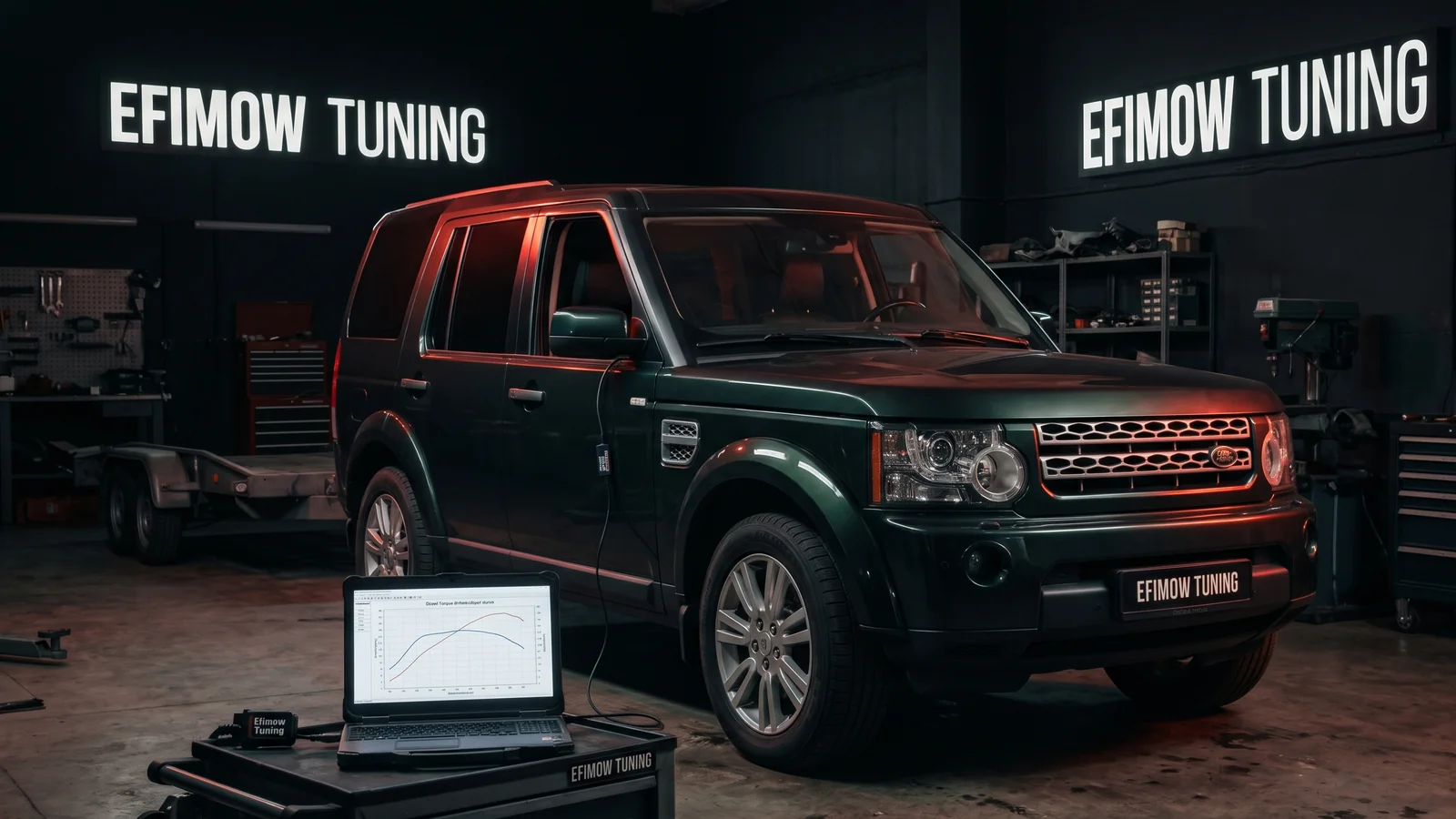
Land Rover Discovery and Range Rover: TDV6 and SDV6 Tuning
Discovery 3/4, Range Rover and Range Rover Sport with V6 and V8 diesel: Siemens and Bosch ECUs, guide values, options and checks before tuning.
October 25, 2026 by Leo Efimow
A Discovery or Range Rover with a V6 diesel is rarely a fun car for country roads. It is a tow vehicle, a touring car, a work tool, and usually weighs well over two tonnes empty. That is exactly why many owners ask about software tuning: not for top speed, but for more pull on hills, with a horse trailer or a caravan. On the TDV6 and SDV6 this is technically very feasible, but the engines have their quirks. This article shows which ECUs are fitted in which models, what is realistic and what you should check beforehand.
The engines at a glance
Land Rover's V6 diesels come from a cooperation between Ford and PSA and were also used by Jaguar, Peugeot and Citroën. At Land Rover they are called TDV6 and (in the stronger version with two turbochargers) SDV6. There are also V8 diesels (TDV8, SDV8) in the big Range Rover models. Our catalog lists these combinations:
| Model | Engine | ECU | Stage 1 from |
|---|---|---|---|
| Discovery III (2004–2009) | 2.7 TDV6, 190 hp | Siemens SID201/203/204 | €200 |
| Discovery IV (2009–2016) | 2.7 TDV6 | Siemens SID204 | €200 |
| Range Rover Sport (2005–2013) | 2.7 TDV6 / 3.6 TDV8 | Siemens SID20x | €200 |
| Range Rover III (2002–2012) | 3.6 TDV8 | Siemens SID203 | €200 |
| Range Rover IV (2012–2021) | 3.0 TDV6, 245/255 hp | Bosch EDC17CP55 | €300 |
| Range Rover IV | 4.4 SDV8, 334 hp | Bosch EDC17CP55 | €350 |
| Range Rover Sport II (2013–2022) | 3.0 TDV6/SDV6, 4.4 SDV8 | Bosch EDC17CP55 | €300 |
Prices follow from our pricing rules by ECU generation; the 4.4 SDV8 adds the surcharge from 300 hp. Important: for the Discovery IV our catalog only lists the 2.7 TDV6 as a separate variant. If you have a later Discovery IV with the 3.0-litre engine, enter it in the configurator or send a request. We then check the specific ECU.
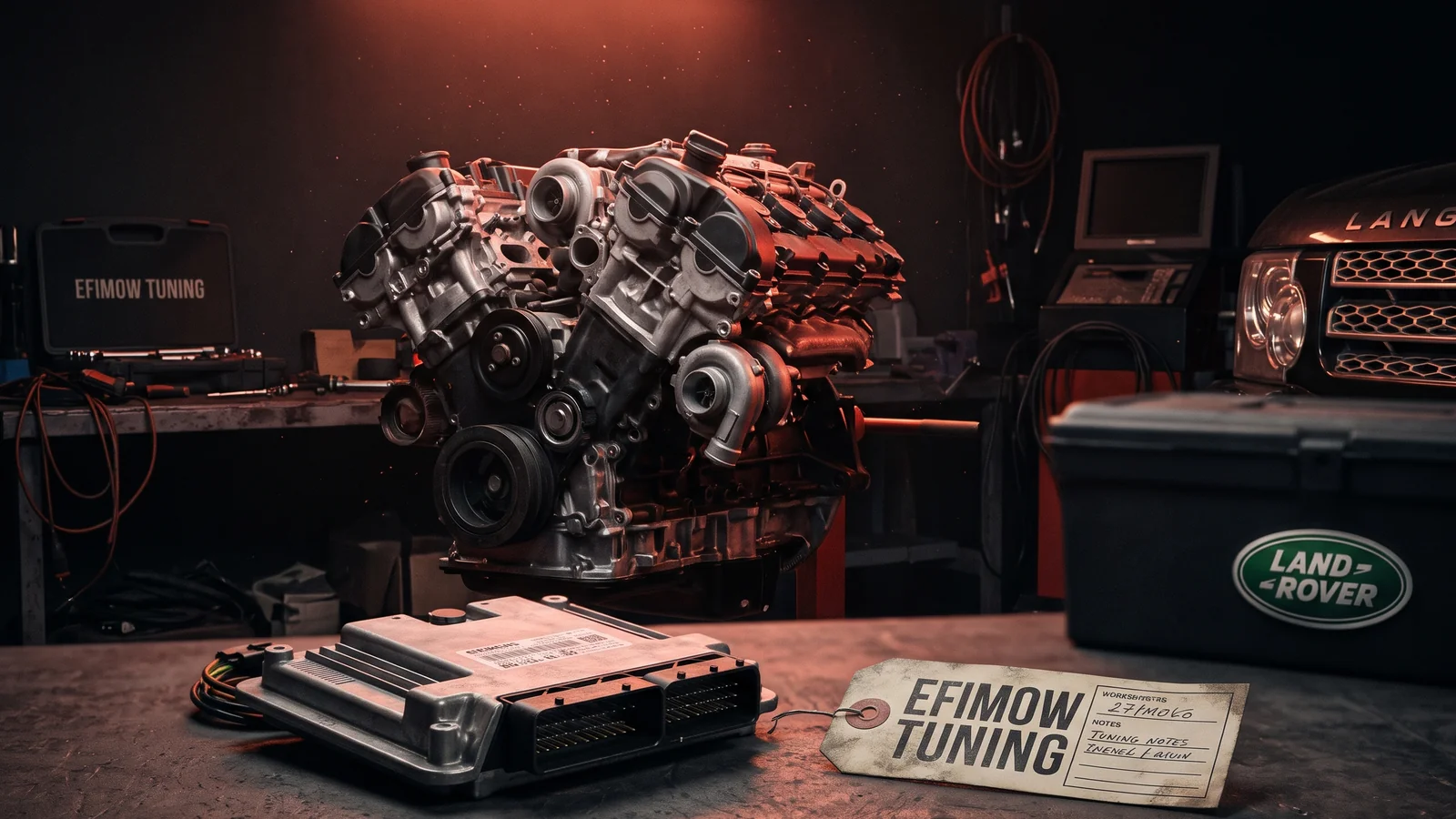
Two ECU worlds
The older engines use Siemens/Continental ECUs of the SID20x family, the newer 3.0-litre engines and the 4.4 SDV8 use Bosch EDC17. That has practical consequences:
- SID20x (2.7 TDV6, 3.6 TDV8): Typical Stage 1 guide values are around 15 to 25 percent more power and 20 to 30 percent more torque.
- EDC17 (3.0 TDV6/SDV6, 4.4 SDV8): For V6 and V8 diesels our data gives around 15 to 25 percent more power and 20 to 30 percent more torque.
Both are ranges for the respective ECU family, not measurements for your car. In daily use this means above all: the heavy off-roader pulls noticeably harder in the mid-range, the automatic needs to kick down less often on gradients and when towing, and the engine works in a more relaxed range for the same performance.
What the software changes
On a common-rail diesel the calibration works on injection quantity, rail pressure, boost pressure, torque limiters and smoke limitation. On the SDV6 with its two turbochargers, the interplay is calibrated too: when the second turbo comes in and how the transition feels. A clean calibration keeps this transition smooth; a torque hole or a jerky surge in this range is a typical sign of a sloppy tune.
The protection functions stay active: exhaust temperature limitation, smoke limiter and component protection are adapted to the new load points. Especially when towing, when the engine runs under high load for long periods, these limits matter more than peak power.
Check the condition, especially on the 2.7 TDV6
Many Discovery 3s and 4s have high mileage and a hard life behind them. Before tuning, keep an eye on the following:
- Oil change history: With neglected oil maintenance the 2.7 TDV6 is considered sensitive in the crankshaft bearing area. A complete service history is worth more here than any power figure.
- Turbocharger and boost control: The vane mechanism and vacuum control should move freely; oil leaking at the turbo is a warning sign.
- Gearbox: Discovery 3 and 4 use a ZF six-speed automatic, newer Range Rovers the ZF eight-speed automatic. A gearbox with harsh shifts or slip should be checked before tuning; an oil change and the adaptation values belong to that.
- Cooling: In heavy towing a clean radiator is just as important as a working viscous or electric fan.
- Diesel particulate filter and EGR: A heavily loaded DPF or a coked EGR system leads to fault messages or limp mode more quickly after tuning.
Options
For the SID20x ECUs our data lists Stage 1+ and Stage 2+, ECO tuning, Sharp Throttle, Vmax removal and suppressing individual, non-emissions-related fault codes as feasible. Raising the rev limiter is only possible to a limited extent and rarely useful on a diesel. The same list applies to the EDC17 engines; Launch Control is available there on request depending on the software version.
ECO tuning is particularly interesting for tow vehicles: it optimises torque in the low and mid-range without raising peak power. For vehicles that tow a lot and rarely drive fast, this is often a better fit than a classic power increase.
What you should not expect
A tuned Discovery remains a heavy vehicle with a large frontal area. More torque shortens overtaking and relieves the engine on hills, but it changes nothing about weight, braking distance and suspension. A significant drop in fuel consumption is not a serious promise either: if you use the extra pull, you will rather use more fuel. With ECO tuning and an unchanged driving style small savings are possible, but they depend heavily on how the car is used. And a Stage 2 with a larger turbo or modified exhaust only makes sense on these vehicles in exceptional cases, and then only with catalytic converter, DPF and certification.
Emissions control and the law
The software change voids your vehicle's type approval; the software is intended for motorsport use only. For road use, a power increase requires an inspection and registration. Removing or disabling the DPF, the EGR or (on newer models) SCR aftertreatment with AdBlue in software is emissions tampering and prohibited on public roads. Especially with off-roaders, where "coking" is often used as an argument for such interventions, this should be clear.
Process
We tune Land Rover vehicles directly on the ECU: on site in Stödtlen at a date of your choice or by sending in the ECU. The price is the same in both cases and can be booked online. Examples from the catalog are the Discovery IV 2.7 TDV6, the Range Rover IV 3.0 TDV6 and the Range Rover Sport II with V6 or V8 diesel.
Conclusion
TDV6 and SDV6 are rewarding candidates if the goal is right: more pull for a heavy vehicle, not maximum peak power. The ECUs are well known, the reserves are solid, and with a calibration that respects protection functions and gearbox, everyday life with a trailer becomes noticeably more relaxed. A healthy engine is the prerequisite. On the 2.7 TDV6 the service history counts more than anything else.
The configurator shows you which variant is in your Land Rover and which options can be booked.