
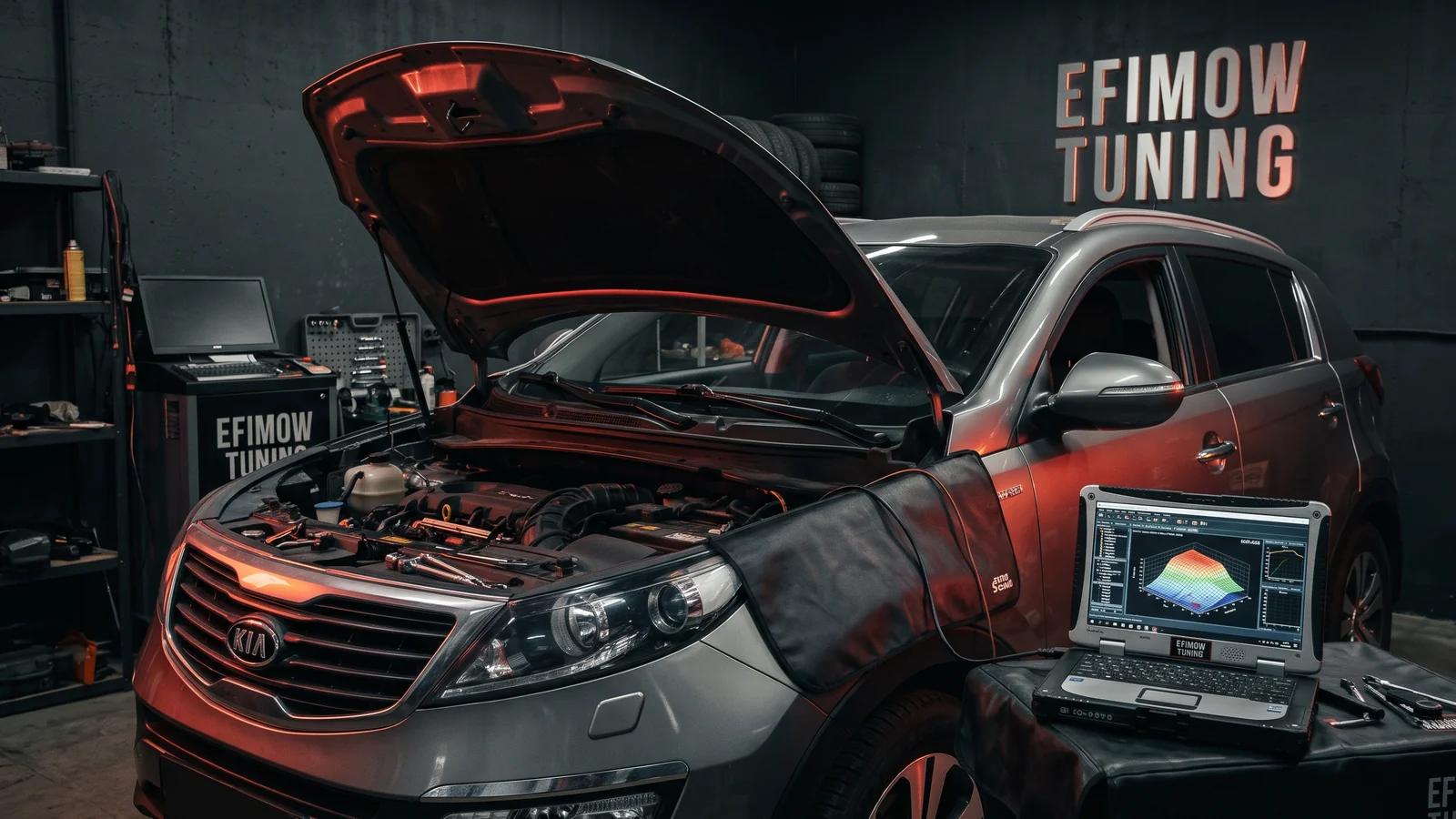
Hyundai/Kia CRDi: Tuning the i30, Tucson, ix35 and Sportage
U, D and R engines: which CRDi diesels power the i30, cee'd, Tucson, ix35 and Sportage, which ECUs are fitted and what software delivers.
October 25, 2026 by Leo Efimow
In Europe, Hyundai and Kia have grown from price breakers into established volume manufacturers, and their CRDi diesels have grown with them. The i30, cee'd, Tucson, ix35 and Sportage use solid common-rail engines that mainly do one thing in daily life: run reliably and economically. If you want more pulling power, say for a trailer or a fully loaded holiday trip, software offers good prospects. What matters is knowing the right engine family and the matching ECU.
Three engine families
Hyundai and Kia's CRDi diesels can be roughly divided into three families:
U engine (1.4 / 1.6 CRDi): The small diesel for the i30, cee'd and other compact models. Listed in our catalog with 90 to 128 hp and ECUs from Bosch (EDC16C39, EDC16+, EDC17C08) and Delphi (DCM3.7).
D engine (2.0 CRDi, D4EA): The older two-litre in the first-generation Tucson, Sportage II and early i30. Listed with 113 to 140 hp and a Bosch EDC15C7 or EDC16.
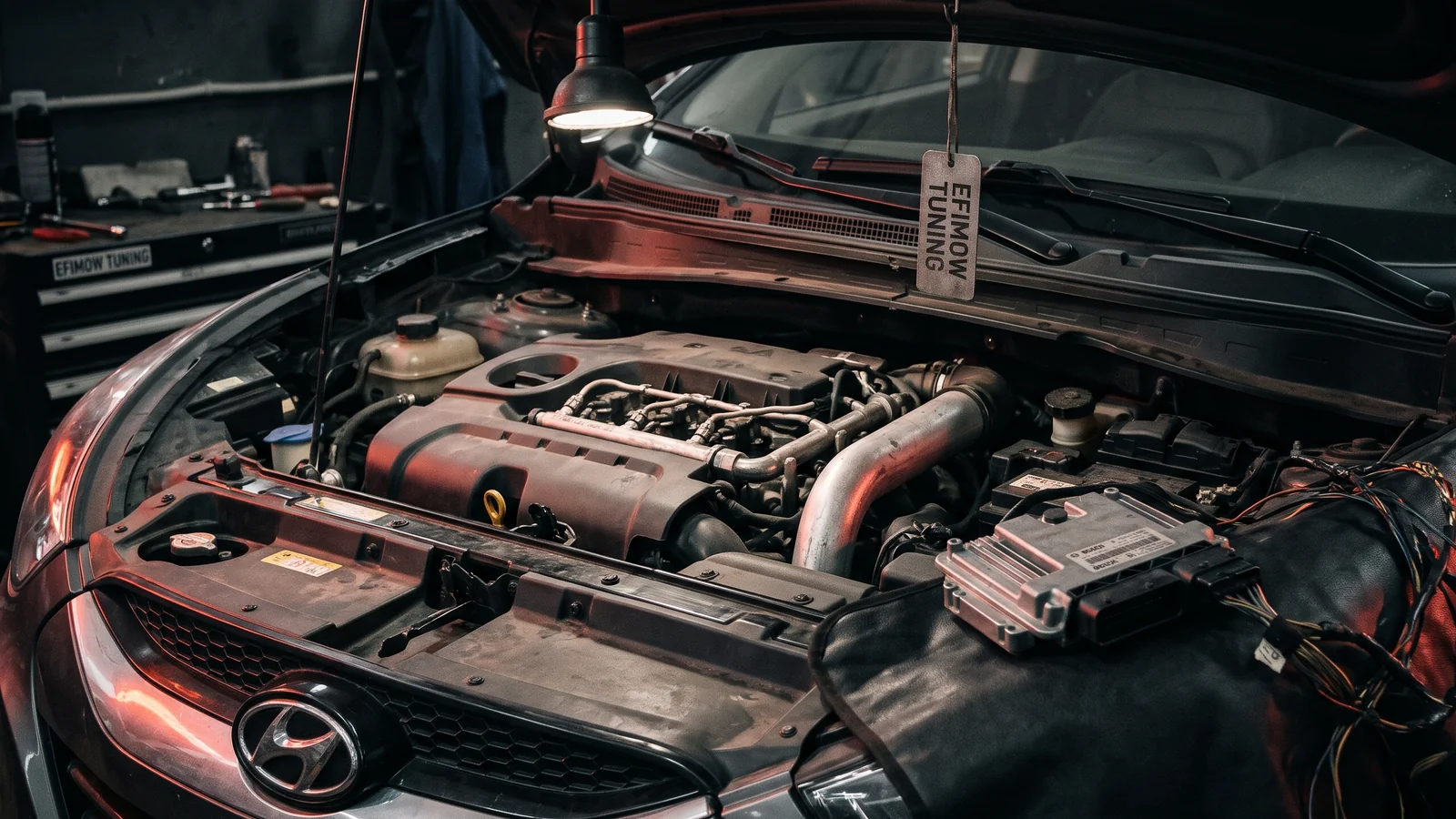
R engine (2.0 / 2.2 CRDi, D4HA): The more modern generation in the ix35 and Sportage III. Listed with 136 and 184 hp and a Bosch EDC17C08.
The versions at a glance
| Model | Engine | Output (catalog) | ECU |
|---|---|---|---|
| Hyundai i30 (FD) | 1.4 / 1.6 CRDi | 90–116 hp | Delphi DCM3.7 / Bosch EDC16+ |
| Hyundai i30 (FD) | 2.0 CRDi | 140 hp | Bosch EDC16+ |
| Kia cee'd | 1.6 CRDi | 90–128 hp | Bosch EDC16C39 / EDC17C08 |
| Kia cee'd | 2.0 CRDi | 140 hp | Bosch EDC16C39 |
| Hyundai Tucson (JM) | 2.0 CRDi | 113 / 140 hp | Bosch EDC15C7 / EDC16+ |
| Kia Sportage II | 2.0 CRDi | 113–140 hp | Bosch EDC15C7 / EDC16C39 |
| Hyundai ix35 | 2.0 CRDi | 136 hp | Bosch EDC17C08 |
| Kia Sportage III | 2.0 CRDi (R) | 136 / 184 hp | Bosch EDC17C08 |
We do not currently list the newer Tucson and Sportage generations from the mid-2010s as separate variants. For these cars, an enquiry is worthwhile so that we can check the ECU and access in advance.
What software delivers on the CRDi engines
The Stage 1 guide values depend on the ECU family:
- Bosch EDC16 common rail (U and D engines): typically 20–30% more power and torque
- Bosch EDC17C08 (R engine, late U engines): typically 20–30% on four-cylinders
- Delphi DCM3.7 (1.4 CRDi): typically 20–30%
- Bosch EDC15C7 (early 2.0 CRDi with 113 hp): typically 15–25% power and 20–30% torque
On the R engine in the ix35 and Sportage III, the effect is particularly interesting: the 136 and 184 hp versions largely share the same basic design, so the smaller version becomes noticeably stronger with software. On the U engine in the i30 and cee'd, the mid-range benefits most. The small diesel feels much less strained afterwards.
Options
For the families mentioned, the following are documented alongside Stage 1:
- Stage 1+ as a finer calibration step (Bosch and Delphi families)
- ECO tuning with more torque in the low and mid range and unchanged peak power
- Sharp Throttle for a more direct throttle pedal
- Vmax removal (mind the tyre speed rating and registration)
- DTC Off only for non-emissions-related fault codes
Stage 2 with hardware is possible in principle on the EDC16 and EDC17 families. For SUVs in daily and towing use, though, a clean Stage 1 or ECO tuning is usually the more sensible choice.
Drivetrain
Many ix35s and Sportages are driven with all-wheel drive and an automatic. The torque-converter automatic has its own torque limits; a serious calibration builds the extra torque so that the transmission control does not intervene. On all-wheel-drive models, check the coupling in the rear drive; on manual cars, the clutch and dual-mass flywheel, both components that feel extra torque first.
Exhaust aftertreatment
The CRDi engines from Euro 4/5 onwards have a particulate filter. An i30 or cee'd used mainly for short trips often has a heavily loaded DPF. That should be checked before tuning. Disabling the particulate filter, EGR or catalyst is emissions tampering and illegal on public roads.
Process and prices
We work on Hyundai and Kia directly at the ECU: on site in Stödtlen at an appointment of your choice or by sending in the removed ECU. The price is the same in both cases, and booking is online.
Under our pricing rules, the Hyundai i30 1.6 CRDi with 116 hp, the Kia cee'd 1.6 CRDi with 115 hp and the Tucson 2.0 CRDi with 140 hp with EDC16 start from €200 for Stage 1. The Hyundai ix35 2.0 CRDi with 136 hp and the Kia Sportage III 2.0 CRDi with 184 hp with EDC17C08 start at €300. You will find all versions in the configurator.
On the legal side: the software change voids the type approval. The software is intended for motorsport use only; see the motorsport notice.
Common questions from the workshop
Are there differences between Hyundai and Kia? Technically hardly any. Hyundai and Kia use the same engine families and largely the same ECUs, for example the R engine with a Bosch EDC17C08 in the ix35 and Sportage III. Differences lie more in calibration, gearbox and equipment. For tuning, engine and ECU count, not the badge.
Is the 1.6 CRDi with 90 hp the same engine as the one with 128 hp? Both belong to the U engine family but differ in ECU and components depending on the model year. On the weaker versions in particular, software adds noticeably more pulling power in daily driving. We identify which version you have from the ECU identification.
What happens to the manufacturer's warranty? Hyundai and Kia are known for long warranty periods. A software change can become an issue in the event of damage if there is a link to the modification. If your car is still under warranty, weigh this up consciously before tuning. The original state of the ECU is backed up before writing.
Conclusion
Hyundai and Kia's CRDi diesels are solid candidates for a moderate Stage 1: a typical 20–30% more power and torque as a guide value, somewhat less on the early EDC15 engines. What matters is the right engine family, a drivetrain that can handle the extra torque and an intact particulate filter. For tow vehicles, ECO tuning is a worthwhile alternative. More on Delphi ECUs in our article on Delphi DCM, and on the brand's hot hatch in our article on the Hyundai i30 N.