
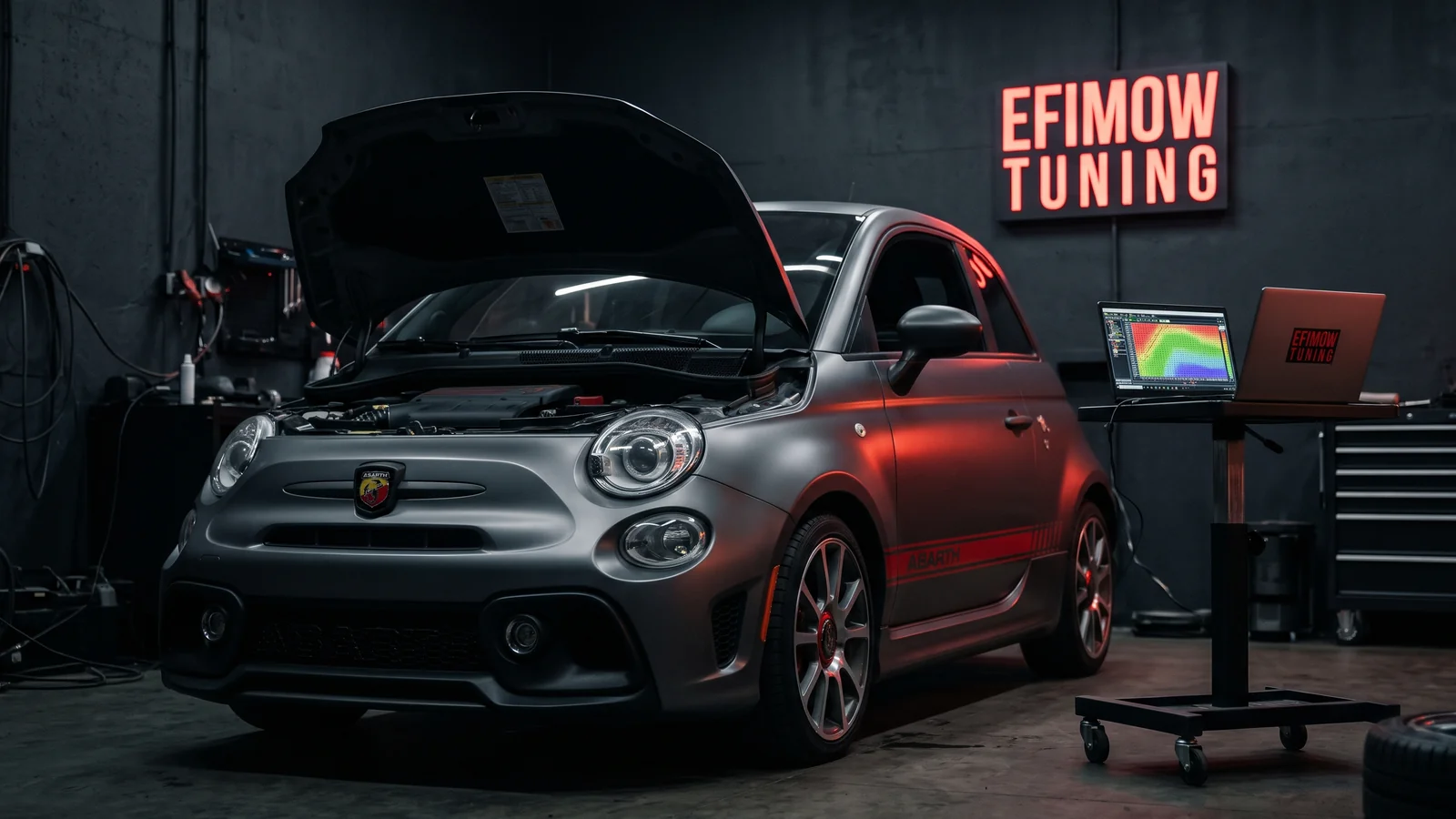
Abarth 500/595: Tuning the Little Scorpion
1.4 T-Jet with Bosch ME7.9.10 or MultiAir with Marelli: what software does for the Abarth, what stays motorsport-only and how we handle the 595 and 695.
October 25, 2026 by Leo Efimow
An Abarth is not a sensible car, and that is exactly why people buy one. Short wheelbase, throaty sound, a small turbo engine that loves to rev: the 500 with the scorpion on the bonnet is a toy. No wonder many owners ask about software. The good news: the 1.4 T-Jet has reserves. The important news: part of what you see in Abarth forums and videos belongs on the race track, not on the road.
Which Abarth models we list
Our catalog lists the Abarth models with the 1.4 turbo engine from 2007 to 2015:
| Model | Engine | Output (catalog) | ECU |
|---|---|---|---|
| Abarth 500 / 500C | 1.4 16V T-Jet | 135–140 hp | Bosch ME7.9.10 |
| Abarth 500 esseesse | 1.4 16V T-Jet | 160 hp | Bosch ME7.9.10 |
| Abarth 500tf | 1.4 16V T-Jet | 180 hp | Bosch ME7.9.10 |
| Abarth Grande Punto / esseesse | 1.4 16V T-Jet | 155 / 180 hp | Bosch ME7.9.10 |
| Abarth Punto Evo / esseesse | 1.4 MultiAir Turbo | 163 / 179 hp | Magneti Marelli 8GMF |
We do not currently list the newer Abarth 595 and 695 as separate variants. They are also based on the 1.4 T-Jet, but ECU and software versions differ by model year. For these cars, the best route is an enquiry through the configurator, so that we can check the ECU and readability in advance.
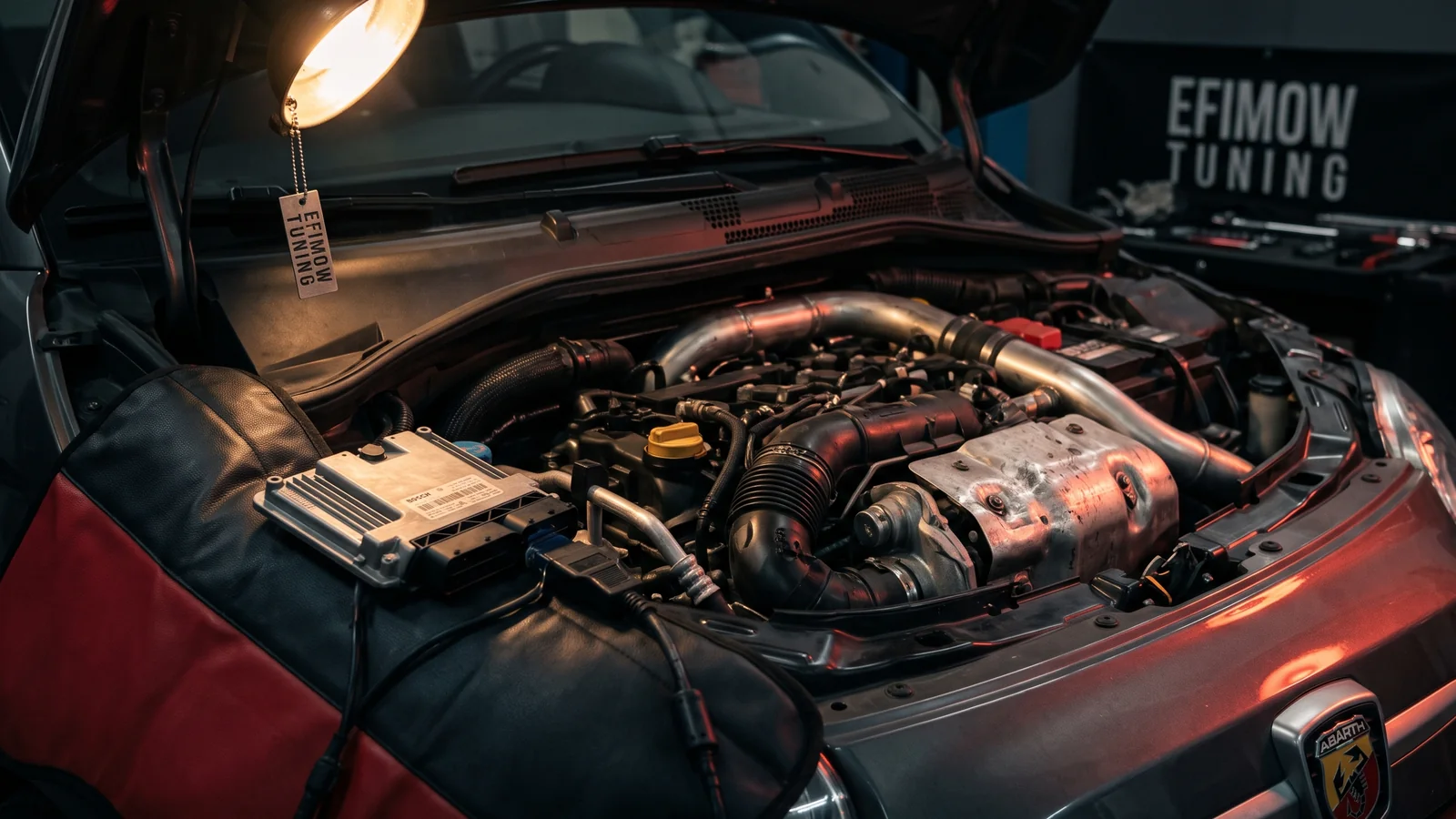
The 1.4 T-Jet with Bosch ME7.9.10
The T-Jet is a small turbocharged four-cylinder with port injection, a proven design that Bosch ME7-series ECUs handle well. For the turbo versions of this family, our data gives a typical 20–35% more power and torque as a Stage 1 guide value. That is one of the larger margins our data lists for petrol engines and explains why the T-Jet is so popular with tuners: the power levels from 135 to 180 hp differ to a large extent in software.
What the software adjusts: boost targets, ignition timing, torque limiter, full-load lambda and the throttle pedal curve. Boost build-up matters especially on the Abarth: a small turbo driven too aggressively delivers a peaky torque maximum and overwhelms the front axle in second gear.
The 1.4 MultiAir Turbo with Marelli 8GMF
In the Punto Evo, the 1.4 MultiAir works with electro-hydraulic intake valve control and a Magneti Marelli ECU. For the MultiAir turbos, our data gives a typical 10–25% more power and 15–25% more torque. The headroom is somewhat smaller than on the T-Jet, but the power delivery is very linear thanks to the variable valve control.
Stage 2 and hardware
For the turbo versions of both families, Stage 2 with hardware is possible, typically intercooler, intake and an exhaust from the turbo with catalyst and certification. On the Abarth, the clutch belongs on the list: it is designed for stock torque and becomes the weak point with significantly more.
Options and which of them are motorsport
For the Bosch ME7 family and the Marelli family, the following are documented alongside Stage 1:
- Sharp Throttle for a more direct throttle pedal
- Vmax removal and rev limiter increase
- DTC Off only for non-emissions-related fault codes
- Launch Control and No-Lift Shift: on the ME7 only with custom code, so on request
And then the classics of the Abarth scene: pops & bangs, hardcut limiter, popcorn limiter and anti-lag. Some of them can be implemented on these ECUs, but they are intended exclusively for motorsport on closed tracks. They are not permitted on public roads because of noise and emissions behaviour and because they put extra load on the catalyst and turbocharger. An Abarth already sounds gruff from the factory; more bang on public roads is not an option.
Before tuning
A few points are typical on the T-Jet:
- Check spark plugs and ignition coils: a turbo petrol with weak ignition loses the extra power through knock control.
- Check the charge-air path for leaks, especially the hose connections at the intercooler.
- Check the clutch: if it already slips in third or fourth gear at full load on the stock engine, software will not make it better.
- Fuel: high-octane fuel is the basis for a safe calibration.
Process and prices
We work on Abarth directly at the ECU, on site in Stödtlen at an appointment of your choice or by sending in the removed ECU. The price is the same in both cases, and booking is online.
Under our pricing rules, the Abarth 500 1.4 T-Jet with 135 hp and the Abarth 500 esseesse with 160 hp with Bosch ME7.9.10 start from €170 for Stage 1. The Abarth Punto Evo 1.4 MultiAir with 163 hp starts at €250. For the 595 and 695, use the enquiry in the configurator.
On the legal side: the software change voids the type approval. The software is intended for motorsport use only; see the motorsport notice.
Common questions from the workshop
What about the Sport button? On the Abarth, the Sport button changes the throttle pedal curve and torque release. Good software takes both states into account: in normal mode the Abarth stays suitable for everyday use; with Sport pressed, the full calibration is available. That way the little scorpion keeps its character instead of always running flat out.
I already have a sports exhaust. Do I need Stage 2? Not necessarily. An exhaust from the turbo back with catalyst and certification changes the exhaust back-pressure; whether it is worthwhile depends on the scope. A rear silencer alone usually changes little for the software. Tell us beforehand which parts are fitted so the calibration matches.
How important is the turbocharger's condition? Very important. The T-Jet's small turbo works at high speeds from the factory. Whistling noises, blue smoke or oil traces in the charge-air system are warning signs. A worn turbo will not get better with more boost. The mechanics need sorting first. We back up the original state of the ECU before writing.
Conclusion
The Abarth with the 1.4 T-Jet is one of the most rewarding small turbo petrols: a typical 20–35% as a Stage 1 guide value, because the factory power levels are separated mainly by software. The MultiAir in the Punto Evo delivers somewhat less at 10–25%, but very evenly. Clutch, ignition and fuel decide whether the extra power actually arrives. And the sound functions stay on the race track. More in the glossary under pop and bang and MultiAir.