
Tuning Euro 6 Diesels: What to Consider with SCR and AdBlue
Euro 6 diesels with SCR, AdBlue and particulate filter: what a proper calibration must respect, what is prohibited and which reserves are realistic.
October 25, 2026 by Leo Efimow
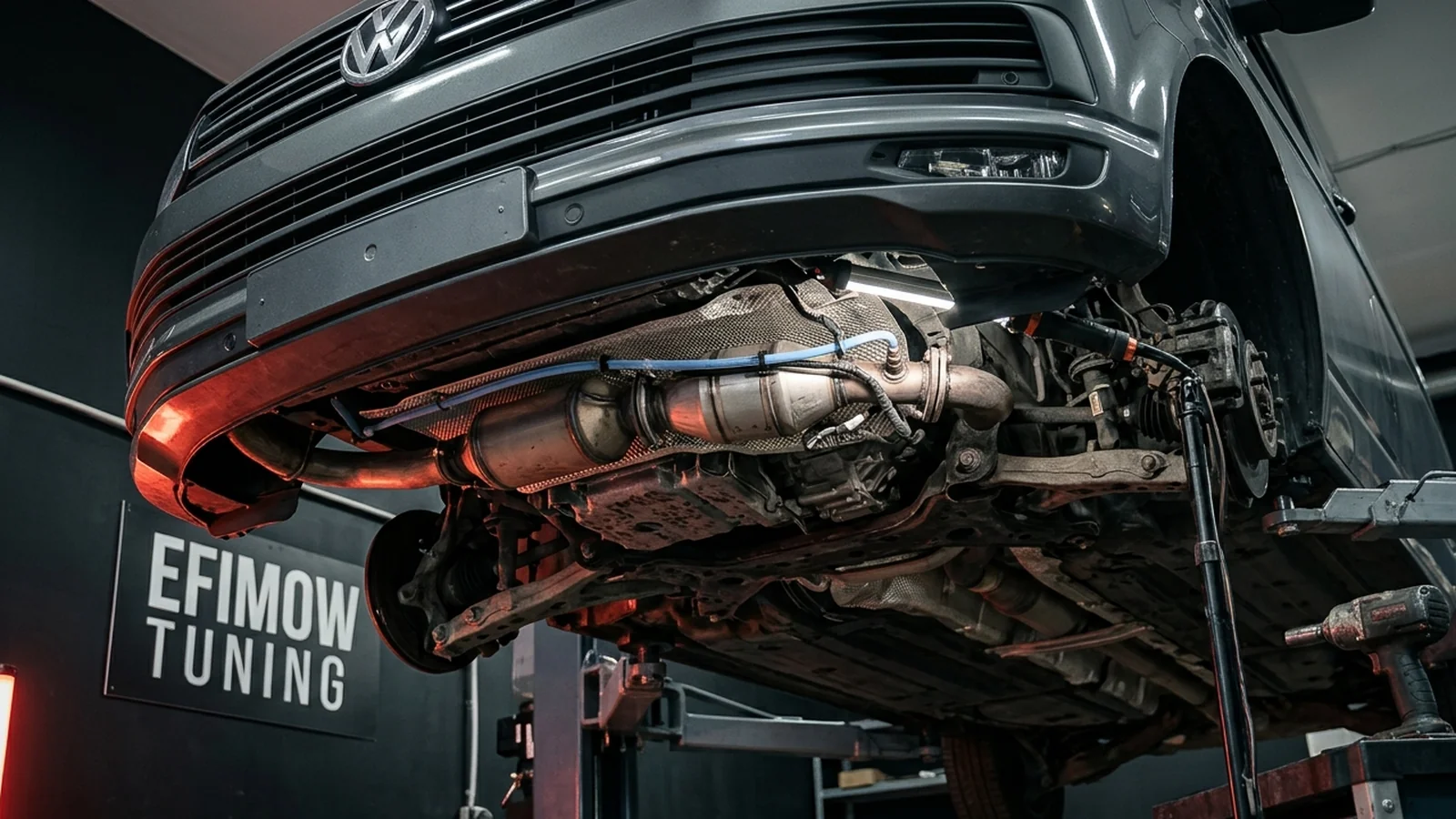
A Euro 6 diesel is a very different animal from a 2008 diesel. Under the car sits an emission control system tightly interlinked with the engine ECU: exhaust gas recirculation, particulate filter, SCR catalyst with AdBlue and NOx sensors that constantly monitor the result. Calibrating such an engine means not only changing boost and fuel quantity but working inside a system that only functions as a whole. Here you learn what to consider, what is clearly prohibited and how much power remains realistic.
What Euro 6 means for the diesel
With Euro 6, the NOx limit for diesel cars dropped from 180 to 80 mg/km. The standard has applied to new types since September 2014 and to all new registrations since September 2015. Later came Euro 6c with the WLTP cycle, and Euro 6d-TEMP and Euro 6d with real driving emissions (RDE) testing.
Most diesels only reach this limit with a combination of several systems:
| System | Task |
|---|---|
| EGR (exhaust gas recirculation) | lowers combustion temperature and thus NOx formation |
| DPF (particulate filter) | traps soot, burnt clean regularly |
| SCR with AdBlue | converts NOx into nitrogen and water using urea solution |
| NOx storage catalyst (some engines) | stores NOx and reduces it during regeneration phases |
| NOx and lambda sensors | measure whether the cleaning works |
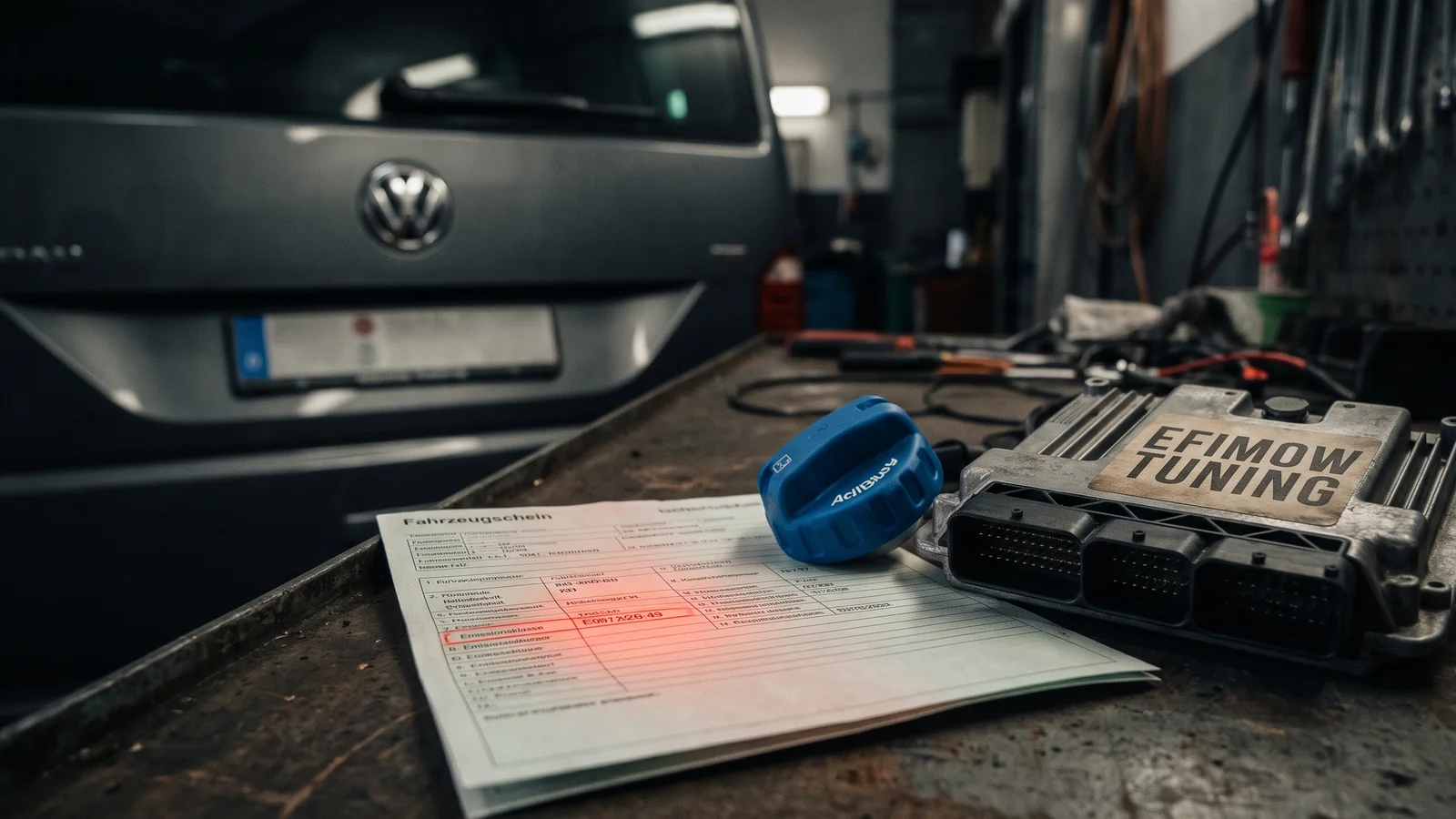
Not every Euro 6 diesel has SCR. Some smaller engines, for example many 1.5 dCi Euro 6, use a NOx storage catalyst without AdBlue. Larger engines and vans almost always have SCR, with Euro 6d often even two SCR stages.
How tuning and emission control interact
More diesel power mainly means more fuel per cycle and more boost. That changes raw emissions. More fuel tends to mean more soot; higher combustion temperatures tend to mean more NOx.
A proper calibration takes this into account in several places:
- Smoke limitation: fuel quantity is tied to the air mass actually available, so the engine does not smoke and the DPF does not fill up unnecessarily fast.
- SCR dosing: the system measures NOx and doses AdBlue accordingly. With more power and lots of full load, AdBlue consumption can rise slightly. That is normal and shows the cleaning is working.
- Exhaust temperature: SCR catalyst and DPF have temperature windows in which they work best. The calibration must not exceed these ranges permanently.
- Torque model: modern ECUs calculate internally with a torque model. Gearbox and aftertreatment depend on it. It must stay consistent.
In short: emission control stays fully active, and the calibration is designed to work with it.
What is clearly prohibited
Removing DPF, EGR, AdBlue/SCR or the catalytic converter, or switching them off by software, is emissions tampering. Under EU law such defeat devices are not permitted, and the type approval becomes void. On public roads this is prohibited. The same applies to suppressing fault codes that belong to emission control, for example for NOx sensors, SCR or the particulate filter. Calling it "motorsport" changes nothing if the vehicle is still driven on the road.
In practice, there is more: at the periodic technical inspection the diesel's smoke opacity is measured and the vehicle diagnostics read stored faults. Tampering shows.
Which reserves are realistic
Euro 6 diesels have less headroom than older generations because manufacturers need part of the reserves to meet the RDE limits. Typical Stage 1 guide values from our data:
| ECU family | Example | Typical Stage 1 guide value |
|---|---|---|
| Bosch EDC17 (VAG TDI) | 2.0 TDI EA288 | approx. 20–30 % power and torque |
| Bosch EDC17 (other makers) | four-cylinder diesel | approx. 20–30 %, V6/V8 and vans approx. 15–25 % |
| Bosch MD1 | Euro 6d diesel from approx. 2018 | approx. 15–25 % |
These are guide values, not promises. The actual result depends on the engine, its condition and the software version.
Access: often no longer via OBD
On many Euro 6 diesels the ECU is better protected than before. EDC17 units have had write protection since around 2010. From around 2017/2018, for example on the EA288 in Euro 6d, bench or boot mode access is often required. Bosch MD1 is almost always Euro 6d with SCR and usually can only be worked on after an unlock. That means more effort and is reflected in the price.
A worked example
Take the VW Transporter T6 2.0 TDI (EA288) with Bosch EDC17C74. It falls into the newest price tier (€400), plus the surcharge for vehicles from model year 2015 (€50). Stage 1 therefore costs from €450. Details are on the T6 2.0 TDI product page and on the page for the Bosch EDC17C74. For other models the configurator calculates the price by the same rules.
Process
For BMW you order online, flash it yourself via OBD and pay for the software only once it is finished; today you pay only for the hardware and a €5 deposit. The file is usually ready within 48 hours. For all other brands you come to Stödtlen on a date you choose or send in the ECU, at the same price and bookable online.
Maintenance after tuning
A calibrated Euro 6 diesel needs the same care as a stock one, with a few points to watch more closely:
- Avoid short trips: the DPF needs drives on which it can regenerate.
- Top up AdBlue in time: with an empty tank, the engine may not restart after a warning phase.
- Oil changes as specified: frequent DPF regenerations can let fuel into the oil.
- Take warnings seriously: an emission control warning is not a tuning artefact but a sign of a problem.
Legal framework
Any software change voids the type approval unless it is inspected and registered. Our software functions are intended exclusively for motorsport. The exact wording is in the motorsport notice.
Conclusion
A Euro 6 diesel can be calibrated, but only in harmony with its emission control. EGR, DPF, SCR and sensors stay active; the calibration respects smoke limitation, AdBlue dosing and exhaust temperatures. The reserves are smaller than on older diesels and access to the ECU takes more effort. The glossary explains the terms under Euro 6 and AdBlue.