
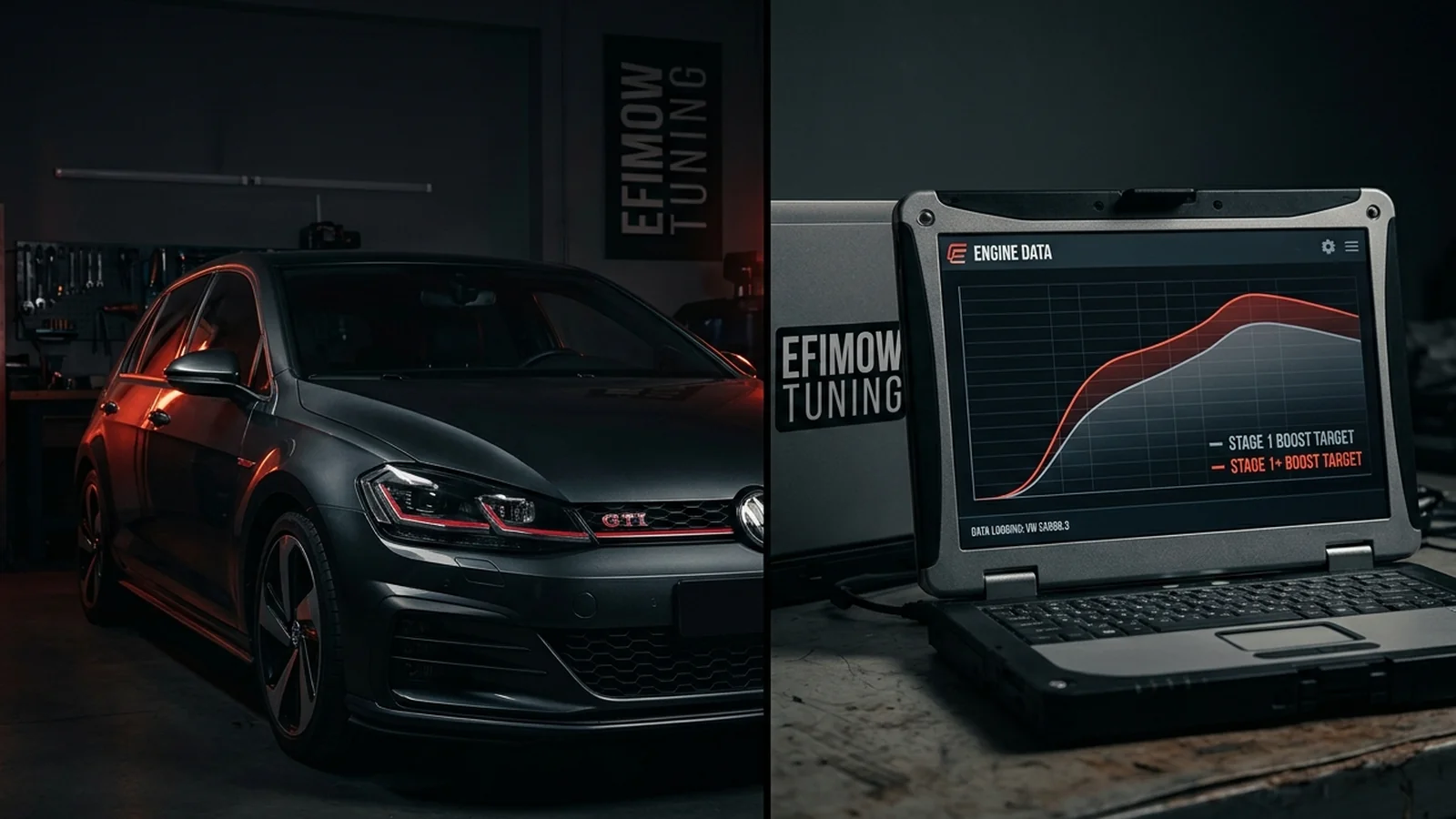
Stage 1+ and Stage 2+: What the Plus Stands For
Stage 1+ and Stage 2+ explained: what the fine-tuning changes compared to Stage 1 and Stage 2, which ECUs support it and what it costs.
October 25, 2026 by Leo Efimow
Stage 1, Stage 2, Stage 3: the stages are fairly well established in the tuning world. At the latest in the configurator, however, an intermediate step appears: Stage 1+ and Stage 2+. Some consider the plus to be marketing, others a "hidden Stage 2". Neither is right. The plus stands for fine-tuning that builds on the respective base stage and uses the platform's reserves more precisely. In this article we explain what happens in the ECU, which ECUs it applies to and how the price is made up.
The basics: Stage 1 and Stage 2
Stage 1 is the software optimisation for the stock vehicle. Boost, cylinder filling, injection quantity, ignition timing or rail pressure and the torque limiters are adjusted within the factory reserves; the protective functions remain active. No hardware is changed.
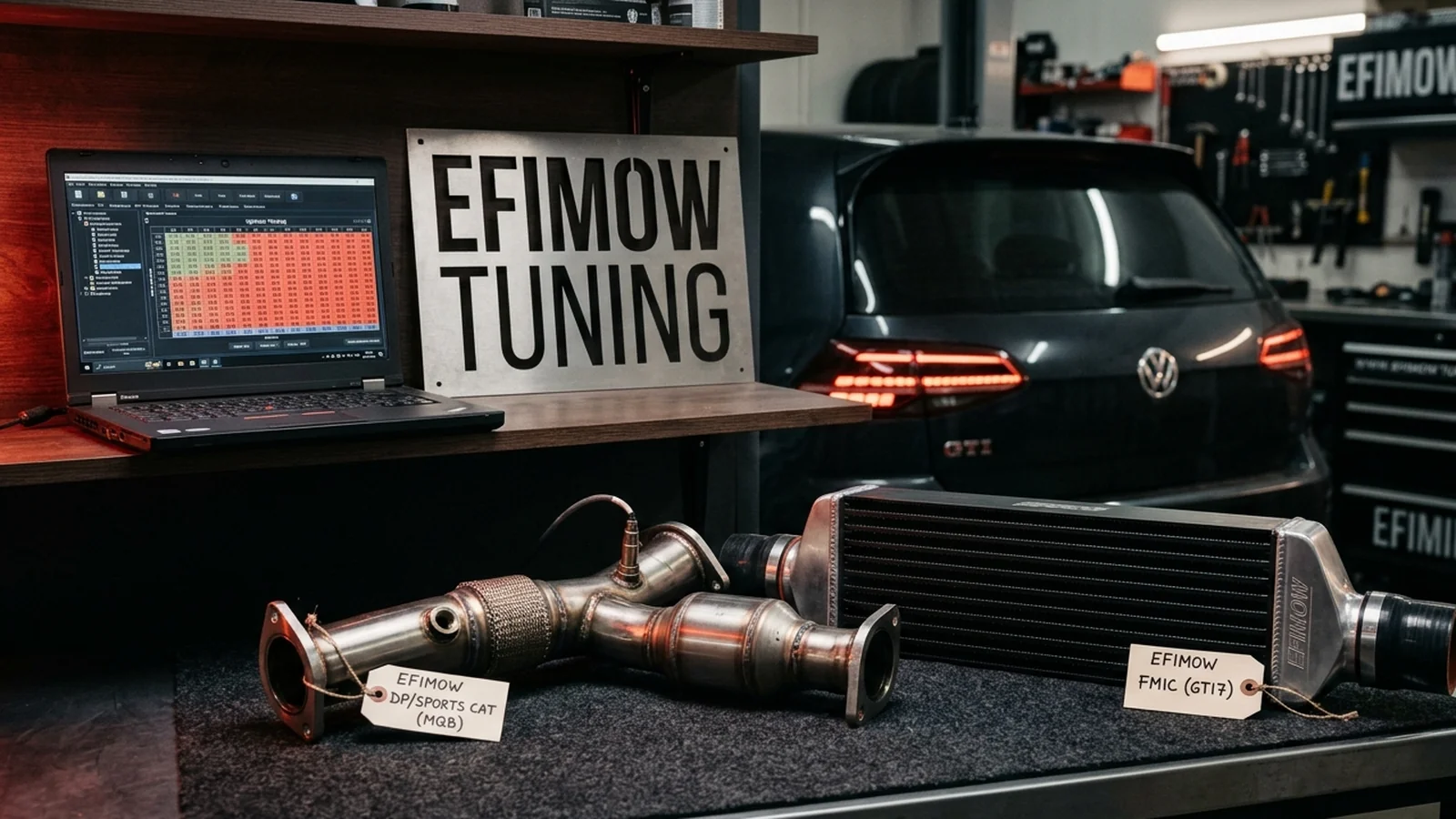
Stage 2 requires modified hardware, typically a downpipe with catalytic converter, a larger intercooler or a modified intake. The software is calibrated to the lower exhaust back-pressure and lower charge-air temperatures. With us, Stage 2 is intended exclusively for motorsport.
Both stages are a solid basis. But they are deliberately calibrated so that they work reliably on a broad range of vehicles with the same engine, regardless of whether the car does lots of short trips or regularly runs on the motorway.
What the plus changes
Stage 1+ refines the Stage 1 calibration. The focus:
- Response: boost builds earlier and more decisively, the car reacts more directly to the throttle.
- Torque delivery: the torque curve is shaped more evenly across the rev range instead of only raising the peak.
- Boost curve: where the platform allows, it is laid out somewhat more aggressively.
The limits remain the same as with Stage 1: fuel pressure, knock control, intake air temperature and exhaust gas temperature are still kept within the manufacturer's margins. Stage 1+ is therefore not a crowbar but a more precise use of the room that Stage 1 leaves open for safety reasons.
Stage 2+ builds on Stage 2 in the same way. Ignition timing, torque build-up and power band are tuned more finely to the installed hardware so that the lower back-pressure and better airflow are used more consistently. Control of exhaust gas temperature, oil temperature and turbocharger speed remains part of the calibration.
What the plus is not
A few distinctions matter. Stage 1+ does not replace hardware: if you want more than a stock turbo and stock intercooler can handle permanently, you end up at Stage 2. The plus is also not a fixed power add-on. How much it brings depends on the platform. Some engines have a lot of headroom from the factory, others are already close to what the hardware sensibly delivers with Stage 1. That is why we deliberately do not quote horsepower figures. As a guide for the base stage: on the Simos turbo ECUs of the EA888 engines, the typical Stage 1 gain in our evaluation is about 25–40 % power, on the VAG 2.0 TDI with Bosch EDC17 about 20–30 %. These are guide values, not promises.
Which ECUs support the plus
According to our data, Stage 1+ can be implemented on practically all ECU families, from Bosch EDC17 to Simos and MG1 and the older Motronic generations. For Stage 2+ the picture is more mixed: on most modern diesel families and some petrol ones (such as Simos turbo, Bosch MG1 or the premium manufacturers' MED17) it is considered feasible, on many other petrol families only partly. "Partly" means it depends on the software version and the installed hardware, which is why the option appears as "on request" in the configurator there and we check it based on your file.
What it costs: two examples
For vehicles outside the BMW online flow, Stage 1+ costs €25 on top of the Stage 1 price and can only be booked together with Stage 1; Stage 2+ costs €50 on top of the Stage 2 price and only together with Stage 2. The base price depends on ECU generation, power, model year and access.
| Vehicle | ECU | Stage 1 | with Stage 1+ | Stage 2 | with Stage 2+ |
|---|---|---|---|---|---|
| VW Golf 7 GTI 2.0 TSI, 220 PS | Siemens Simos 18 | from €450 | from €475 | from €550 | from €600 |
| VW Golf 6 2.0 TDI, 140 PS | Bosch EDC17CP14 | from €300 | from €325 | from €375 | from €425 |
For the Golf 7 GTI, the Stage 1 price consists of the newest ECU generation (€400) plus €50 for bench/boot access, because the Simos 18 has to be opened for this. The Golf 6 TDI sits in the EDC17 diesel tier without surcharges. For BMW, the configurator shows the prices for your ECU.
How the fine-tuning is created
A plus is not an off-the-shelf file. The basis is always the original software read from your ECU. From it, the base-stage calibration is created first, and the plus then builds on top. Several factors play a role:
- Transmission: a dual-clutch or automatic transmission has its own torque limits. If the plus brings more torque low down, this has to fit the transmission's design.
- Fuel: on petrol engines, the octane rating used determines how much ignition advance knock control allows. A calibration designed for higher-grade fuel then requires that fuel.
- Usage profile: if you drive under load a lot, for example with a trailer, you need different priorities than someone who mainly values response in city traffic.
With Stage 2+, the installed hardware is added to that: which downpipe, which intercooler, which intake? Only when that is known can the calibration be targeted at it.
Legal
Any power increase (whether Stage 1, Stage 1+ or higher) changes the engine software. Without an expert assessment and registration, the operating permit expires. Our software functions are intended exclusively for motorsport; the details are in the motorsport notice. For Stage 2 and Stage 2+, additionally: exhaust parts may only be fitted with a catalytic converter and the corresponding type approval or expert report.
When the plus is worth it
The plus is worth it mainly if, with Stage 1, you care less about peak power than about how the car feels: earlier response, more even pull, less of a "hole" low in the rev range. If you overtake a lot, tow a trailer or drive on twisty roads, you notice that in everyday driving more clearly than a few extra horsepower at the top end. With Stage 2+, the plus makes sense if the hardware is already fitted and the calibration should really make use of those parts.
Conclusion
Stage 1+ and Stage 2+ are not separate tuning stages but fine-tuning of the respective base stage: better response and a cleaner torque curve within the same safety limits. How much that brings on your engine depends on the platform. Whether the plus can be booked for your ECU and what it costs is shown in the configurator when you choose the stage.