
Motorcycle Throttle Response: What Mapping Changes at Constant Throttle and Load Change
Surging at constant throttle, a jolt when you open up, sluggish response: what sits in the software, what mapping can change and what stays mechanical.
October 26, 2026 by Leo Efimow
You rarely ride at peak power. Most of the time you move the throttle within the first quarter: hold, open a little, close a little. That is exactly where it is decided whether a bike feels good. If it surges at constant throttle, slams a jolt into the chain when you open up or responds sluggishly, that annoys more than a few missing horsepower. Many of these quirks sit in the software. Here you read what happens in the control unit at small throttle openings, what a remap can change and which causes are purely mechanical.
What "throttle response" actually means
When riders talk about throttle response, they usually mean three different things:
- Response: how quickly and directly does the engine react when you turn the grip?
- Constant throttle: does the engine run smoothly at a steady opening, or does it push and brake alternately?
- Load change: how soft is the transition from overrun to pulling and back?
All three depend on the same part of the map: the area with little throttle and low to medium revs. That is where the limits for emissions and noise are strictest, and therefore where most factory compromises sit.
What happens in the control unit
On many motorcycles the control unit determines injection quantity and ignition angle via maps over engine speed and throttle position. On the Keihin enduros the grip still pulls the throttle valve the classic way via a cable; the control unit only measures the position. On motorcycles with ride-by-wire, by contrast, a motor sets the throttle and the software has a say in how far it opens.

Besides the base maps there are corrections for the transitions:
- Overrun fuel cut: when you roll with the throttle closed, injection is switched off. That saves fuel and lowers emissions.
- Re-entry: when you open the throttle, injection resumes. How abruptly that happens is a calibration question.
- Acceleration enrichment: when the throttle opens quickly, a lot of air suddenly rushes in. Part of the fuel condenses on the wall of the intake port. Without a short extra quantity the engine would go lean at that moment and "stumble".
Constant throttle: where the surging comes from
At constant small throttle openings the mixture is often kept very lean from the factory. That is good for emissions but bad for smoothness. Combustion becomes uneven, individual power strokes turn out weaker. On a single you feel that immediately as surging, because nothing evens it out.
A remap can smooth this area. A slightly richer mixture and suitable ignition timing at small openings make combustion more even. The result is an engine that runs more calmly at constant throttle and can be metered more finely. More on the particularities of big singles in the article on tuning big singles.
Load change: the jolt when you open up
The load change has two sides, an electronic one and a mechanical one.
Electronic: if injection resumes abruptly at full quantity after the overrun cut, torque jumps from "braking" to "pulling". You feel that as a jolt. A softer calibration of re-entry and enrichment takes out this step without making the response lazy.
Mechanical: any play in the drivetrain amplifies the jolt. Too much chain slack, worn sprockets, play in the throttle cable. No software can help here. If the load change stays harsh despite a good calibration, check chain and sprockets.
Response: direct but controllable
Many riders want a "sharper" response. Off-road, though, the fastest bike is not the most aggressive one but the most controllable one. A rear tyre that has to find grip on wet roots and rocks needs an engine that delivers exactly as much torque as your hand asks for, no more.
Good calibration therefore means: more direct, without steps. The power upgrade for the Keihin enduros aims for exactly that, more punch and a more direct response without making the throttle snatchy.
Multi-map: one character for every trail
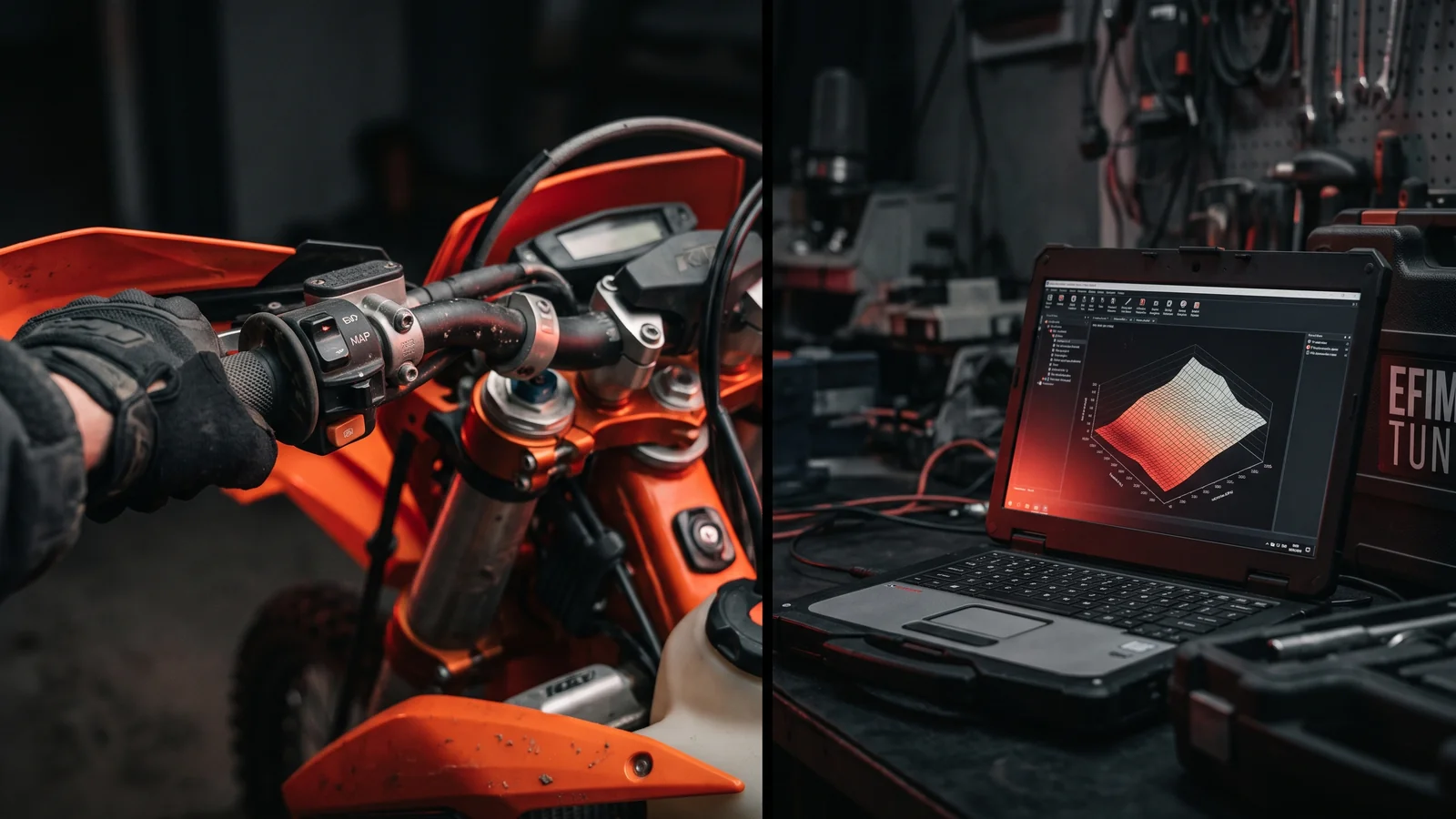
Because there is no single perfect throttle response, multi-map makes sense off-road in particular. With four freely assignable maps you can, for example, keep the stock calibration for difficult, wet terrain and put the power upgrade on a second map. You switch with the map switch on the handlebar. Prices:
- one option, always active: €150
- several options, always active: €200
- multi-map with four maps: €230, map switch Stealth +€40 or Clean +€80
You can put this together in the motorcycle configurator.
What pops & bangs have to do with throttle response
Pops & bangs act on exactly the area discussed here: overrun with the throttle slightly open. Fuel is deliberately sent into the exhaust so that it bangs. That also changes how it feels when you roll off. If you want a particularly fine throttle response off-road, put pops & bangs on a map of their own. More in the article on pops & bangs on motorcycles. On cars the related topic is called Sharp Throttle; there it is about the pedal curve of an electronic accelerator.
How you recognise a good calibration
After a successful calibration you mainly notice the throttle response because it no longer stands out. Typical feedback from practice:
- In tight sections the bike can be moved at walking pace with one finger on the throttle without stuttering or jumping.
- When rolling off and back on in corners, the drive comes in softly and predictably, and the rear wheel stays calm.
- At constant throttle on link sections the engine runs smoothly, without pushing and braking alternately.
- When pulling through you feel more punch without the throttle having become nervous.
If one of these does not fit, that is a hint, either towards the mechanics or that a different map would suit your riding better.
Check before calibrating
Before you have the throttle response improved by software, rule out the simple causes:
- Throttle cable play set correctly, grip turns easily and springs back cleanly
- Air filter clean and properly oiled
- Intake boot without cracks, no false air
- Chain correctly tensioned, sprockets not worn
- Idle set cleanly
Legal framework
Modifying the engine software voids the type approval. All functions are intended exclusively for motorsport and are not permitted on public roads; details in the motorsport notice.
Conclusion
Throttle response is decided at small openings, exactly where the factory calibration makes the most compromises. A remap can smooth constant-throttle surging, soften the re-entry after overrun and make the response more direct. Play in chain, sprockets and throttle cable, however, remains mechanical. Check the basics first, then the software makes the difference you feel at the grip.