
Big Singles: What Software Tuning Can Do for a 690 & Co.
Big singles like the KTM 690 or Husqvarna 701 have their own factory weak spots. What mapping can change, where the limits are and what to check first.
October 26, 2026 by Leo Efimow
A big single is a special engine. One piston with almost 700 cc, every power stroke a noticeable punch, plenty of torque from low down and a sound no multi-cylinder can match. The KTM 690 with the LC4 engine and the Husqvarna 701 are the best-known examples. But exactly these engines have factory quirks many riders complain about: surging at constant throttle, a harsh response when you open the throttle again, a somewhat strangled character. A good part of that sits in the software. Here you read why, what a remap can fundamentally change and where physics sets the limits.
Why big singles are hard to calibrate
A single with a large displacement has a large combustion chamber and a big bore. The flame has to travel a long way from the spark to the edge of the chamber. That makes the engine sensitive to ignition timing and to knock, especially at high load and low revs.
Then there is smoothness. A multi-cylinder spreads its power strokes so that irregularities even out. A single has exactly one combustion event every two crankshaft revolutions. Every variation from one combustion to the next is felt directly in the drivetrain, especially at small throttle openings and low revs.
And finally heat. A single large cylinder converts all the power in one place. The exhaust valves, header and piston are loaded accordingly.
The factory compromises
A production motorcycle has to meet emission and noise regulations worldwide. On a big single this has typical consequences:
- Lean mixture at part load. At small throttle openings the mixture is often kept very lean for low emissions. That is exactly where the well-known constant-throttle surging comes from: combustion becomes uneven, the bike pushes and brakes alternately.
- Harsh load changes. After the overrun fuel cut, injection resumes when you open the throttle. If that transition is calibrated abruptly, it sends a jolt through the drivetrain.
- Cautious ignition timing. So that the engine runs knock-free even with varying fuel quality, it is calibrated with a margin to the knock limit.
- Noise limits. Intake and exhaust noise limit how much charge the engine gets in certain rev ranges.
That is not sloppiness on the manufacturer's part. It is the price for a bike that can be registered anywhere in the world.
What a remap can fundamentally change
The software uses maps to control how much fuel is injected and when the spark fires, depending on engine speed and throttle position. On top of that come the transitions: overrun fuel cut, re-entry, acceleration enrichment. This is where a calibration works:
- Smoothing part load. A slightly richer mixture in the range where you cruise calms the combustion. The surging decreases.
- Softening transitions. A gentler re-entry after the overrun takes the jolt out of the load change.
- Sharpening full load. Ignition and mixture under load are calibrated so the engine pulls cleaner and harder, within what fuel and mechanics allow.
What this looks like in detail depends on the control unit and the condition of the bike. More on the role of ignition timing in the article on ignition timing, knock and fuel quality on a single.
Where the limits are
Software does not turn a single into a four-cylinder. There are a few things it cannot do:
- The power pulse stays. A single runs rougher than a multi, even with a perfect calibration.
- Mechanical restrictions stay. If airbox, throttle body or exhaust restrict, software changes nothing. It can only use the charge that arrives.
- There are no miracle horsepower. On a naturally aspirated engine without a turbo the margin is limited. The bigger gain is usually in how it rides, not on the spec sheet. We deliberately do not quote figures because condition and add-on parts vary too much.
- The knock limit stays the knock limit. More advance only works if the fuel supports it.
Check first: mechanics before software
Especially on a big single it pays to take an honest look at the basics before anyone touches maps:
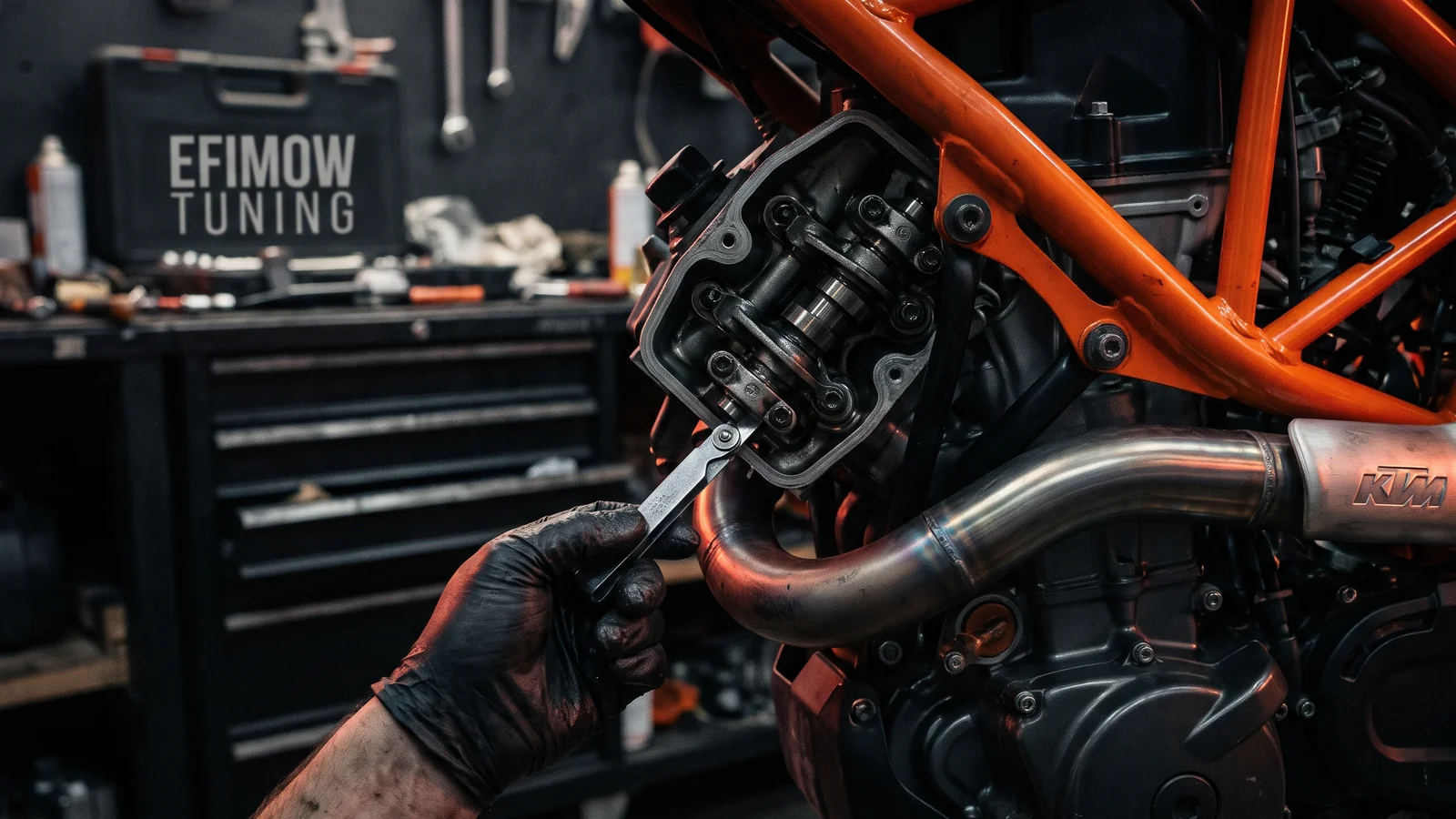
- Valve clearance: incorrect clearance makes idle and part load rough and skews any calibration.
- Intake sealed? A crack in the intake boot or a leaking airbox draws in false air, and the mixture goes lean.
- Clean air filter: a dirty filter shifts the mixture just as much as a wrong injection quantity.
- Exhaust: an aftermarket silencer or a removed baffle changes charge and mixture. That has to be known for the calibration.
- Spark plug and plug cap: in a large combustion chamber a weak spark shows up quickly.
Many complaints about constant-throttle surging already get smaller once these points are in order. What remains is then genuinely a calibration matter.
Heat and load
More power means more heat. On a big single it concentrates on exhaust valves, header and piston crown. A calibration that goes too lean at full load is therefore dangerous. Sound functions such as pops & bangs or a hard cut at the limiter put extra load on exhaust and valves because fuel burns in the hot exhaust tract. If you want that, you should know it and keep an eye on the exhaust.
Frequent questions from practice
Is an aftermarket exhaust enough without a calibration? It often makes the engine louder, but not necessarily better. A freer-flowing exhaust changes the charge, and the mixture can become leaner in some ranges. The part-load surging rarely disappears that way.
Will a calibration shorten the engine's life? A clean calibration that does not push mixture and ignition to the edge under load does not stress the engine much more than stock. It becomes critical with a mixture that is too lean at full load and with a lot of sound functions.
Will I notice the change in everyday riding? On a big single usually more than in horsepower. Smoother running at constant throttle and a softer load change stand out on every ride.
And the KTM 690 / Husqvarna 701?
The 690 and the 701 have their own, larger Keihin control unit, not the compact unit of the EXC enduros. Currently only models with the Keihin control unit 812.41.031 can be configured online. If you have a 690 or 701, you can send an enquiry in the motorcycle configurator via "My bike is not listed". We do not promise in advance what is possible on a unit we have not had in front of us. More on the 690 SMC is in the article on supermoto tuning.
Legal framework
Any change to the engine software voids the type approval. Big singles in particular are usually road bikes. After a software change they are sports equipment for the closed track. All functions are intended exclusively for motorsport; details in the motorsport notice.
Conclusion
Big singles leave the factory with many compromises: lean part-load mixture, harsh load changes, cautious ignition. A good remap can improve a lot of that, above all in how the bike feels. But it does not replace healthy mechanics or suitable fuel. Check valve clearance, intake and filter first, then the calibration is worth it.