
Ignition Timing on a Single: Power, Knock and Fuel Quality
Why ignition timing matters so much on a single, how knock develops and why a Super Plus calibration means you must always fill up with 98 octane.
October 26, 2026 by Leo Efimow
When it comes to power from a naturally aspirated engine, you quickly end up at ignition timing. It is one of the most important adjustments in the control unit and at the same time one of the most delicate. On a single this is especially true. A large combustion chamber, a single piston, often no turbo and no intercooler to create margin: here the ignition point helps decide how hard the engine pulls and whether it lasts. And it is directly tied to what you put in the tank.
What ignition timing is
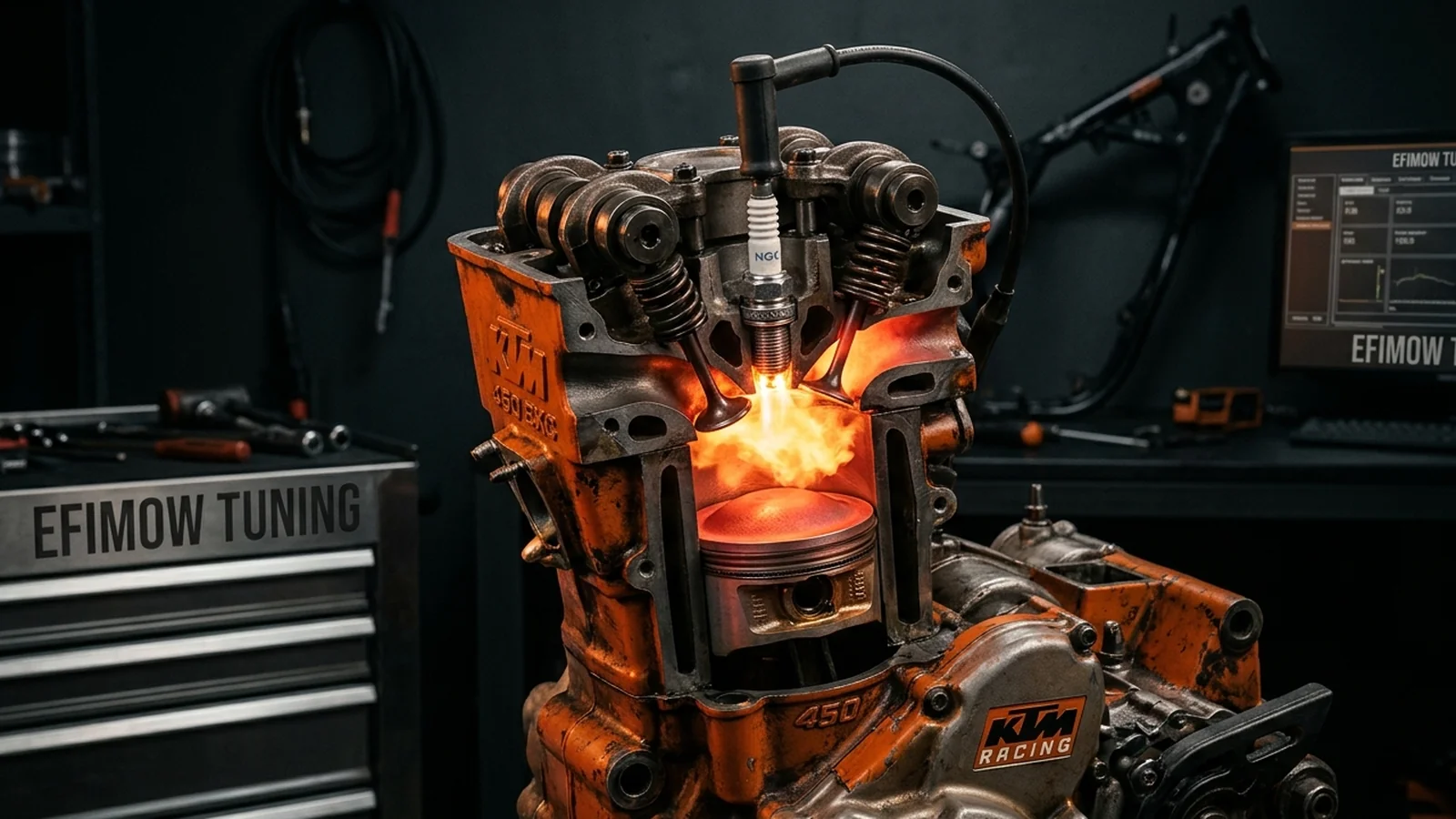
The ignition angle states when the spark fires, measured in degrees of crank angle before top dead centre. The spark always fires a little before the piston reaches the top, because combustion takes time. The flame spreads out from the spark plug, and only when a large part of the mixture has burned does cylinder pressure reach its peak.
Ideally that pressure peak lies shortly after top dead centre. Then combustion pushes the piston down with maximum effect. Calibrators often call this optimum MBT (minimum advance for best torque), the smallest advance at which torque is highest.
Too early, too late: what happens
- Fired too late: the pressure peak comes too late, part of the energy goes into the exhaust as heat instead of into the piston. The engine feels lazy, header and exhaust valves run hotter. Sound functions such as party mode at the limiter use exactly this principle on purpose.
- Fired too early: pressure already rises while the piston is still moving up. That costs power and raises pressure and temperature in the combustion chamber. At some point it tips over into knock.
The best ignition angle is therefore not "as early as possible" but as early as makes sense, and that is a different value depending on engine speed, load and temperature. That is why ignition timing is stored in the control unit as a map over engine speed and load.
What knock is
Knock is uncontrolled auto-ignition. While the flame spreads, the remaining unburnt mixture at the edge of the chamber is compressed and heated. If it gets too hot, it ignites by itself, suddenly and in several places. Pressure spikes hammer against piston, rings and bearings. You can hear it as a metallic pinging, but on a motorcycle it is often masked by engine noise.
Brief, light knock does not destroy an engine instantly. Sustained knock under load, however, can melt pistons, crack ring lands and damage bearings.
Why a single is especially sensitive
On a big single several things come together:
- Big bore, long flame path. The further the flame has to travel, the longer the end gas at the edge has to ignite by itself.
- High charge at low revs. If you open the throttle wide in a tall gear at low revs, the cylinder is well filled but combustion has a lot of time. That is the classic knock zone.
- High compression. Sporty four-strokes are highly compressed to get a lot of power from little displacement. That raises the tendency to knock.
- Heat. A hot engine after a long special stage knocks more readily than a cool one.
Not every motorcycle has knock control as sophisticated as a modern car. Where it is missing or works only coarsely, the calibration itself has to keep a safe margin to the knock limit. How knock control works on a petrol car is explained in the article Knock control: the guardian angel of every petrol tune.
Fuel quality: why octane matters
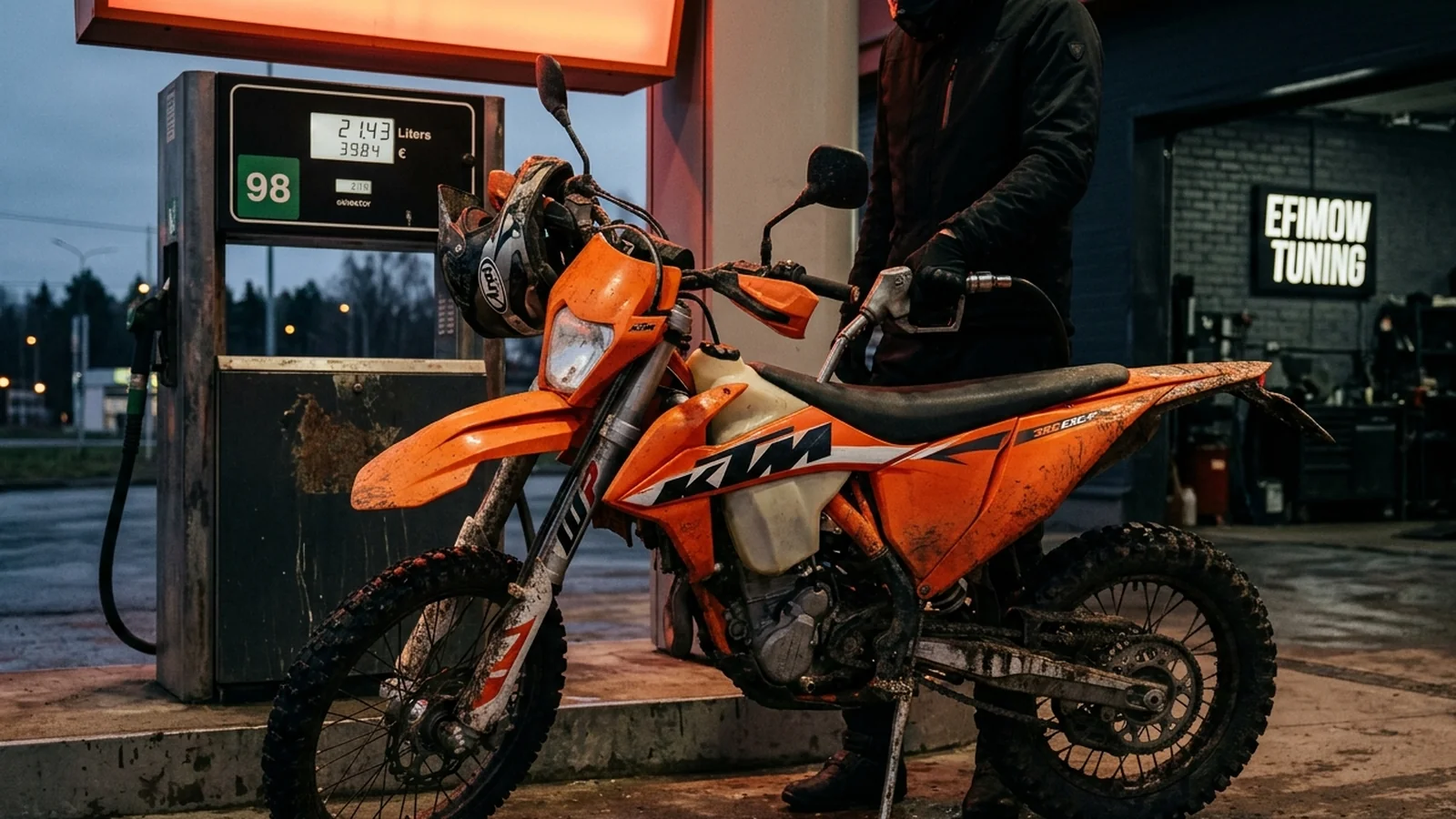
The octane number describes how knock-resistant a fuel is. Super has at least 95, Super Plus at least 98. Higher octane does not mean "more energy" but "tolerates more pressure and temperature before it self-ignites". An engine calibrated for 95 therefore usually gains little from 98. An engine calibrated for 98, however, can get into the knock range on 95.
That is exactly why, for the power upgrade on the Keihin enduros, you choose what the calibration is based on:
| Calibration | Ignition advance | What you must fill up with |
|---|---|---|
| Super 95 | somewhat more cautious | any Super with 95 octane |
| Super Plus | a little more advance | 98 octane, consistently |
The Super 95 variant is the safe choice when you are on the road and do not know which filling station comes next. The Super Plus variant gets a bit more out, but demands discipline. A tank of 95 in a bike with a 98 calibration is not a slip to ignore: ride gently until the next fill-up and avoid full load at low revs.
One way out: two maps for two fuels
If you want both, use multi-map. Then, for example, map 2 carries the power calibration for Super 95 and map 3 the one for Super Plus. On days with 98 safely in the tank you switch up, otherwise you stay on the safe map. How this works with the map switch is explained in the article on multi-map for motorcycles.
What else shifts the knock limit
Fuel is not the only factor. In practice these also play a role:
- Combustion chamber deposits: carbon raises compression and forms hot spots.
- Lean calibration under load: a mixture that is too lean burns hotter and knocks more easily. That is why an ignition change must always be considered together with the mixture.
- Wrong spark plug: a heat range that is too hot can encourage pre-ignition.
- High ambient temperatures and long full-load phases.
What you can do as a rider
- Fill up with the fuel the bike was calibrated for, and if in doubt the better one.
- Avoid full throttle in a tall gear from low revs; shift down a gear instead.
- Keep to service intervals for spark plug, air filter and valve clearance.
- If the engine pings or rattles unusually under load, back off and have it checked.
Legal framework
Modifying the engine software voids the type approval. All functions are intended exclusively for motorsport and are not permitted on public roads; details in the motorsport notice.
Conclusion
On a single, ignition timing is a lever with two sides: set correctly it brings punch and clean response, pushed too far it leads into knock. Above all, fuel shifts the limit. So decide consciously between Super 95 and Super Plus and stick to it. You make that choice in the motorcycle configurator; more on octane in the glossary under ROZ.