
Knock Control: The Guardian Angel of Every Petrol Tune
How knock control detects knock, retards ignition and learns fuel quality, why it is a safety net rather than a strategy in tuning and where it ends.
October 26, 2026 by Leo Efimow
A modern turbocharged petrol engine runs very close to its knock limit most of the time. That is not a design flaw but intent: that is where it is most efficient and strongest. It is only possible because a function in the control unit constantly listens and intervenes before damage occurs. Knock control is the reason a petrol engine runs reliably despite varying fuel, heat and manufacturing tolerances. And it is the reason a petrol tune that ignores it is not a good idea.
What knock is, in short
After the spark, the flame spreads through the combustion chamber. The unburnt end gas at the edge is compressed and heated further in the process. If it gets too hot, it ignites by itself, suddenly, before the flame reaches it. That creates pressure waves that hammer against piston, rings and cylinder walls. Briefly it is harmless; sustained under load it destroys pistons and bearings.
Knock becomes more likely with:
- earlier ignition timing, because pressure rises faster
- more boost, because more charge means more pressure and temperature
- hot intake air, for example in hot weather or after stop-and-go
- lower octane, because the fuel is less knock-resistant
- lean mixture under load, because it burns hotter
How ignition timing and knock are fundamentally linked is also covered in the article Ignition timing on a single. The physics is the same in a car.
How knock control works
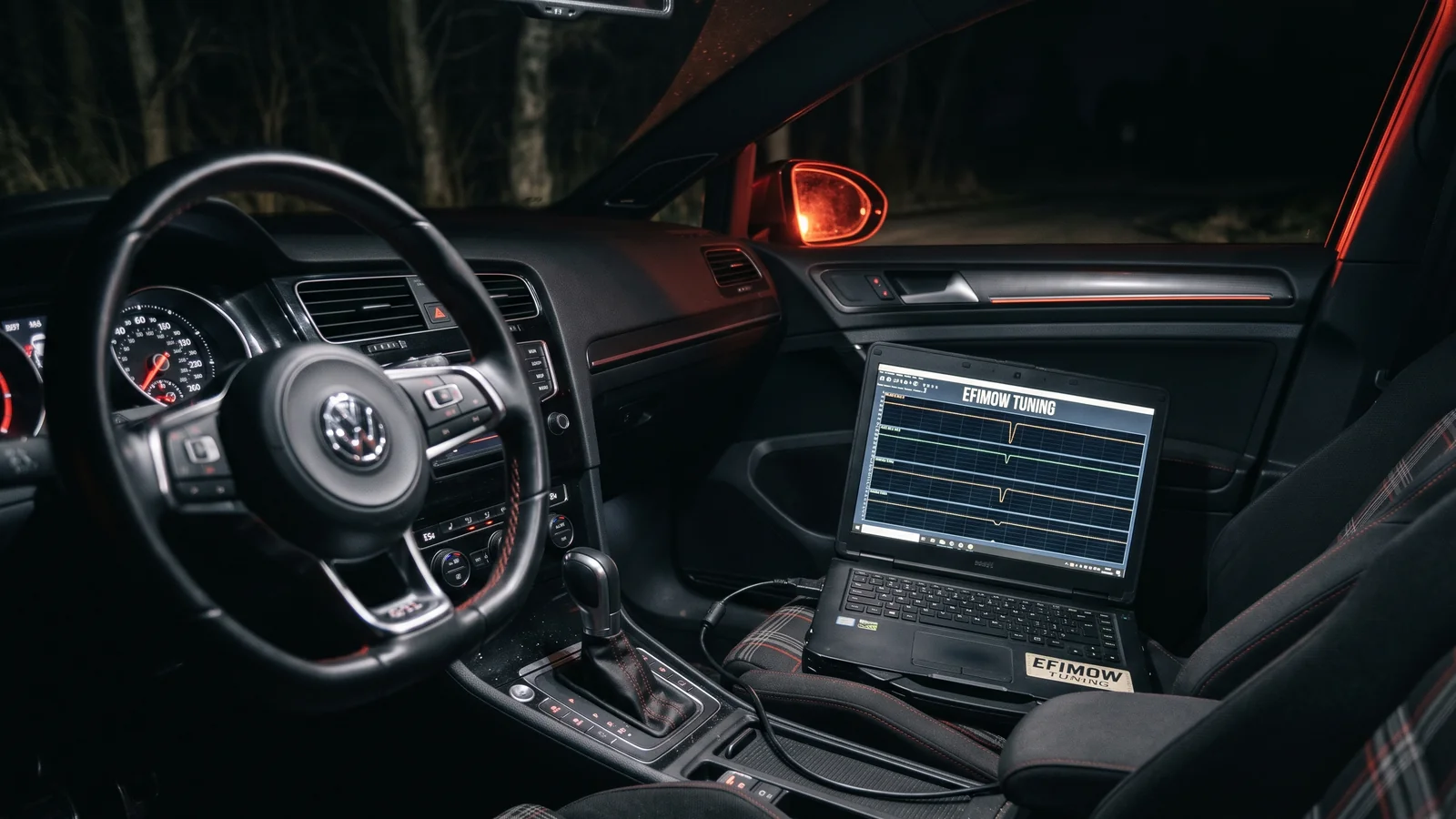
Listening. Knock sensors sit on the engine block. In principle they are structure-borne sound microphones that convert vibrations in the metal into an electrical signal. Knock produces a typical vibration pattern that differs from normal engine noise.
Assigning. The control unit evaluates the signal only in a short time window after each ignition, separately for each cylinder. It compares the signal with the normal background noise of that cylinder. If it is clearly above it, it counts as knock.
Retarding. When the control unit detects knock, it immediately moves the ignition angle for that cylinder a step towards late. If the knock continues, it retards further.
Advancing again. If the cylinder stays quiet, the control unit works its way back towards the base value in small steps. That way the ignition settles just below the knock limit during operation.
Knock control learns
Many control units remember where and how often they had to retard. That has two effects:
- Learned corrections per load range make the ignition start a little later as a precaution where the engine knocks more often.
- Detecting fuel quality: if the engine knocks noticeably often, the control unit concludes the fuel is worse and retards ignition overall. Some engines switch to a more cautious map in the process.
For you this means: a tank of Super instead of Super Plus in an engine designed for 98 octane shows up as noticeably less power. After a few tankfuls of good fuel the control unit learns its way back.
When retarding is not enough
Ignition is the fastest tool, but not the only one. If retarding is not enough, or would have to go so far that exhaust temperatures get too high, further protective functions step in: boost is reduced, the mixture enriched, and in extreme cases a fault code is stored and limp mode engaged.
Because late ignition has its price too. When the spark fires too late, part of the energy only burns in the exhaust. Manifold, turbocharger and catalytic converter get hotter.
What this means for tuning
A performance tune on a turbo petrol engine brings the engine closer to its limits: more boost, more charge, often adjusted ignition timing. That makes knock control more important, not less.
A safety net, not a strategy. Good software is calibrated so that knock control normally has little to do. A file that relies on knock control to retard ignition that is set too early is constantly running on the edge. Power fluctuates, components get hotter, and with bad fuel or heat the reserve is used up quickly.
Do not disable it, do not dull it. With serious tuning, knock control stays fully intact. Anyone who lowers its sensitivity to get "more ignition" takes away the engine's most important protection.
Boost and ignition together. More boost usually calls not for more but rather slightly less ignition advance. How the levers interact is explained in the article Boost, rail pressure and ignition angle.
Mind the mixture. A lean mixture under load increases knock tendency. That is why lambda calibration under load is always part of it. More in the article Lambda control: open loop and closed loop.
Logging: what knock control reveals
Ignition retard per cylinder is one of the most revealing values after a tune:
- Hardly any retard: the calibration has reserve, all good.
- Occasional small retard in heat or at full load: normal, that is what the control is for.
- Constant retard on all cylinders: the calibration is too aggressive for the fuel or conditions.
- Retard always on one cylinder only: that points more to a mechanical issue, such as a worn spark plug, an injector or deposits.
Where knock control reaches its limits
Knock control can only react to something the spark has triggered. There are combustion anomalies where it does not help:
- Pre-ignition (LSPI): on small, highly boosted engines the mixture can ignite before the spark at low revs and high load. Later ignition does not help then, because combustion is already under way. What helps here is mainly suitable engine oil and a calibration that does not put extra load on this range.
- Hot-spot ignition: hot spots in the combustion chamber, for example from deposits or a spark plug that is too hot, ignite the mixture uncontrollably.
- Sensor faults: if a knock sensor fails, the control unit usually runs with heavily retarded ignition as a precaution, and the engine feels weak.
What you can do as a driver
- Use the right fuel. If the software is calibrated for 98 octane, then always 98.
- Change spark plugs at the interval, on tuned engines rather earlier.
- Do not lug the engine at full throttle. Low revs and high load are the most critical range.
- In hot weather and when towing, expect a little power loss; that is the control at work.
Conclusion
Knock control listens to every cylinder, retards ignition immediately when there is danger and learns what fuel it is dealing with. For a petrol tune it is indispensable, but not as a tool to extract power, rather as a net under a calibration that is already clean in itself. What makes sense for your engine can be seen in the configurator, for example for the VW Golf 7 GTI with 220 hp. More on the term in the glossary under Klopfregelung.