
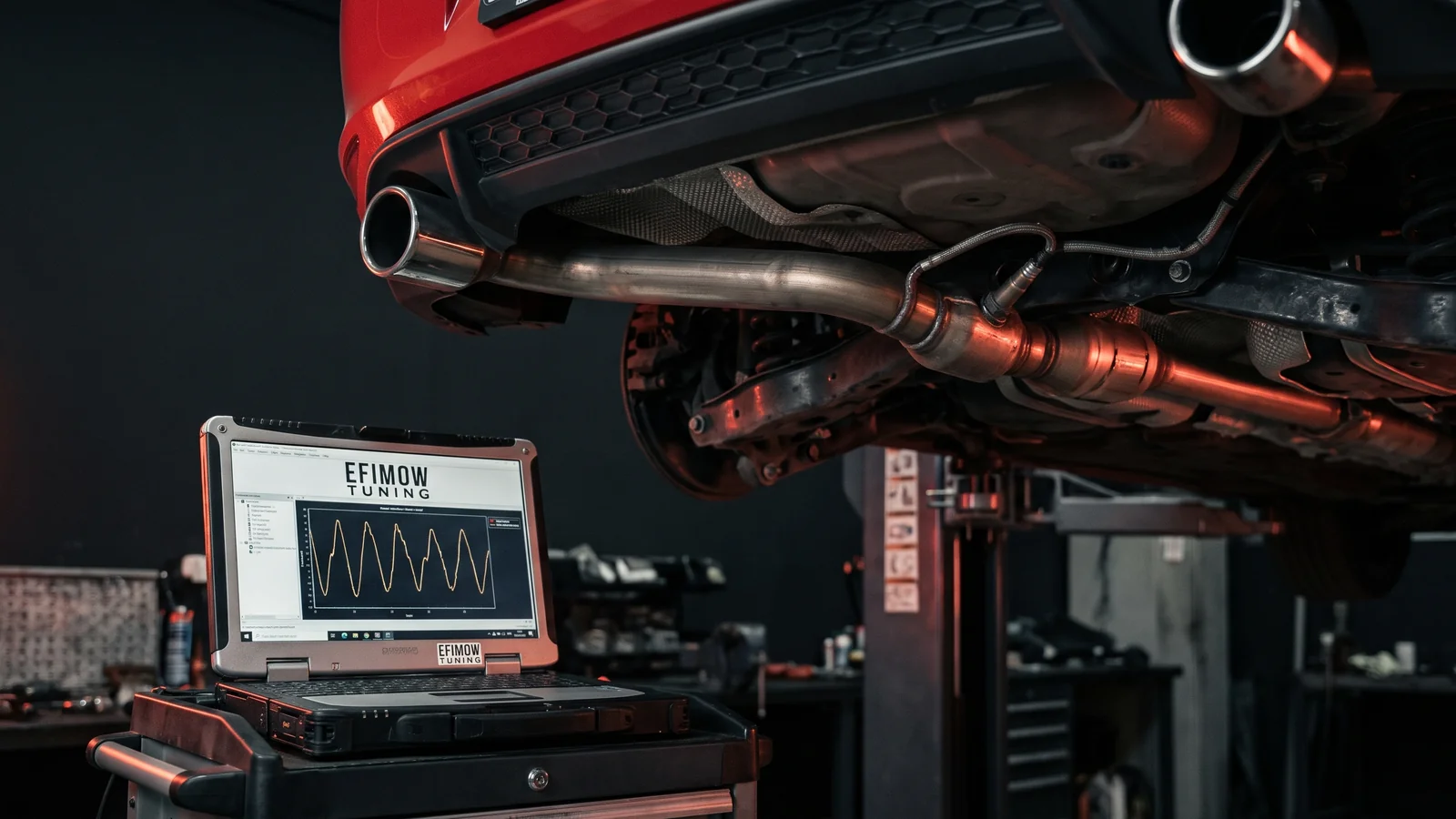
Lambda Control: Open Loop and Closed Loop Explained Simply
When the ECU controls the mixture via the lambda sensor, when it only pre-calculates, and what that means for tuning, adaptation values and diagnosis.
October 26, 2026 by Leo Efimow
Every modern petrol engine has at least one lambda sensor in the exhaust. It measures whether there is still oxygen left in the exhaust gas and reports that to the control unit. But the control unit does not always listen to it. There are operating states in which it controls the mixture based on the sensor, and others in which it deliberately ignores the sensor and works only from pre-calculated values. These two modes are called closed loop and open loop. If you understand when each applies, you also understand why tuning works in some ranges and simply gets "corrected away" in others.
Lambda in one sentence
Lambda describes the ratio of the air actually present to the amount of air needed for complete combustion of the fuel. At λ = 1 it matches exactly; below 1 the mixture is rich (more fuel), above 1 lean (more air). A petrol engine with a three-way catalytic converter has to run very precisely around λ = 1 in everyday driving, because only there can the catalyst convert all three pollutant groups at once.
Open-loop control and closed-loop control: the difference
Open loop means: the control unit calculates the injection quantity from air mass, engine speed, temperatures and maps, and injects that quantity. Whether the result is exactly right is not checked at that moment. The quality depends entirely on how well the model and maps match reality.
Closed loop means: the control unit pre-calculates the quantity in the same way, but then measures the result via the lambda sensor and corrects. If the exhaust is too lean, a little more fuel is added; if it is too rich, a little less. The loop is closed, hence the name.
Important: even in closed loop there is a pre-control. The sensor only corrects the deviation. The better the pre-control, the smaller the correction.
Two kinds of lambda sensor
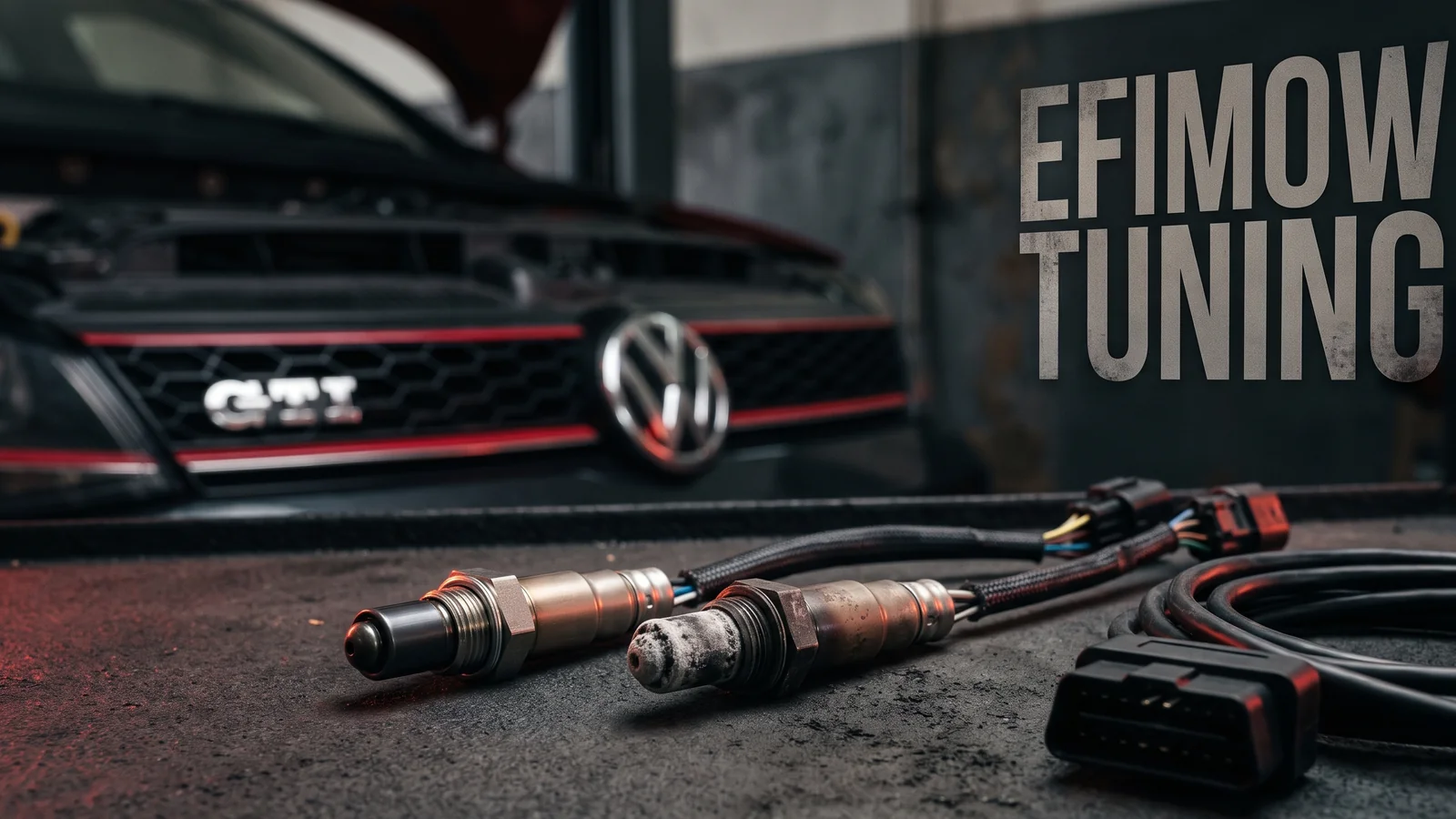
- Narrowband sensor: the classic sensor essentially only detects "rich" or "lean". Its signal jumps around λ = 1. For controlling to λ = 1 that is entirely sufficient.
- Wideband sensor: it measures the air-fuel ratio over a wide range as an actual value. That lets the control unit target values other than λ = 1.
On many vehicles a control sensor sits upstream of the catalytic converter and another sensor downstream. The rear one mainly monitors whether the catalyst still works and fine-tunes the control.
When the control unit works in closed loop
Typical in everyday driving: idle, cruising, normal acceleration, so most of part load. Prerequisites are a sensor at operating temperature with its heater working and an engine without a special operating state.
When it switches to open loop
- Cold start and warm-up: the sensor is not ready yet, and the cold engine needs a richer mixture anyway.
- Overrun fuel cut: without injection there is nothing to control; the exhaust is just air.
- High load: on many engines the mixture is deliberately enriched at full load. The extra fuel cools the combustion chamber, exhaust valves and turbocharger. This target deliberately deviates from λ = 1.
- Sensor fault: if the sensor fails, the control unit runs on pre-control only, often with a fault code and more cautious values.
Newer emission standards strongly restrict enrichment for component protection. Many current engines therefore run as close to λ = 1 as possible even under load and protect components by other means. With a wideband sensor they can also target rich values in closed loop. The clear line "part load controlled by feedback, full load pre-calculated" becomes blurred as a result.
Adaptation: the memory of the control loop
The control unit remembers how much it has to correct permanently. If, for example, it always has to add a few percent more fuel, it learns this value as an adaptation and builds it straight into the pre-control in future. That way it compensates for component tolerances, ageing injectors or small leaks.
For diagnosis these values are worth their weight in gold. A strongly positive adaptation, meaning permanently more fuel, often points to false air or a dirty mass air flow sensor. If the adaptation reaches its limit, a fault code is stored.
What this means for tuning
At part load the control unit corrects back. If you simply have more fuel injected there, you gain nothing. The lambda control detects the rich mixture and takes the fuel away again. What remains is a shifted adaptation, at worst a fault code. That is why serious tuning does not work on the fuel quantity at part load.
Under load the lambda target counts. Where the control unit pre-calculates instead of correcting, the calibration itself has to be right. More air through more boost needs correspondingly more fuel, otherwise the mixture gets too lean and too hot. Good software therefore checks under load whether the desired lambda actually arrives.
The model has to be right. The better the pre-control matches reality, the more calmly the control loop works. A tuning box that fakes a pressure signal, for example, throws this model into disarray. The control loop can compensate for part of it, but the adaptation values drift, and under load, where there is no feedback control, the mixture is no longer right. Background in the article on map-based tuning.
Lambda and knock
Mixture and ignition are linked. A lean mixture under load burns hotter and knocks more readily. A slightly richer mixture cools and gives the ignition timing more room. That is why a good calibration always looks at lambda and ignition angle together. More in the article Knock control: the guardian angel of every petrol tune.
And on a diesel?
A diesel always runs with excess air, well above λ = 1. It is therefore not controlled to λ = 1 like a petrol engine. On a diesel the lambda sensor mainly serves to monitor the air mass and the exhaust aftertreatment and to safeguard the fuel quantity calculation. Limits such as the smoke limiter work with the air-fuel ratio, but the principle is a different one.
Practical tips
- After a tune or a repair the adaptation needs some mileage to settle.
- Reading out adaptation values pays off with a rough idle or lack of power. They show whether the engine is permanently compensating.
- Sensors age. A slow sensor controls more sluggishly, which can worsen consumption and smoothness.
- Look for false air first before changing anything in the software.
Conclusion
Closed loop means: measure and correct. Open loop means: pre-calculate and trust. In everyday driving a petrol engine almost always works in closed loop; under high load, at cold start and on the overrun it runs open loop. For tuning that gives a clear rule: do not work against the control loop at part load, and hit the lambda target cleanly under load. What is possible for your vehicle you can see in the configurator. The terms are in the glossary under Lambda and Open Loop.