
Boost, Rail Pressure, and Ignition Angle: The Three Levers Professional Tuners Pull
What gets changed in a serious software tune and how professionals keep each parameter inside safe limits.
May 6, 2026 by Leo Efimow
When you order a software tune, what arrives is a modified file inside the engine control unit. But what is actually different in it? In practice, serious engine tuning comes down to three parameters: boost pressure, rail pressure on diesels, and ignition angle on petrol engines. These three levers determine how much air enters the combustion chamber, how finely the fuel is atomised, and when the mixture is ignited. Each lever has a point at which more is no longer better, only more expensive. This article walks through what professionals change, where the physical limits sit, and which sensors keep watch.
Boost: the main channel for getting more air into the engine
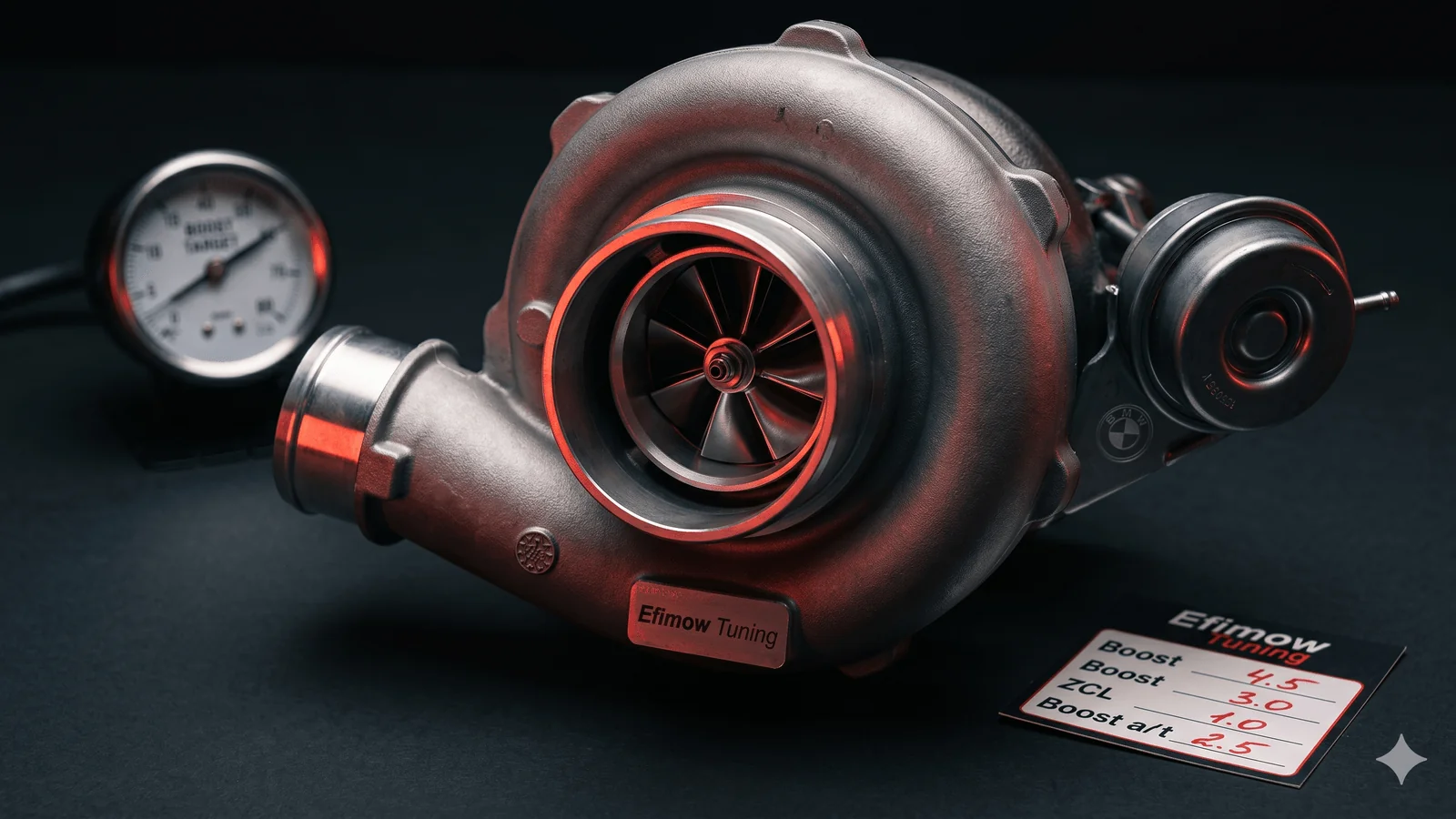
On any forced-induction engine (since the B47/B57 diesel and B48/B58 petrol generations, that means essentially every BMW engine), boost is the most direct route to more power. More pressure in the intake manifold means more oxygen per stroke, and more oxygen allows more fuel. Torque rises almost linearly with the oxygen mass, as long as combustion, cooling and the exhaust path can absorb the extra load.
Concrete numbers help to scale this. A stock B58 typically runs at 1.1 to 1.2 bar of relative boost (roughly 16-18 psi). A professionally calibrated Stage 1 program moves that figure to 1.5 to 1.6 bar (roughly 22-24 psi), depending on rpm range and load. The B48 sits a touch below and responds well to similar moderate increases. The N57/B57 diesel lives in a comparable range, with two-stage charging adding complexity on later generations.
The hard limits are not free to choose. First, every turbo has an efficiency window; outside that window it heats the intake charge so aggressively that knock tendency rises and the intercooler cannot keep up. Second, higher boost increases thermal load on the exhaust valves and the turbine wheel. Third, pistons, conrods and the head-gasket concept are designed for a defined peak cylinder pressure. A serious calibration respects these limits; an unserious one ignores them and sells the first summer as a success.
Rail pressure: the diesel-specific lever
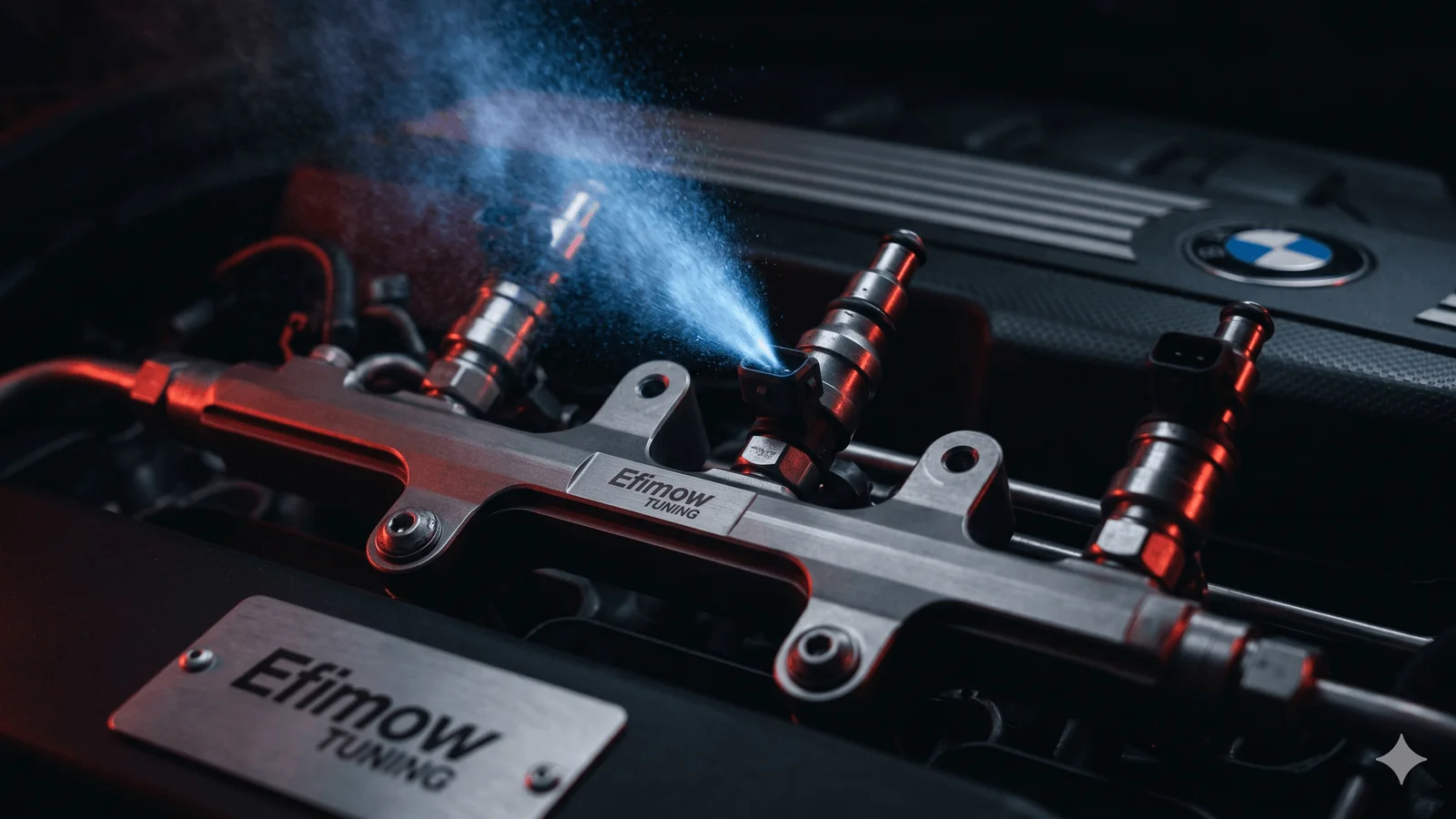
On a diesel, boost matters, but it is not the most interesting parameter. The real precision work happens in the common-rail system. Modern direct-injection diesels operate with rail pressures between 1,800 and 2,500 bar; recent generations reach above 2,700 bar at full load. These pressures are not an end in themselves: the finer the fuel is atomised, the more completely it burns: droplets are smaller, oxygen contact per unit mass is larger, and both soot and unburnt fuel drop. Higher rail pressure therefore means more energy from the same diesel mass and cleaner exhaust.
The limit here is mechanical. The high-pressure pump and the piezo or solenoid injectors are designed for defined peak pressures. Push rail pressure too aggressively and you accelerate pump wear and risk leaking injector seats, which in the worst case let diesel drip into the engine oil. A serious diesel tune therefore rarely pushes rail pressure into the hard limit; it uses the existing reserve moderately (typically a single-digit percent over stock) and pairs that with adjusted injection timing and boost.
The software also controls injection timing and multiple injection events. A common-rail engine injects in several phases per power stroke: pilot, main, and post injection. These phases are often fine-tuned. They directly influence diesel knock noise, soot emissions, and NOx formation. Anyone who ignores all that and only winds the rail pressure up has not done a tune; they have pre-programmed a failure.
Ignition angle: the petrol-specific lever
On petrol engines there is a counterpart: the ignition timing, expressed as ignition angle in degrees before top dead centre (BTDC). In theory, every operating point has an optimum ignition angle that produces maximum torque, the so-called MBT (Maximum Brake Torque). Fire too early and rising cylinder pressure works against the piston before it has crossed top dead centre. The engine becomes inefficient and prone to knock (uncontrolled auto-ignition of the remaining mixture). Fire too late and the energy escapes as heat into the exhaust.
In stock form, ignition is often conservatively mapped, with margin for poor fuel, high ambient temperatures, and production tolerances. A tune trims that margin, advancing ignition by a few degrees in good conditions (cool day, premium fuel with 98-100 RON, light load in the relevant map cell). That delivers more torque at the same fuel mass. But past MBT, advancing further does not help; it harms.
The safety net is built into the ECU itself. Every modern BMW straight-six carries knock sensors on the cylinder banks: small accelerometers that detect the high-frequency oscillation of a knock event. As soon as they report knock, the ECU pulls ignition back immediately (typically several degrees per event) until the knocking stops. This knock control is one of the most important protective layers, which is why a serious tuning file must never disable it or make it less sensitive. It shifts the underlying targets; the protection logic stays active.
Sensors as an early-warning system
Three sensors give the ECU live feedback on whether the three parameters are still inside safe territory. The knock sensor (petrol) was described above. The lambda sensor in the exhaust measures residual oxygen and therefore the air-fuel ratio. It lets the ECU hit the intended mixture under changed conditions. The exhaust gas temperature sensor (EGT) is the third silent watchman; it sits before and sometimes after the turbo. When exhaust temperature climbs past a critical threshold (usually 950-980 °C in stock maps), the ECU enriches the mixture or pulls boost back to protect the turbine wheel and exhaust valves.
A professional calibration works with these sensors, not against them. It raises the targets for boost, rail pressure and ignition, but leaves the protection thresholds active, and often tightens them, because the whole system now runs closer to its limits. That difference (new targets with unchanged, alert protection) is what separates a serious map from a "push-everything-higher" file sale.
Bottom line
Boost, rail pressure and ignition angle are the three levers a tuner actually pulls. They are highly effective but not arbitrarily adjustable: each has a physical limit beyond which there is no more power, only damage. A clean calibration respects those limits, uses the existing reserves moderately, and keeps the protection functions (knock control, lambda correction, EGT limit) fully active. Ask your tuner about these specifics and within a minute you will know whether you are buying a file template or a real calibration.