
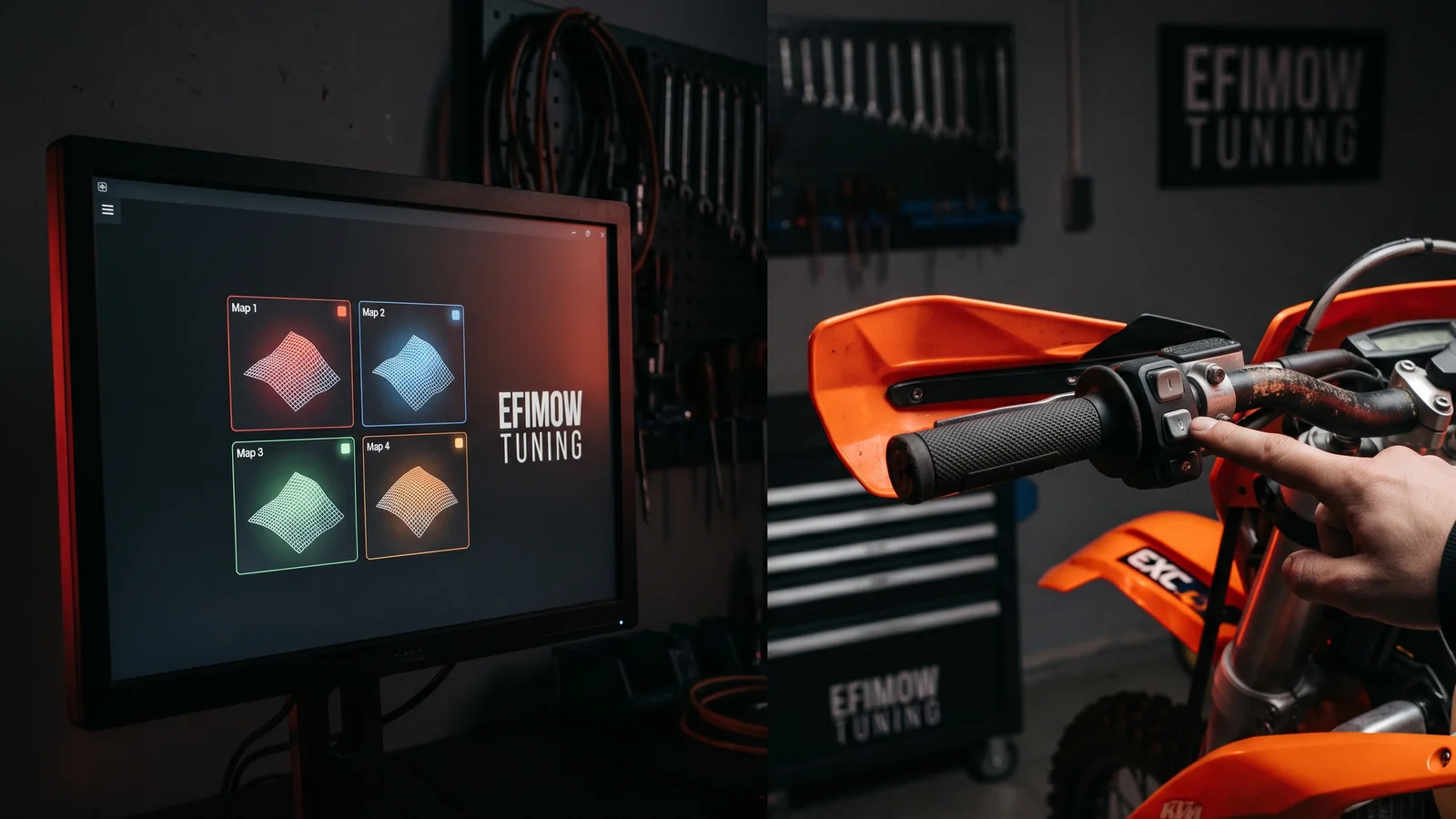
Motorcycle Multi-Map: Four Maps at the Flick of a Switch
How motorcycle multi-map works: four map banks, freely assigned with power, pops & bangs and party mode, selected with a map switch.
October 25, 2026 by Leo Efimow
On a motorcycle, a single calibration has to do a lot at once: be forgiving in a wet forest, pull hard on a gravel track and maybe crackle in the paddock too. That cannot be done without compromise. Multi-map solves it differently. Instead of one calibration, up to four sit in the ECU and you choose with a switch which one applies. Here you learn how it works technically, how to assign the maps sensibly and which switch fits.
Four map banks from the factory
The Keihin ECU 812.41.031, fitted to many KTM, Husaberg and Husqvarna models from 2012 to 2017, has four map banks. Each bank holds a complete set of tables for ignition timing and fuel injection. The unit reads which bank is active from two inputs. KTM uses this from the factory for different riding characters, for example a softer and a more aggressive throttle response.
Tuning does not just change these banks, it assigns them freely. That is the core of multi-map: each of the four maps gets its own combination of options. A map without an option stays stock.
The options you can distribute
There are three options, each with its own strength setting:
| Option | What it does | Setting |
|---|---|---|
| Power increase | Revised ignition and fuel maps for more power and sharper response | Super 95 or Super Plus |
| Pops & bangs | Crackling and popping on the overrun with the throttle slightly open | Level 1 (quick, light) to 5 (slow, strong) |
| Party mode | Hard cut at the limiter: ignition off, timing retarded, bangs and flames | Level 1 ("brrrrr") to 5 ("boom boom") |
The trick: with multi-map, every map carries its own strengths. Map 3 can crackle lightly while map 4 goes hard. The fuel choice can be set per map too.
Sensible layouts
The configurator starts with a stepped layout you can change as you like:
- Map 1: stock
- Map 2: power
- Map 3: power and pops & bangs
- Map 4: power, pops & bangs and party mode
For many riders this already fits. The stock map is your fallback when it gets slippery or you lend the bike to someone. The power map is your everyday map on track. You only switch to the two sound maps when you really want them.
Other layouts work just as well. Some riders put only the power increase with Super 95 on map 2 and the power increase with Super Plus on map 3, for days when they are sure to have 98 octane in the tank. If you only want party mode to be switchable, leave map 1 stock and put party mode alone on map 2.
A practical note: if all four maps are assigned identically, the map switch changes nothing. In that case the cheaper always-on variant is enough.
Always on or multi-map: the difference
Without multi-map, the chosen options are always active, whatever map is running. That costs €150 for one option and €200 for several. With party mode in particular it means it kicks in every time the engine hits the limiter, because it depends only on engine speed.
Multi-map costs €230. In return, every function is only active where you put it. If you have already picked always-on options in the configurator and then switch to multi-map, they are not lost: they move to map 2, and map 1 stays stock.
Which map switch fits
Multi-map needs a map switch. When ordering you make an explicit choice; there is no default.
KTM stock switch (part number 77239974200). It fits KTM and Husqvarna models 2011–2017 and works with our files. It has two positions on the handlebar: in position 1 you ride map 1, in position 2 the map you select on the rotary switch for the base setting, which sits in the airbox or under the seat depending on the model. So from the handlebar you reach two of the four maps.
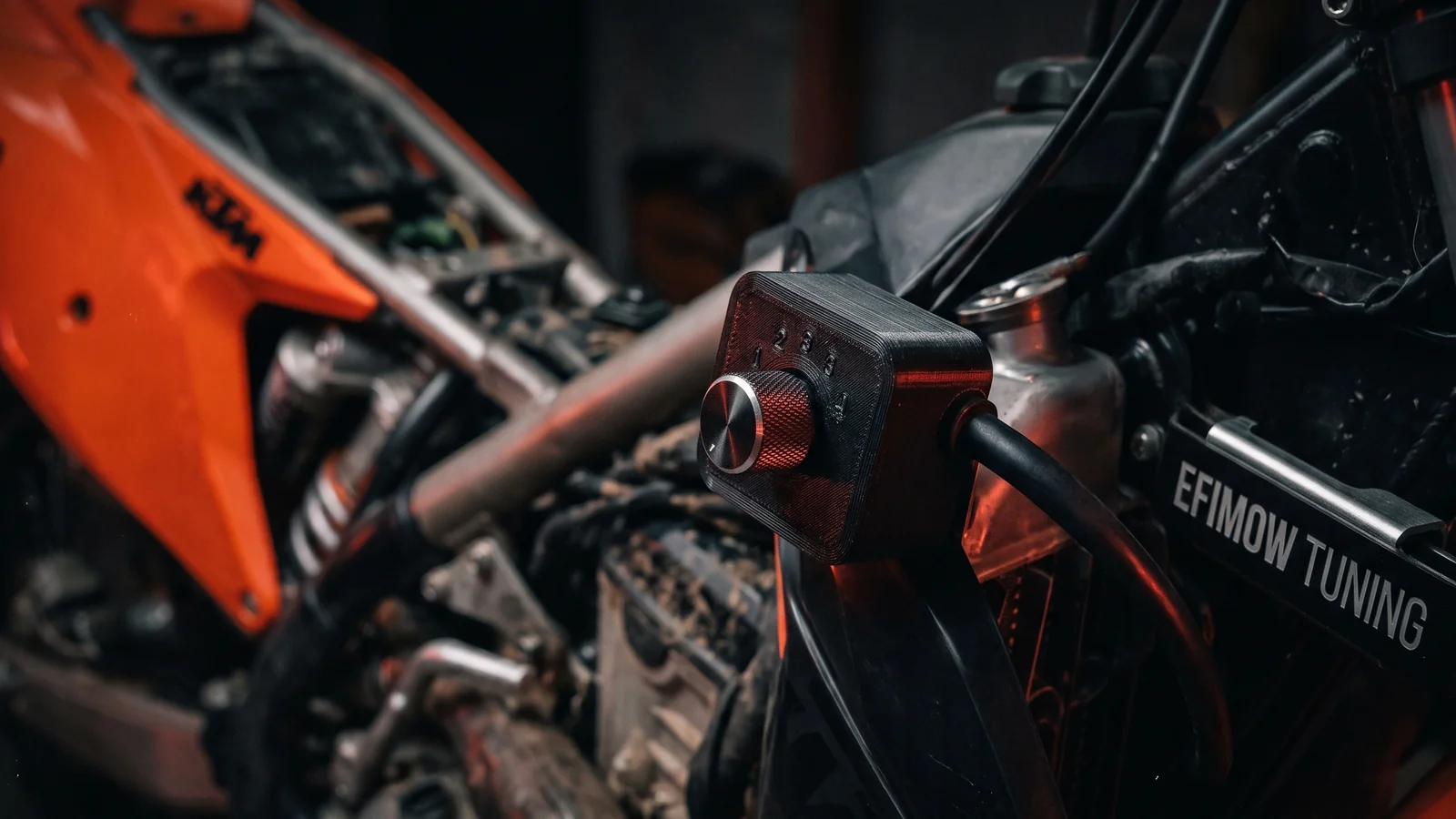
Stealth (+€40). A 4-way rotary switch in a 3D-printed housing that you hide in the bodywork wherever you like. Each position is one map. It is not waterproof.
Clean (+€80). An aluminium handlebar switch with two buttons, waterproof to IP67. Nothing pressed is map 1, button 1 map 2, button 2 map 3, both map 4.
Both of our own switches are still in development. You can pre-order them with the tune. Once they are built and have passed testing, yours is shipped for retrofitting and we let you know by email. The change is taken over at idle or on restart. Map switching by smartphone has also been announced.
Ordering and process
You put multi-map together in the motorcycle configurator: choose model and year, activate multi-map, assign the four maps, pick the switch. Then you come to Stödtlen or send in the ECU. We read the original software, match all four maps to it and program the unit. By post this takes about 3–7 days including shipping. Which models fit is listed on the page for the Keihin ECU.
Legal and stress
Multi-map makes the sound functions switchable, not legal. Changing the engine software voids the vehicle's type approval, regardless of which map is active. All functions are intended exclusively for motorsport and are not permitted on public roads. Details are in the motorsport notice. Pops & bangs and party mode stress exhaust valves, header and silencer through unburnt fuel. With multi-map you at least only use them when you want to.
Conclusion
Multi-map uses the four map banks of the Keihin ECU for four different characters. You decide what sits on which map and how strong it is. The map switch makes changing easy: with the stock switch you reach two maps, with Stealth or Clean all four. If you want to switch between trail, track and show, multi-map is the most flexible solution. The glossary also explains multi-map and the map switch.