
Jaguar XF 2.2d and 3.0d: British Diesels Optimised
Jaguar XF diesel: what software can do on the 2.7 and 3.0 V6, which ECUs are fitted and how we handle the four-cylinder 2.2d.
October 25, 2026 by Leo Efimow
The first-generation Jaguar XF repositioned the brand in the executive class, and in Europe it was mostly sold as a diesel. Depending on the model year, a V6 diesel with 2.7 or 3.0 litres works under the long bonnet or, from the facelift, a 2.2-litre four-cylinder. All three engines come from the cooperation between Ford and PSA, which at the time also supplied Land Rover, Peugeot and Citroën with diesel engines. For tuning this means: the technology is well known, but the ECUs differ considerably between engines. This article sorts out what is possible on the XF and where we have to say honestly that it needs checking first.
The diesels in the XF
Our catalog lists the following diesel variants for the XF (2007–2015):
| Engine | ECU | Access per catalog | Stage 1 from |
|---|---|---|---|
| 2.7 TDV6 | Siemens SID204 | OBD | €200 |
| 3.0 V6 Diesel / 4.4 V8 Diesel | Bosch EDC17CP55 | OBD | €300 |
The 2.2-litre four-cylinder (2.2d) is currently not listed as a separate XF variant in our catalog. That does not mean it cannot be optimised. It means we check your car's ECU and software version specifically before quoting price and options. The easiest way is to enter the car via the request in the configurator.
The 2.2d: a four-cylinder from the group toolkit
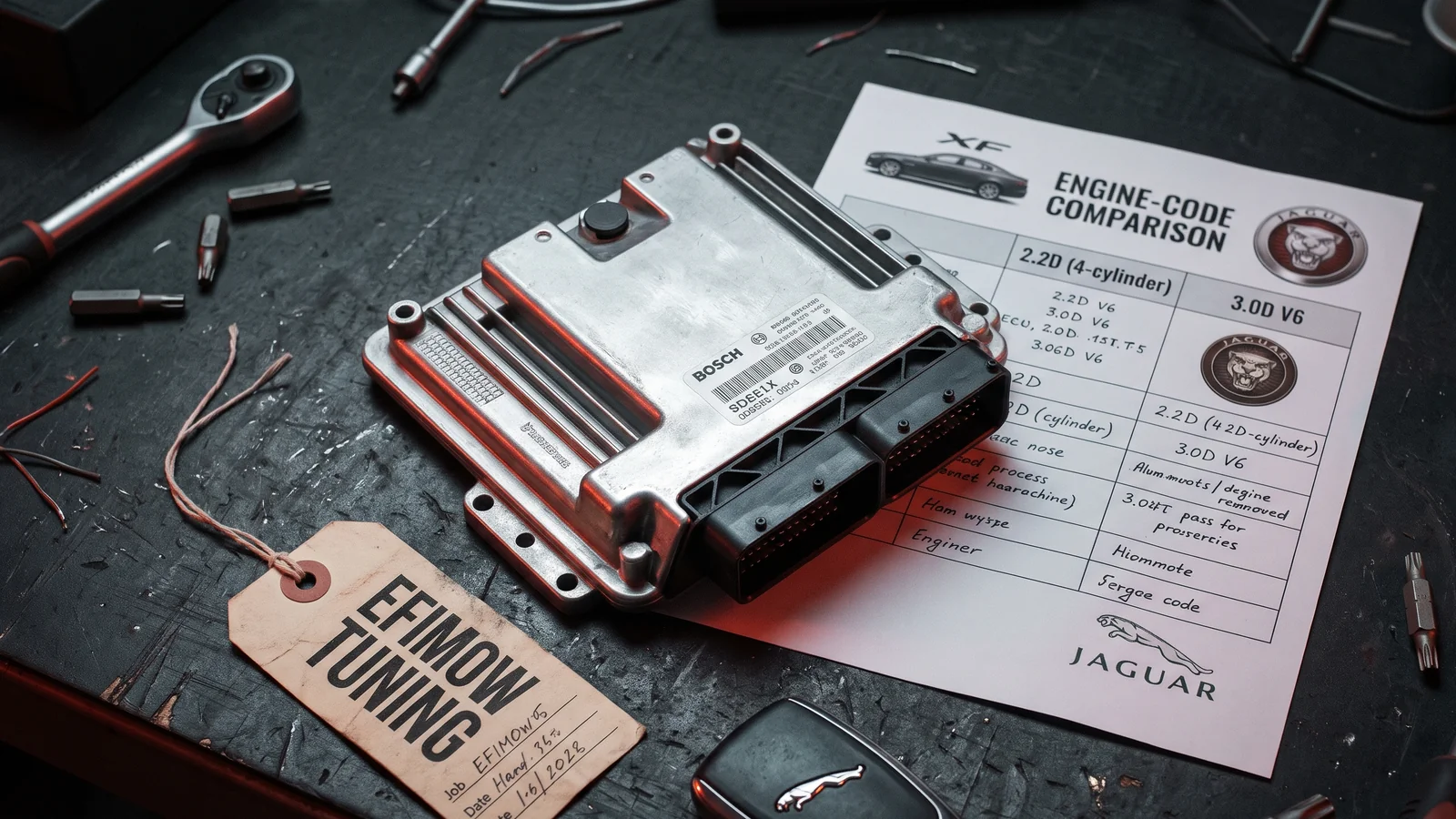
The 2.2-litre diesel in the XF is a common-rail four-cylinder from the Ford/PSA family. Land Rover uses the same engine type, code 224DT, in the Range Rover Evoque as the 2.2 TD4 and SD4; our catalog lists a Bosch EDC17CP42 there, and Stage 1 for the Evoque 2.2 SD4 starts at €300. Whether the XF uses the same ECU with the same access we check using the software ID, because longitudinal instead of transverse installation, a different gearbox and different vehicle integration can affect the software version.
For Bosch EDC17 ECUs on four-cylinder diesels our data gives typical Stage 1 guide values of around 20 to 30 percent more power and torque. That is a range for the family, not a promise for a specific car. On the XF 2.2d a successful tune mainly means: the heavy saloon or Sportbrake loses the slightly strained feeling when accelerating from medium speeds, and the automatic kicks down less often.
The V6 diesels: 2.7 and 3.0
The 2.7 TDV6 was used in the XF until the 3.0-litre engine arrived and works with a Siemens SID204 ECU. For this SID20x family, typical Stage 1 guide values are around 15 to 25 percent more power and 20 to 30 percent more torque.
The 3.0 V6 Diesel replaced the 2.7 and is equipped with two turbochargers in its stronger versions. Like the 4.4 V8 Diesel, it is controlled by a Bosch EDC17CP55. For V6 and V8 diesels with EDC17 our data gives around 15 to 25 percent more power and 20 to 30 percent more torque. On the twin-turbo versions, calibrating the transition between the two turbos is part of a clean tune; a jerky surge or a torque hole at this point is a quality marker you should watch for.
The same technology in S-Type and XJ
If you drive another Jaguar diesel rather than an XF, you will find the same engines in related form. The S-Type and the previous-generation XJ were offered with the 2.7 TDV6; our catalog lists a Siemens SID20x ECU there too, and Stage 1 starts at €200 according to our pricing rules. The XJ from 2009 uses the 3.0 V6 Diesel or the 4.4 V8 Diesel with a Bosch EDC17CP55, the same ECU family as the XF, with Stage 1 from €300. Guide values and options therefore largely match those of the XF. Differences exist in vehicle weight, gearbox calibration and cooling. These feed into the calibration but do not change the basic principle. Here too: identify the specific ECU first, back up the original file, then calibrate.
What the software changes
On all three engines the calibration works with the classic diesel parameters: injection quantity, rail pressure, boost pressure, torque limiters and smoke limitation. The protection functions (exhaust temperature, component protection, smoke limiter) stay active and are adapted to the new load points.
An important point on the XF is the gearbox. Depending on the model year, a six- or eight-speed ZF torque-converter automatic is fitted. Both handle a moderate torque increase well if oil condition and adaptation values are right. A gearbox that already shifts harshly or slips should be checked first, though.
Options
For the EDC17 engines our data lists the following options as feasible: Stage 1+ and Stage 2+, ECO tuning, Sharp Throttle, Vmax removal and suppressing individual, non-emissions-related fault codes. Launch Control and a higher rev limit are only partly possible and therefore on request; on a diesel the latter is rarely useful. For the 2.7 TDV6 with SID204 a similar list applies, without Launch Control.
ECO tuning suits the XF's character well: more torque in the low and mid-range, unchanged peak power. For long-distance drivers often the more fitting choice than the maximum power increase. With Vmax removal, the tyres' speed rating and the registration must match.
What to check before tuning
An XF diesel often has many motorway miles behind it. Before calibration it is worth looking at:
- Turbocharger: play, oil loss and a freely moving vane mechanism,
- Injectors: even correction values, no smoke when accelerating,
- Diesel particulate filter: soot load and regeneration behaviour,
- EGR and intake: coking leads to faults or limp mode more quickly after tuning,
- Fault memory: existing faults are fixed first, not masked.
Emissions control and the law
The software change voids your vehicle's type approval; the software is intended for motorsport use only. For road use, a power increase requires an inspection and registration. Removing or disabling the DPF or EGR in software is emissions tampering and prohibited on public roads.
Process
We tune Jaguar vehicles directly on the ECU: on site in Stödtlen at a date of your choice or by sending in the ECU. The price is the same in both cases and can be booked online. You will find the details on the product pages for the XF 2.7 TDV6 and the XF 3.0 V6 Diesel.
Conclusion
As a diesel, the XF is a pleasant candidate for software tuning: well-known engines from the Ford/PSA toolkit, solid reserves and a gearbox that handles moderate increases well. For the V6 diesels, ECU, options and price are clear; for the four-cylinder 2.2d we check the ECU individually first, because it is not yet listed as a separate XF variant in our catalog.
Select your car in the configurator or enter the 2.2d there as a request. We will get back to you with price and options.