
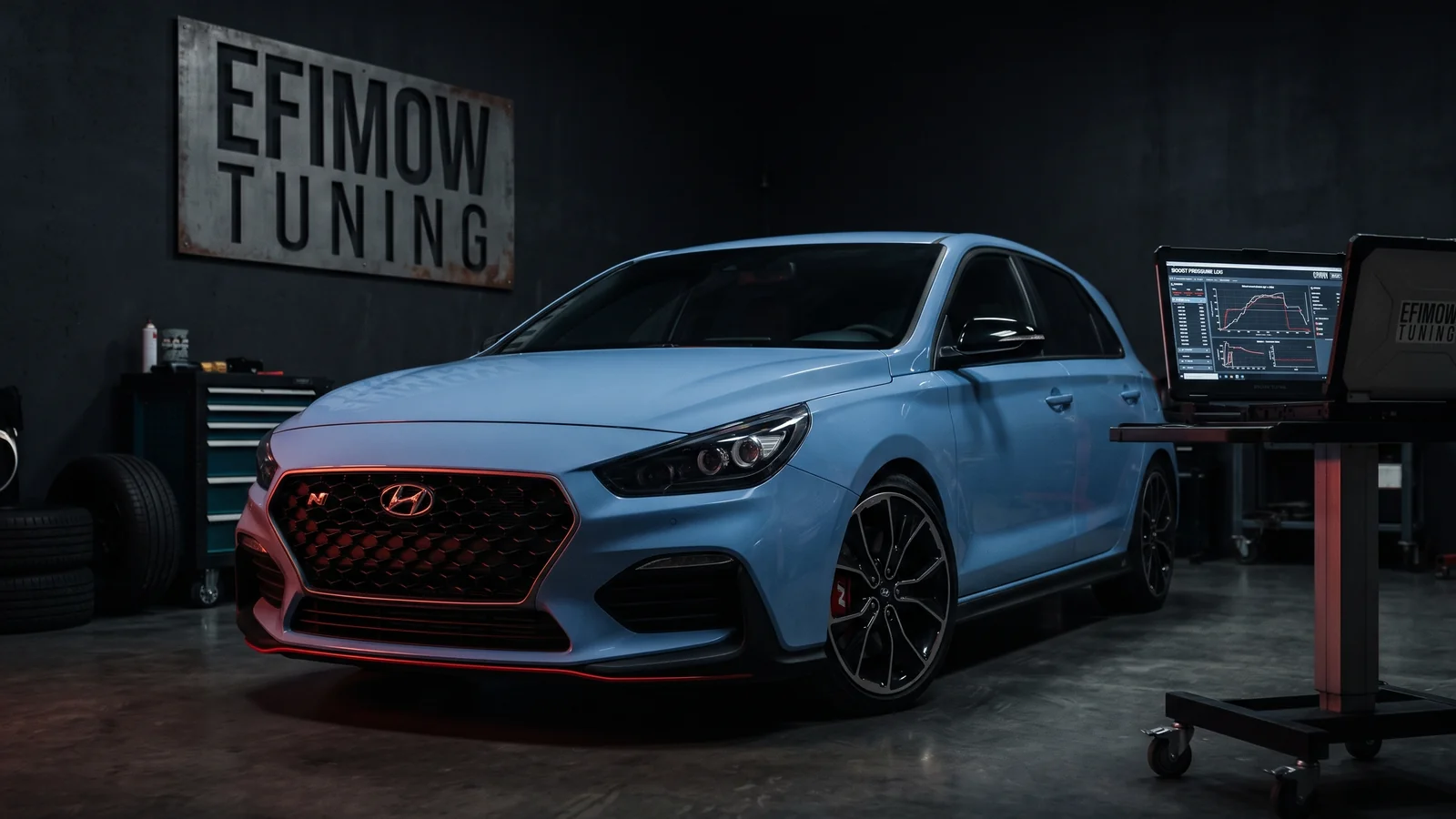
Hyundai i30 N: A Factory Hot Hatch With Reserves?
2.0 T-GDi, launch control and rev matching from the factory: what still makes sense in software on the i30 N, where the limits are and how we proceed.
October 25, 2026 by Leo Efimow
With the i30 N, Hyundai showed in 2017 that a hot hatch does not have to come from Wolfsburg or Paris. The two-litre turbo, a firmly tuned chassis, an electronically controlled limited-slip differential depending on specification, and functions such as launch control and automatic rev matching straight from the factory: the i30 N already brings much of what other cars need software for. So the question is: what is left for tuning?
What the i30 N can do from the factory
The i30 N uses a 2.0-litre direct-injection turbo petrol. Hyundai offered it in a base and a more powerful Performance version; with the facelift, the Performance version's output was raised again and a dual-clutch gearbox was added. Factory features include:
- Launch control for the optimal start
- Rev matching on the manual gearbox, i.e. automatic throttle blips on downshifts
- Drive modes with their own settings for engine, steering, suspension and exhaust flap
- Electronically controlled limited-slip differential on the Performance version
Many functions that other cars only receive through software are therefore already part of the i30 N's type approval. That changes the perspective: on the i30 N, it is less about extra functions and more about power and response.
Why we check each i30 N individually
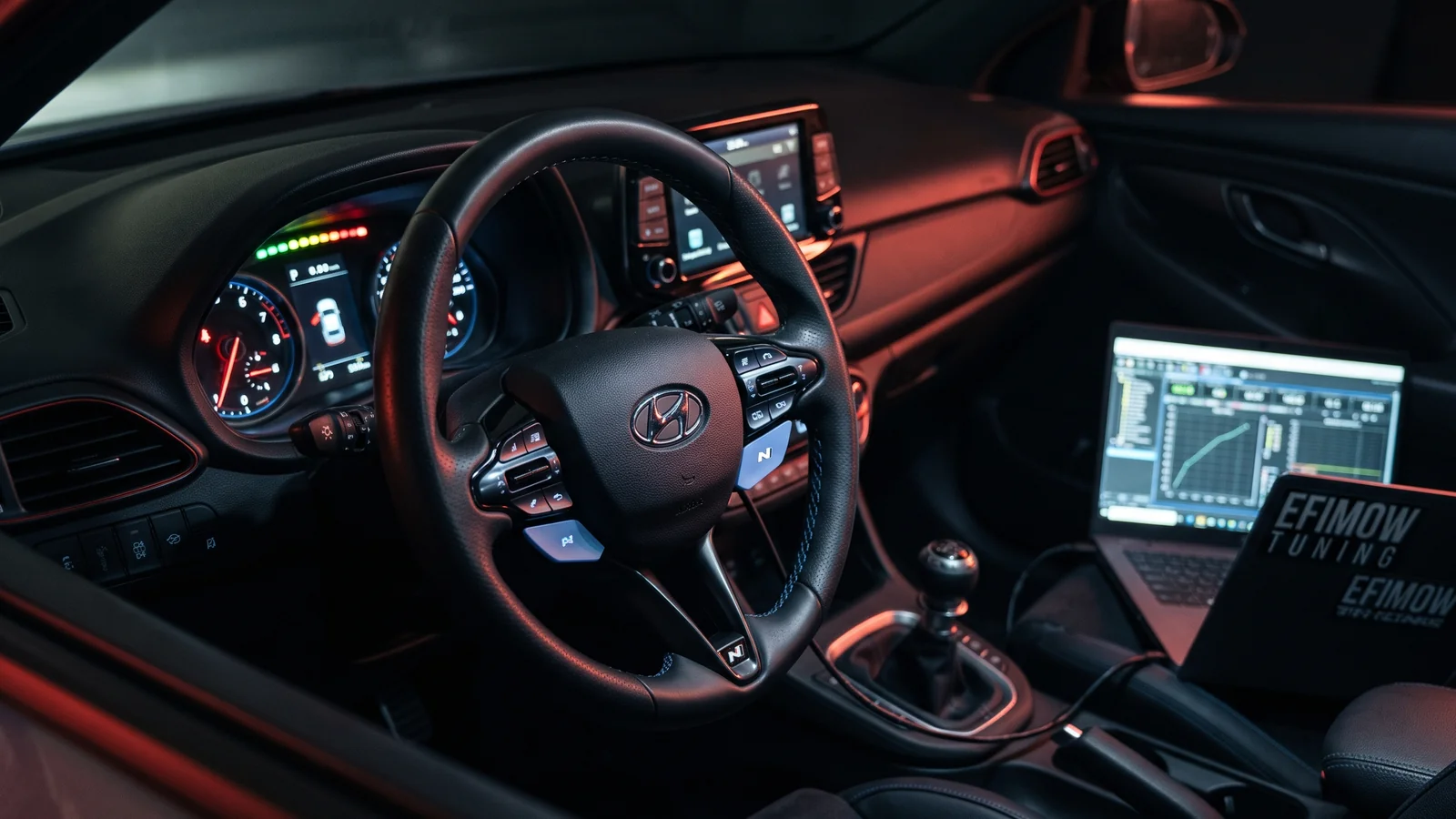
We do not currently list the i30 N as a separate variant in our catalog. That is no accident: current Hyundai ECUs vary in accessibility depending on model year and software version. Some generations can only be written after an unlock, others only on the bench. Before we make any statement on headroom or price, we therefore check the ECU, software version and access method of your specific car.
For context: for current Hyundai turbo petrols with Kefico ECUs, such as the 1.4 T-GDI in the third-generation i30, our data gives a typical 15–25% more power and 20–30% more torque as a Stage 1 guide value. Whether and to what extent that transfers to the i30 N depends on the ECU fitted. A blanket figure would not be serious here.
What software would change on the i30 N
On a direct-injection turbo like the 2.0 T-GDi, a Stage 1 calibration works on the familiar areas:
- Boost targets across rpm and load
- Ignition timing, matched to fuel quality; high-octane fuel is the basis
- Torque limiter, including by gear
- Full-load lambda targets and component protection functions
On the i30 N, the interaction with the drive modes comes on top. A clean calibration takes into account that the car uses different pedal and torque curves depending on the mode. The aim is for the car to feel coherent in every mode, not just the sharpest one.
Gearbox, clutch and differential
The i30 N puts its power down through the front axle. More torque here also means more load on driveshafts, limited-slip differential and tyres. On the manual gearbox, the clutch is the first point to feel extra torque. On the dual-clutch gearbox, the transmission control monitors its own torque limits; engine software that ignores these limits leads to transmission interventions instead of more drive.
Sound and motorsport functions
From the factory, the i30 N is known for its soundtrack in the sportiest mode, within what the type approval allows. Software functions that go beyond that, i.e. pops & bangs, hardcut or popcorn limiter and anti-lag, are intended exclusively for motorsport on closed tracks. They are not permitted on public roads because they change noise and emissions behaviour and put extra load on the catalyst and turbocharger.
The particulate filter fitted to many current direct-injection petrol engines also stays untouched: disabling or removing a gasoline particulate filter or catalyst is emissions tampering and illegal on public roads.
Before your appointment
If you want to have your i30 N optimised, these points help:
- Read the fault memory and have open faults fixed
- Check spark plugs at higher mileage (a wear item on a highly stressed turbo petrol)
- Check the clutch critically on manual cars, especially after track days
- Have vehicle data ready: model year, gearbox, specification and, if possible, the ECU identification
Process
We work on Hyundai directly at the ECU: on site in Stödtlen at an appointment of your choice or by sending in the removed ECU, at the same price and bookable online. For the i30 N, send an enquiry with model year and gearbox through the configurator; we will get back to you with an assessment before anything is booked.
On the legal side: the software change voids the type approval. The software is intended for motorsport use only; see the motorsport notice.
Common questions from the workshop
Is tuning the i30 N worthwhile at all when it already does so much? That depends on what you are looking for. If you are happy with the car and mainly value the factory functions, you do not need software. If you want more mid-range pull or sharper response, you can benefit, provided the ECU is accessible and clutch or gearbox play along.
What about the base version: is it "just software" away from the Performance model? Depending on specification, the versions differ not only in engine software but also in components such as the limited-slip differential, brakes and exhaust. A software calibration therefore does not turn the base version into a full Performance model. It can, however, change the engine's character.
Will factory functions such as launch control be lost through tuning? A serious calibration changes the engine control in a targeted way and leaves functions such as launch control or rev matching untouched. What matters is that the new torque structure fits these functions, so that, for example, a launch-control start stays clean. The original state of the ECU is backed up before writing.
Conclusion
The i30 N brings a lot from the factory that other hot hatches only get through software: launch control, rev matching, drive modes and, depending on specification, a limited-slip differential. What remains is the question of power and response, and we answer that only after checking the ECU, not with a figure from the internet. Keep an eye on the clutch and gearbox, and a good car can become an even more coherent one. More on the brand's diesel models in our article on Hyundai/Kia CRDi, and on the start function in the glossary under launch control.