
Hardcut and Popcorn Limiter: Motorsport Functions Explained Honestly
What a hardcut and a Popcorn-Limiter change in the ECU, which engines support them, what they cost and why they belong on a closed track only.
October 25, 2026 by Leo Efimow
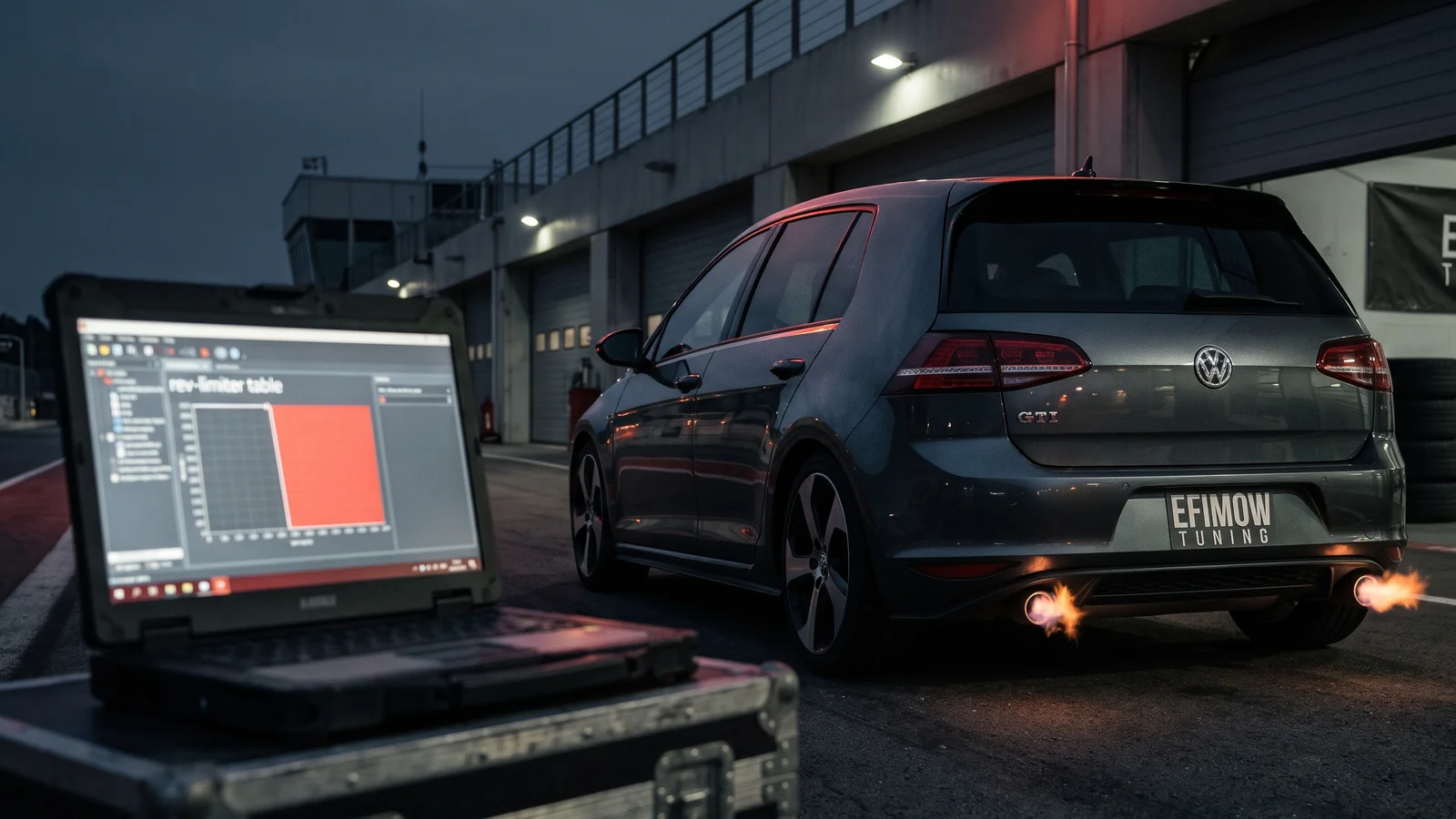
Few topics get discussed as loudly in tuning forums as the bang at the rev limiter. Videos of rally cars sitting on the start line with a stuttering engine and flames from the exhaust have turned two motorsport functions into a lifestyle topic: the hardcut and the Popcorn-Limiter. Both change how the engine behaves at the limiter, and both have a clear place: the closed track. In this article we explain what actually happens in the ECU, which engines can run these functions and which components pay the price.
How a stock limiter works
Every modern engine ECU limits engine speed. From the factory this is usually done softly: shortly before maximum rpm the software takes torque away by closing the throttle, lowering boost and retarding ignition. Engine speed rolls gently into the limit without the engine stuttering. For daily driving that is ideal: comfortable, quiet and easy on the catalytic converter and turbocharger.
The downside from a motorsport point of view: a soft limiter already removes power before the actual limit. If you rev to the limiter on track or want to hold engine speed on the start line, you lose time and get imprecise behaviour.
Hardcut: a hard interruption instead of soft limiting
With a hardcut, the limiter is no longer controlled via throttle and cylinder filling, but via ignition or injection cut. When the engine reaches the set speed, ignition or injection is skipped for individual combustion cycles, rpm drops slightly, ignition resumes, in rapid succession. The throttle stays open and boost pressure largely stays up.
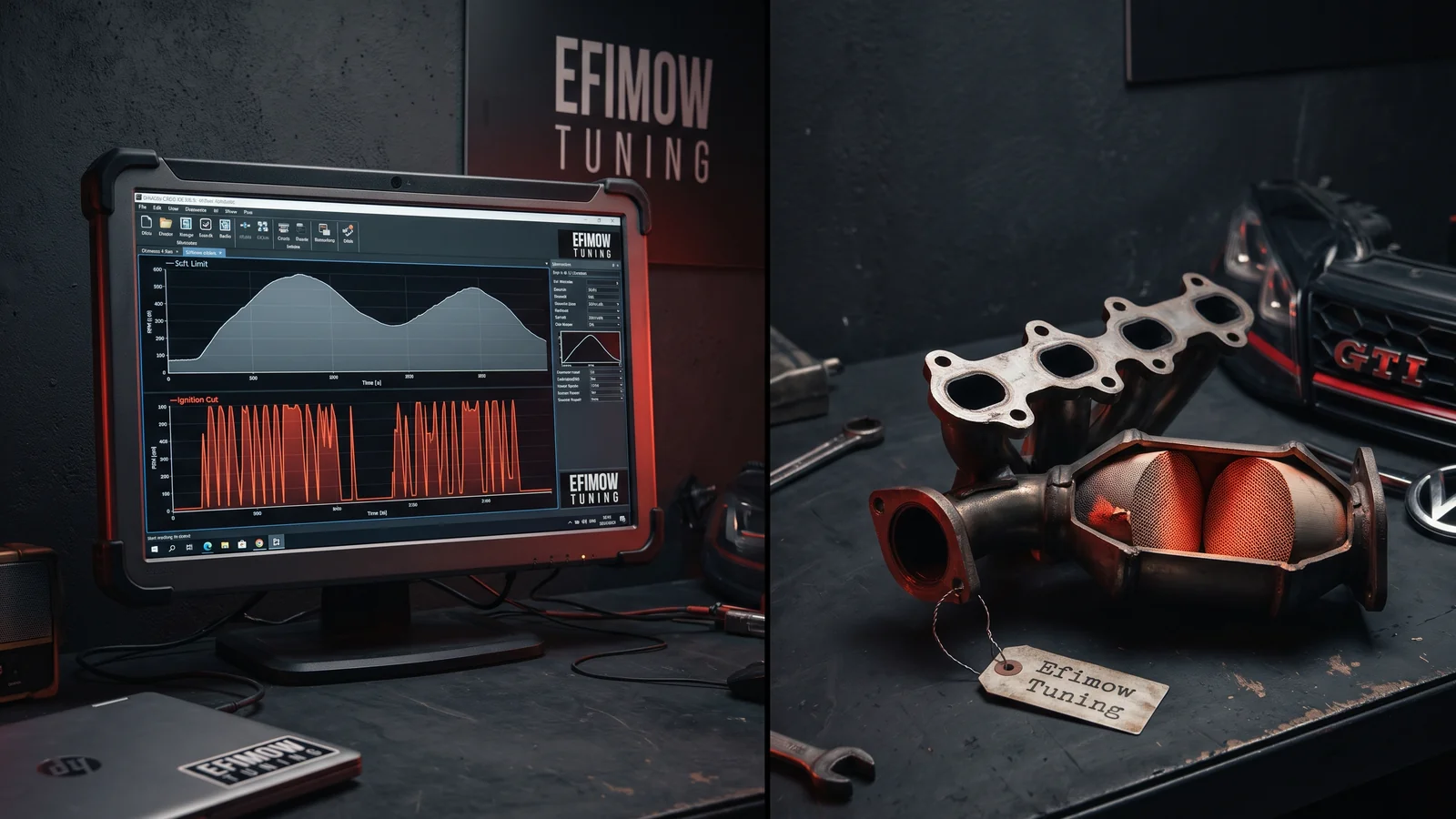
The result is the typical hard stutter at the limiter. Technically this has two effects: the engine keeps full power right up to the limit, and turbo engines keep more boost because the throttle does not close. On petrol engines there is an acoustic side effect: when ignition is skipped, unburnt fuel reaches the hot exhaust and can burn there.
Diesel engines are different. A diesel has no spark ignition, so there is no ignition cut. A diesel "hardcut" is a hard injection cut at the limiter instead of soft limiting, without any bang. On many diesel ECUs (such as Bosch EDC16/EDC17 and MD1) this is partly feasible; for Siemens/Continental SID, Delphi, Visteon or Marelli Multijet ECUs our data does not list it as feasible.
Popcorn-Limiter: retarded ignition at the limiter
The Popcorn-Limiter is the loud version. Here too, ignition is cut at the limiter, and in addition ignition timing is retarded heavily. Part of the combustion therefore no longer takes place in the combustion chamber but in the manifold and exhaust. That creates the characteristic crackle and bang, hence the name. It is related to pops & bangs on overrun, but not identical: pops & bangs work when you lift off, the Popcorn-Limiter only works at the limiter.
Because the Popcorn-Limiter depends on ignition timing, it is not possible on a diesel. On petrol engines it depends heavily on the ECU family and software version. In our evaluation it is feasible on Continental Simos turbo ECUs (for example Simos 18 in the Golf 7 GTI), on Bosch MG1 and on the Bosch MED17 variants of the premium manufacturers. For most other petrol families it is only partly feasible. There, a look at the read-out file decides.
What these functions do to the hardware
This is where honesty matters, because the bang has consequences. Combustion in the exhaust means very high temperatures in places that were not designed for them:
- Catalytic converter: the ceramic substrate is built for exhaust gas, not for combustion. Repeated afterburning can overload it thermally; in extreme cases the structure melts or cracks.
- Turbocharger: the turbine sits right in the hot exhaust flow. Pressure pulses and temperature peaks add load to the turbine wheel and bearings.
- Exhaust valves and manifold: retarded ignition raises exhaust gas temperature, valve seats and manifold get more heat.
- Drivetrain: a hardcut creates harsh load changes. Clutch, dual-mass flywheel and driveshafts feel every cut.
These loads are not a design flaw of the software, they are the price of the function. In motorsport this is accepted, because parts are treated as wear items anyway. In a daily car it simply makes no sense.
Legal classification: motorsport only
Hardcut and Popcorn-Limiter are intended exclusively for motorsport: for vehicles used on closed tracks and not on public roads. There are several reasons: noise and emission behaviour no longer match the type approval, and any change to the engine software voids the vehicle's operating permit. Driving on public roads with a banging limiter means driving without a valid operating permit, with all consequences for insurance and liability. The details are in our motorsport notice.
Cost and availability
For vehicles outside the BMW online flow, both functions can be booked as an option with the calibration, provided they are listed as feasible for your ECU family: hardcut €50, Popcorn-Limiter €50, each on top of the stage price and marked as a motorsport option. Where a function is only "partly" feasible, the configurator shows it as "on request". We then check on the basis of your file whether it can be implemented cleanly on your software version. For BMW, the configurator shows which extras are available for your ECU.
| Function | Principle | Petrol | Diesel |
|---|---|---|---|
| Stock limiter | Throttle, boost, ignition reduced softly | yes | yes |
| Hardcut | Ignition or injection cut, throttle stays open | mostly feasible | partly, no bang |
| Popcorn-Limiter | Ignition cut plus heavy retard at the limiter | depends on family | not possible |
What to consider before you decide
First ask yourself what you need the function for. If you regularly drive track days and want a stable rpm on the start line, you will benefit more from the hardcut than from the Popcorn-Limiter. The hardcut is the functional variant, the Popcorn-Limiter the acoustic one. Second: a car with a catalytic converter that is supposed to last a long time is not a good candidate for afterburning. Third: the setting can be reversed by flashing back the original file or a calibration without the function. Damaged components, on the other hand, cannot be flashed back.
Conclusion
Hardcut and Popcorn-Limiter are genuine motorsport tools: the hardcut keeps power and boost up to the limit, the Popcorn-Limiter adds retarded ignition and the bang. Both cost lifetime on the catalytic converter, turbocharger and exhaust side and belong exclusively on a closed track. Whether your ECU family supports these functions and what they cost is shown in the configurator, where they are marked as motorsport options.