
The torque model: how modern ECUs think
From accelerator pedal to requested torque: how modern engine management calculates in torque, coordinates requests and why that's central to tuning.
October 26, 2026 by Leo Efimow
When you floor the accelerator in a modern car, you don't open a throttle. You make a request. The engine control unit translates the pedal position into a desired torque, compares it with every other request in the vehicle, checks the limits and only then decides how much air, fuel and ignition the engine gets. This principle is called torque-based engine management, or the torque model for short. Understand it and you'll understand why reputable tuning works differently from a box on the boost sensor.
From throttle cable to requested torque
On older engines things were simple: the accelerator pulled the throttle open via a cable, the engine drew in air accordingly, and the ECU calculated the matching injection quantity and ignition timing. The driver controlled the air directly; the ECU reacted.
With the electronic throttle (drive-by-wire) and more and more systems intervening in the powertrain, that model became too narrow. Stability control, gearbox, cruise control and air conditioning all want a say. So in the late 1990s the torque-based structure became established, at Bosch for example with the ME7. Since then, torque has been the common language in which engine management and other control units talk to each other.
The chain at a glance
Torque-based control can be described as a chain of five steps:
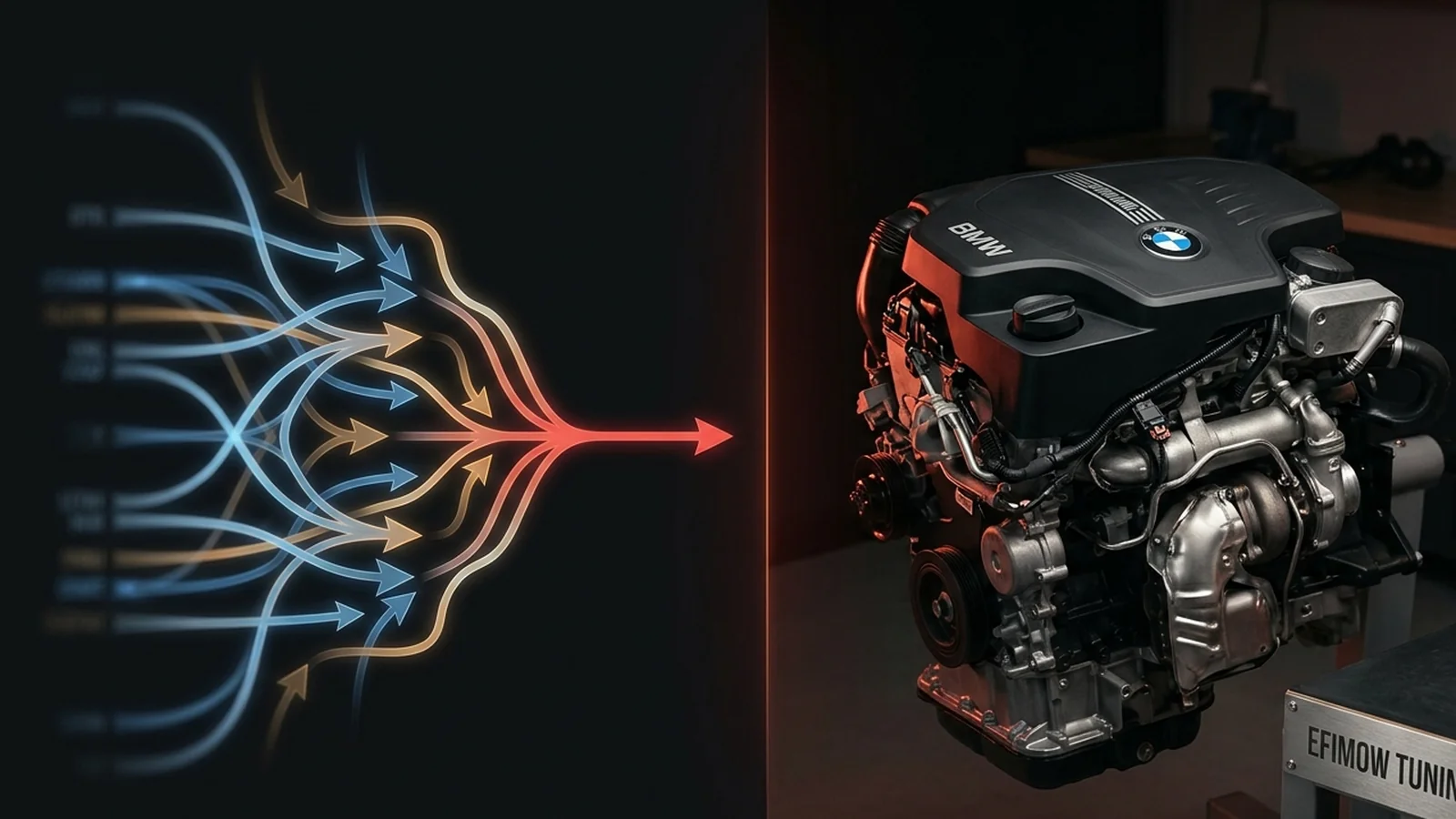
- Form the request: pedal position and engine speed produce the driver's requested torque.
- Collect requests: other systems report their own torque requests or limits.
- Coordinate: the ECU decides which request takes priority.
- Limit: protection limits for engine, gearbox and components are applied.
- Implement: the resulting target torque is translated into air charge, injection and ignition.
Step 1: the driver's request
The pedal map defines which torque is requested at which pedal position and engine speed. It largely determines how responsive a car feels. A driving mode such as Sport can use a different pedal map than Comfort or Eco. The engine can't deliver more, but it releases the torque earlier.
This is exactly where a throttle box intervenes: it only changes the pedal signal, not the engine's capability. More in Throttle boxes: why pedal modules don't make real horsepower.
Steps 2 and 3: requests and coordination
Besides the driver, other systems send torque requests to the engine control unit:
- Stability and traction control request less torque when a wheel spins, or briefly more, to stop the driven wheels from locking when you lift off.
- The gearbox requests a short torque reduction during shifts so the gear change is clean, and reports its maximum permissible input torque.
- Cruise control and adaptive cruise set a torque request of their own.
- Idle control holds engine speed when no pedal is pressed.
- Ancillaries such as the A/C compressor and alternator cost torque, which is accounted for as a loss.
Coordination follows fixed rules: driving-safety interventions take priority over the driver's request, protection limits over both. It's minimum and maximum logic, not averaging.
Step 4: the limiter chain
Before a torque is implemented, it passes through a series of limits. Typical ones are:
- maximum permissible engine torque depending on engine speed,
- gearbox and clutch protection,
- temperature limits for engine, charge air and exhaust gas,
- corrections for altitude and intake air temperature,
- engine speed and vehicle speed limitation.
This chain is why good tuning doesn't just mean "more boost". Raise only one actuator target and a limit elsewhere kicks in and the engine takes the torque away again, or it runs without effective protection.
Step 5: implementation in petrol and diesel engines
In a petrol engine, the target torque is achieved mainly via air charge: throttle, boost pressure, camshaft timing, and at BMW also variable valve lift. This air path is relatively slow because pressure in the intake manifold has to build up first. For fast interventions (during shifts or traction control, for example), the ECU uses the ignition angle: retarding the ignition lowers torque within a few combustion cycles. The injection quantity follows the air so the mixture is right.
In a diesel, the path is more direct: torque depends mainly on the quantity of fuel injected. It's limited among other things by the available air: smoke limitation ensures no more fuel is injected than can burn cleanly. Boost and rail pressure are controlled to match the requested quantity. How these variables relate is explained in Boost, rail pressure and ignition angle.
Monitoring: a second pair of eyes
Because with drive-by-wire the ECU determines torque itself, it must be ensured that it never delivers too much unintentionally. Modern engine management therefore contains an independent monitoring level. It calculates in parallel which torque would be permissible and compares it with what is actually being delivered. If the two don't match, it reacts with torque limitation, limp mode or, in the extreme case, shutdown.
For tuning this means: a change has to be consistent in itself. Raise the torque in the function path without the monitoring considering it plausible, and you end up in limp mode. A reputable modification takes both levels into account and keeps the monitoring effective.
What this means for tuning
Three principles follow from the torque model, and a clean modification works by them:
- Consistency instead of single values: request, limits and implementation are adapted together. More boost without matching torque limits achieves nothing or causes problems.
- Protection stays active: temperature, component and knock protection are calibrated to the new load points, not switched off.
- Include the gearbox: because engine and gearbox communicate via torque, the gearbox software often has to be adjusted too on automatic and dual-clutch transmissions. More in DSG/Steptronic TCU on BMW.
One example is the B58 straight-six in the BMW M340i (G20/G21): a Stage 1 there doesn't simply raise boost but shifts the torque limits, adapts charge and ignition and keeps the protection functions active at the new level.
That's also exactly the difference from a tuning box. It falsifies a sensor signal and makes the torque model calculate with false input data. The ECU believes it has less pressure or fuel than is actually present, and its protection logic works on a false basis.
Common questions from the workshop
Does a car with a modified pedal map feel stronger? It feels more responsive because torque is released earlier. Maximum power doesn't change.
Why does my car go into limp mode after a bad tune? Often because the changes don't fit the torque model, for instance when the monitoring considers a torque implausible or a limit wasn't adjusted along with it.
Does this apply to motorcycles too? Modern motorcycles with an electronic throttle work on similar principles, often with a simpler structure. The principles (consistent changes, active protection) apply just the same.
Conclusion
Modern ECUs think in torque. The pedal becomes a request, all requests become a coordinated target torque, the limits become a safe frame, and only at the end does a specific air charge, injection and ignition follow. Good tuning respects this chain instead of outwitting it. The configurator shows which stages and options are possible for your BMW. The software change voids the type approval; the software is intended for motorsport use only (motorsport notice).