
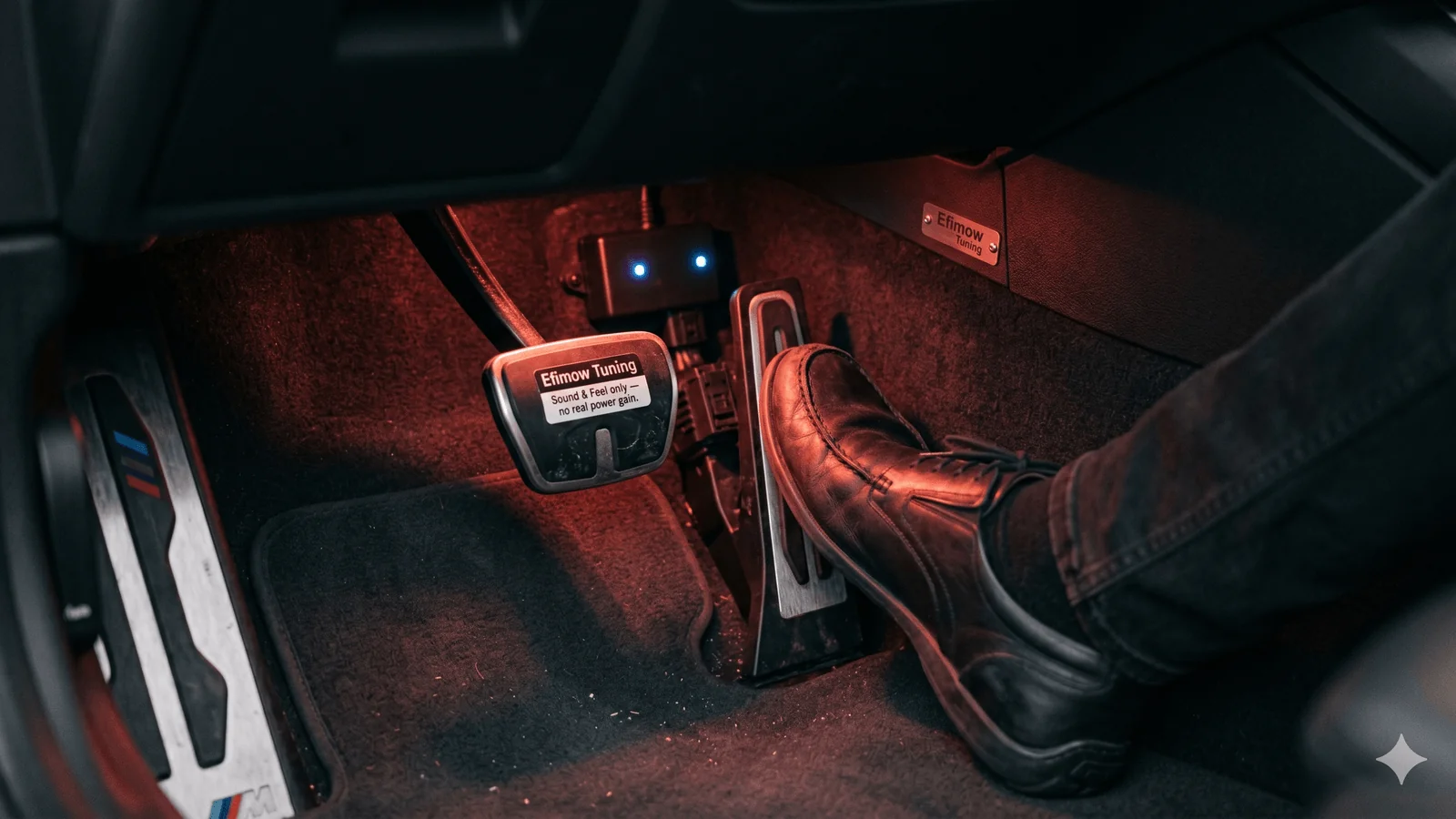
Throttle Boxes: Why Pedal Modules Don't Make Real Horsepower
A subjective sportiness effect with zero added horsepower. What the module actually does, and why some tuners still pair it with a real tune.
May 6, 2026 by Leo Efimow
A throttle-response box (also sold under names like pedal tuner, throttle controller, or sprint booster) is one of the best-selling aftermarket products in the BMW world. The pitch is seductive: faster throttle response, sportier feel, plug-and-play installation in five minutes. What the marketing rarely mentions: the device does not change a single horsepower number on your engine. A throttle box is a perception tool, not a tune. Once you understand what it actually does electrically, you also understand why it produces the exact same dyno trace as the bone-stock car.
What the Throttle Box Actually Does
In modern BMWs there is no mechanical link left between the pedal and the throttle plate. The accelerator is an electronic sensor: two redundant Hall-effect channels send a voltage signal, typically between 0.5 and 4.5 volts, to the ECU. That voltage describes nothing more than pedal angle. It is the input the ECU uses to compute driver torque demand.
The throttle-response box sits as a small interceptor module directly on the pedal-sensor connector. It reads the original signal, multiplies it by a factor (1.2 to 1.8 depending on selected mode), and forwards the modified signal to the ECU. Press the pedal physically to 30 percent travel, and the ECU suddenly sees a value that corresponds to a 50-percent press. The ECU responds the way it always does: it opens the throttle plate a bit further, requests a bit more torque, and the car feels more aggressive.
The scale of that shift matters. With the pedal pressed all the way down (about 4.5 volts at the sensor), the box has nothing left to amplify. The maximum is already reached, the ECU already sees "100 percent driver demand." From that point on, your car with the box installed behaves identically to stock.
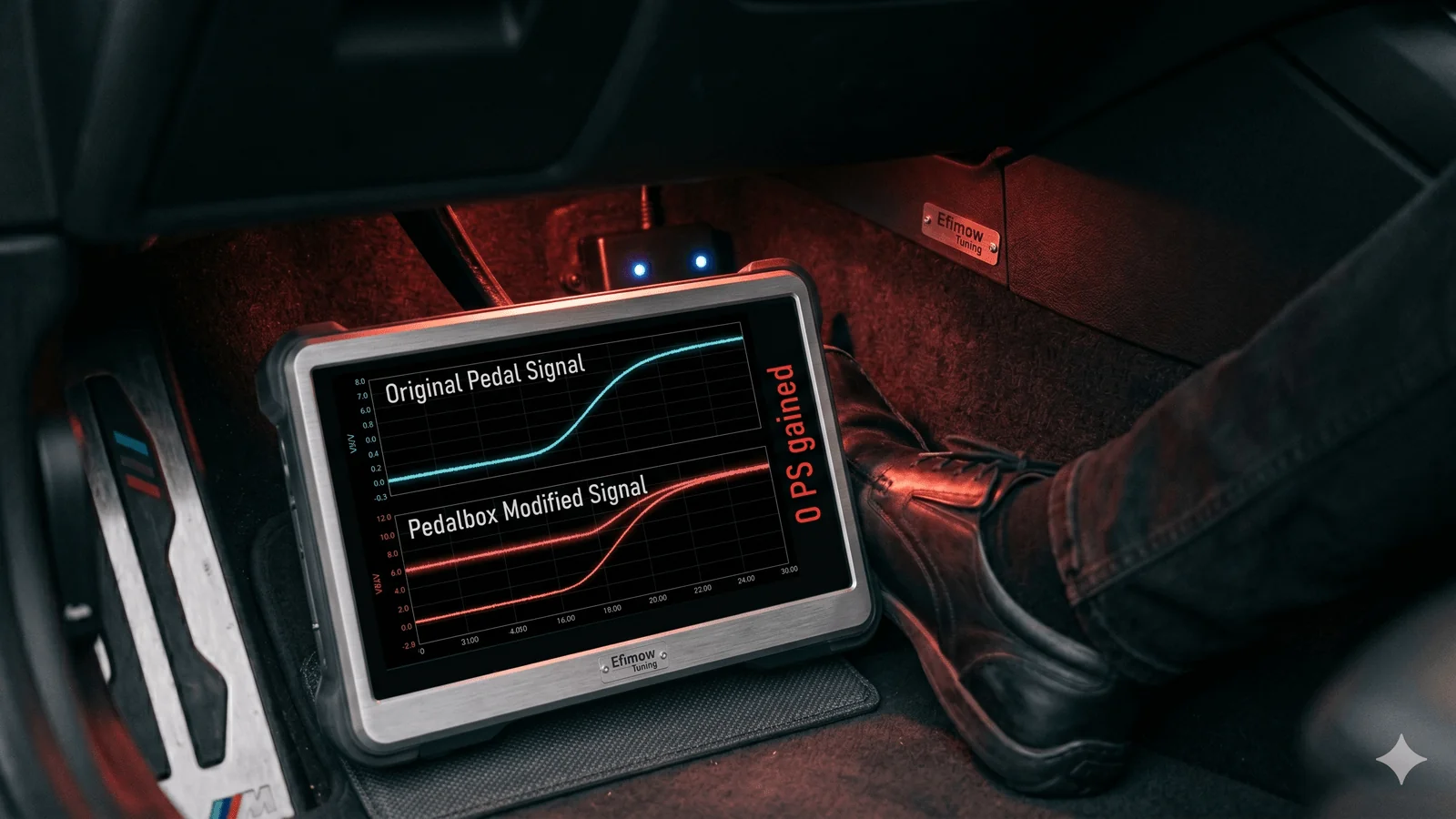
Properly engineered modules also forward both Hall channels with a plausible offset so the ECU's sanity check does not throw a fault. Cheap no-name boxes only manipulate one channel, and that, in the worst case, triggers a plausibility error, a check-engine light, and a limp-home mode with reduced torque. The ECU compares both pedal channels several times per second; if one path drifts too far from the other, pedal demand falls back to a safe minimum instantly.
Why the Dyno Sees Nothing
A power dyno measures what the engine actually delivers under wide-open throttle: torque across RPM, with horsepower derived from that. Wide-open throttle means: pedal floored, lambda target met, boost target tracked, ignition timing set within knock margin. None of those four parameters is influenced by a module hanging off the pedal connector.
A throttle box can shift when the ECU requests a given torque target, but not how high that target is allowed to go. The ceiling is set by the torque map inside the ECU, and that map is not touched by a pedal sensor module. On a 330i with factory calibration, a wide-open dyno run shows the same 258 hp regardless of whether a box is plugged in or not. Reproducible. Across every brand we have ever benchmarked.
If you want the same subjective effect without buying anything, simply press the pedal faster. The connector-side change saves you 100 to 200 milliseconds of pedal travel. That is all. The factory Sport Mode in any current BMW already does the same thing for free: it adjusts the pedal map inside the ECU itself, with no add-on hardware in the sensor path.
Where a Throttle Box Can Genuinely Help
We are not saying the module is useless. It does have a measurable effect, just not the one printed on the box. Three scenarios where customers do appreciate it:
First, on older vehicles with very softly calibrated pedal mapping, where the car feels lazy from the factory. Here the throttle box noticeably lifts initial sensitivity.
Second, in combination with a real software tune. When the engine already produces 320 hp from a Stage 1 calibration, the faster pedal response feels like an extension of that gain. The added power, however, comes from the ECU software, not from the module.
Third, for drivers who want a permanently sharper pedal map without toggling the drive-mode switch every trip. That is a comfort argument, not a power argument.
In all three cases the customer should understand what they are buying: perception, not physics. Anyone spending 250 euros on a pedal module and expecting "noticeable extra power" simply has the wrong product in the cart.
What to Watch When Evaluating Boxes
When a vendor advertises "up to 25 hp added by our throttle box," that claim is not technically defensible. An honest product description names the device for what it is: a pedal-sensor modulator that changes response feel, not power output. Reputable tuners therefore use throttle boxes only where a customer specifically wants an even sharper response on top of an already-flashed ECU: as a comfort add-on, never as a substitute.
Second, watch electromagnetic compatibility and connector quality. Because the module sits directly in the signal path of a safety-relevant sensor, a poorly built solder joint can cause dropouts in pedal acquisition, and the ECU will go straight to limp mode if it sees implausible data. Exactly the outcome nobody wanted.
Third, OBD diagnostics will normally not detect the box, because the modified pedal signal stays inside its plausible voltage range. That keeps it inconspicuous during dealer service or test drives. That can be an advantage, but it also means a fault, when one occurs, is harder to localize.
Bottom Line
The throttle-response box is an honest product as long as you see it for what it is: a module that changes pedal response feel. It multiplies the voltage at the accelerator sensor and shifts the perceived start of acceleration forward by a few hundredths of a second. What it does not do is change torque, boost, or ignition, the very parameters that produce real horsepower. Anyone looking for a sharper initial bite who can live with the fact that the dyno sees no change can run a throttle box with a clear conscience. Anyone after actual added power has to go where horsepower is actually decided: into the ECU's maps.