
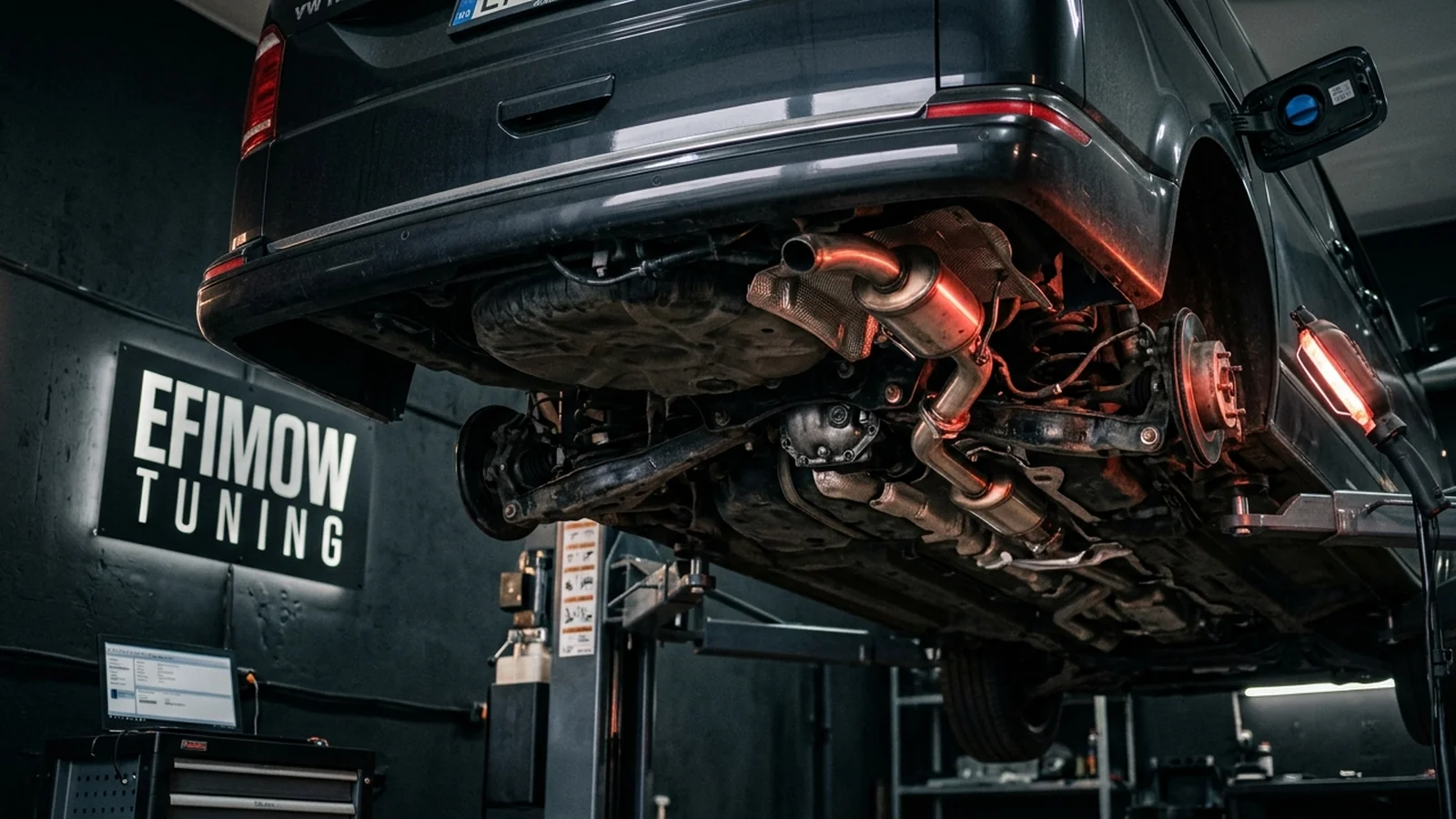
DPF, EGR, AdBlue: Why Disabling Them Is Prohibited
What DPF, EGR, AdBlue, OPF, catalytic converter and secondary air do, what the law says about disabling them and what emissions tampering can lead to.
October 25, 2026 by Leo Efimow
A clogged particulate filter, a coked EGR valve, a failed AdBlue doser: repairs to the exhaust aftertreatment quickly get expensive. Accordingly, the idea of "solving" the problem in software comes up often: remove or disable the component, switch off monitoring, done. Technically this is feasible on many ECUs. Legally, on public roads, it is clearly prohibited. In this article we explain factually what each system does, which rules apply and what consequences emissions tampering can have.
What the systems do
Modern combustion engines do not meet their emission standard through the engine alone, but through several systems working together:
- DPF (diesel particulate filter): traps soot particles and burns them off during regeneration phases.
- EGR (exhaust gas recirculation): routes part of the exhaust back into the intake, lowering combustion temperature and thus nitrogen oxides.
- SCR with AdBlue: injects urea solution into the exhaust; in the SCR catalyst, nitrogen oxides are converted into nitrogen and water.
- OPF (gasoline particulate filter): the counterpart of the DPF on direct-injection petrol engines, fitted to many engines since Euro 6d.
- Catalytic converter: converts carbon monoxide, hydrocarbons and (on petrol engines) nitrogen oxides.
- Secondary air system: on some petrol engines it blows air into the exhaust after a cold start so that the cat reaches temperature faster.
Each of these systems is controlled by the engine ECU and monitored by on-board diagnostics. If a component fails, the ECU sets a fault code and reports it via the engine warning light.
What "disabling" means technically
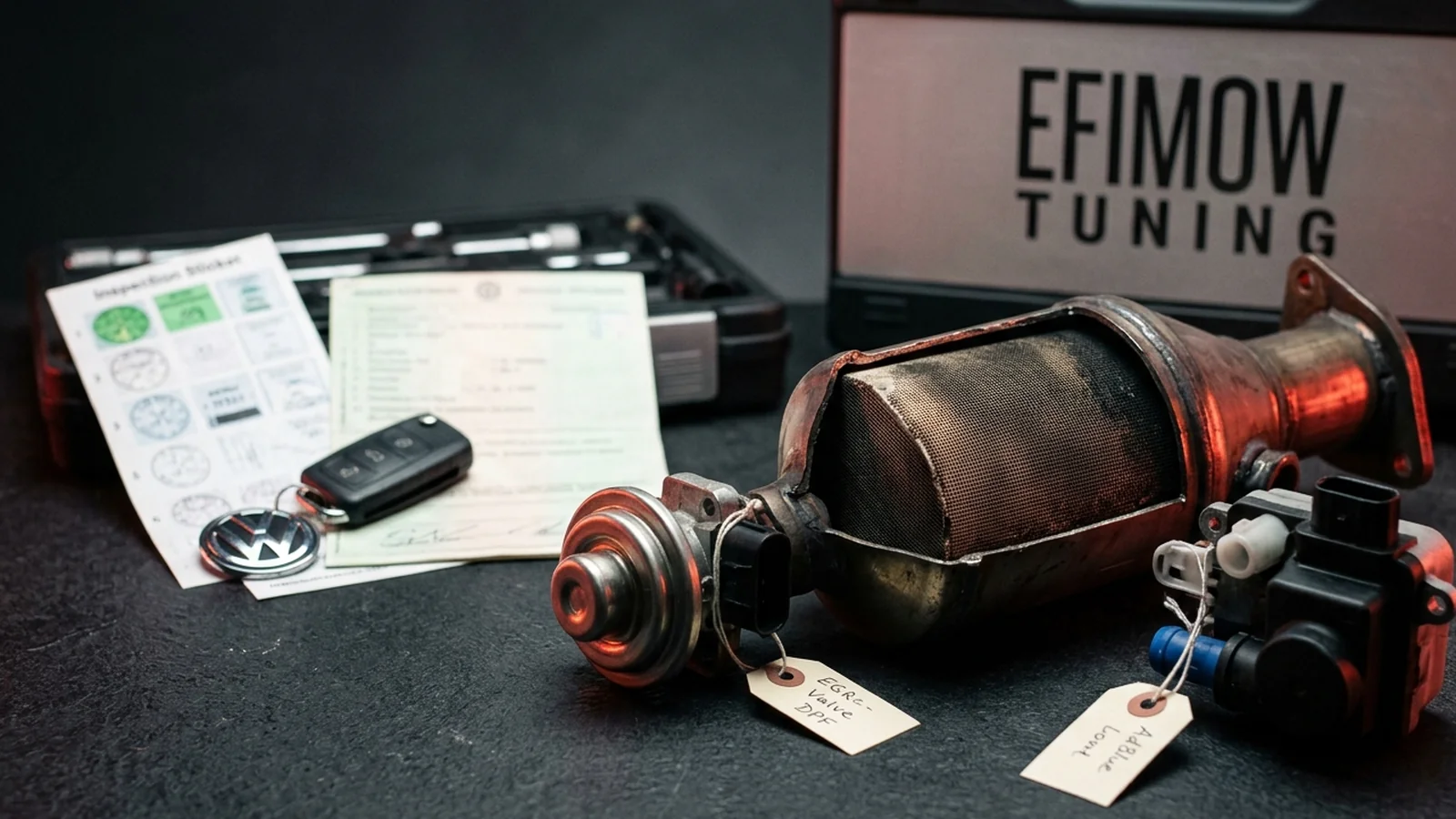
Disabling almost always has two levels. On the hardware level, the component is removed, gutted or mechanically blocked, for example an emptied filter or a blanked EGR valve. On the software level, the related control is deactivated and monitoring is changed so that the missing function no longer shows up: no regeneration, no dosing, no fault codes, no warning light.
Legally it does not matter whether both levels are changed or only one. A pure software deactivation with the component still installed is also tampering if it reduces the effectiveness of the exhaust aftertreatment. This explicitly includes simply suppressing fault codes of emission-related components: rear lambda sensor, cat, DPF, OPF, EGR, SCR and secondary air.
The legal position
Two sets of rules are decisive:
EU type approval, Regulation (EC) 715/2007, Article 5: vehicles must be designed to comply with emission limits in normal use. Defeat devices that reduce the effectiveness of emission control systems are prohibited. The regulation only allows narrowly defined exceptions, for example to protect the engine against damage. A permanent deactivation to save costs is not one of them.
Section 19(2) StVZO (German road vehicle licensing regulation): a vehicle's operating permit expires, among other things, when a modification worsens its exhaust or noise behaviour. A vehicle without DPF function, without EGR or without SCR dosing inevitably has worse exhaust behaviour. There is no registration that legalises this condition for road use, unlike a power increase, which can be registered with an expert report.
| System | What it reduces | Disabling on public roads |
|---|---|---|
| DPF / OPF | Particulates | not permitted |
| EGR | Nitrogen oxides | not permitted |
| SCR / AdBlue | Nitrogen oxides | not permitted |
| Catalytic converter | CO, HC, NOx | not permitted |
| Secondary air | Cold-start emissions | not permitted |
| Fault codes of these systems | (monitoring) | not permitted |
What the consequences can be
Once the operating permit has expired, the vehicle may no longer be used on public roads. Several consequences follow from this:
- Periodic inspection and emissions test: during the emissions test the fault memory is read via OBD and a tailpipe measurement is taken as well. A missing filter or changed emission behaviour can show up; without properly working exhaust aftertreatment, the vehicle will not pass.
- Emission class: the vehicle's classification (and with it things like the environmental badge and the basis for vehicle tax) relies on the approved condition. A tampered vehicle no longer corresponds to that condition.
- Insurance: if a vehicle is driven without a valid operating permit, the insurer may reduce payments or claim recourse after damage.
- Administrative offence: operating a vehicle without an operating permit is prosecuted as an administrative offence.
When selling the car, there is a further level: anyone who sells a vehicle with disabled exhaust aftertreatment without disclosing it risks civil claims from the buyer.
And in motorsport?
For vehicles used exclusively on closed tracks and without road registration, road licensing rules do not apply in the same way; the regulations of the respective racing series govern what is allowed. A registered car that "also goes on track sometimes" is not a race car in the legal sense, though. As soon as it goes on the road, the type-approval rules apply. In general: any change to the engine software voids the operating permit; the details are in the motorsport notice.
The better solution: fix the cause
Most problems with exhaust aftertreatment have a cause that can be found. In workshop practice, the same candidates come up again and again:
- DPF: pure short-trip driving never gets the filter hot enough to regenerate. Often a longer motorway drive or a regeneration triggered with a diagnostic tool is enough. A faulty differential pressure sensor or a leaking sensor hose, on the other hand, simulates a soot load that does not exist.
- EGR: deposits of soot and oil mist clog the valve and cooler. Cleaning or replacing the valve is a regular repair.
- SCR/AdBlue: crystallised urea at the dosing valve, a faulty level or quality sensor or a frozen line are typical fault patterns, almost all of them repairable.
- Cat and OPF: faults here are often a consequence of other problems, such as misfires or an overly rich mixture. If you only treat the symptom, the next damage is already on its way.
A thorough diagnosis is almost always cheaper than the consequences of tampering, and the vehicle stays road-legal. A cleanly read fault memory with freeze-frame data is the best place to start.
Conclusion
DPF, EGR, SCR with AdBlue, OPF, catalytic converter and secondary air are not optional add-ons but part of the type approval. Disabling them on public roads or suppressing their monitoring is prohibited under Regulation (EC) 715/2007 and, under Section 19(2) StVZO, voids the operating permit. If your exhaust aftertreatment is giving you trouble, a clean diagnosis is the best way forward. The software options available for your ECU are shown in the configurator.