
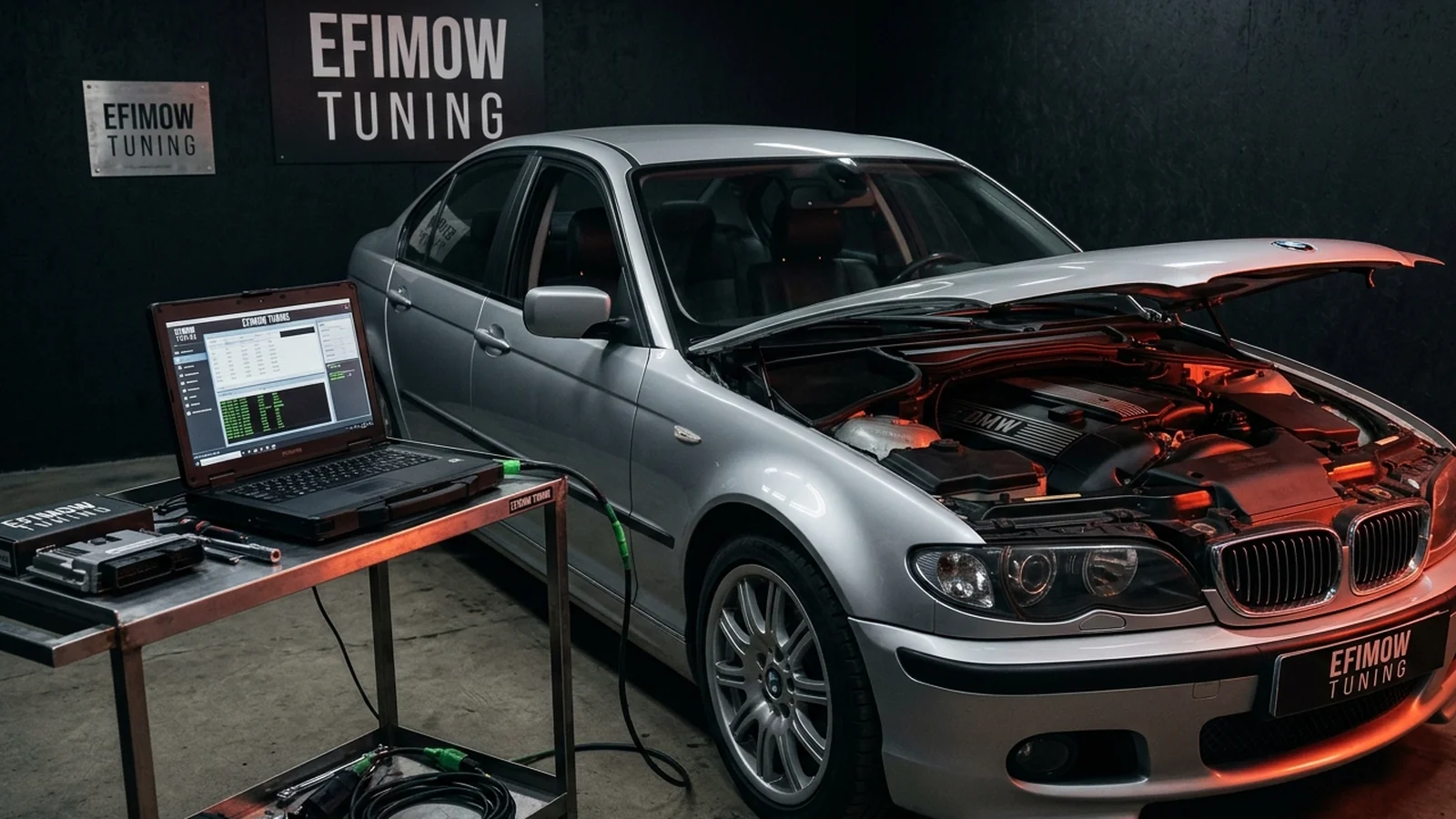
Siemens MS42/MS43: Tuning the M52TU and M54 Naturally Aspirated Sixes
MS42 and MS43 control BMW's M52TU and M54 in the E46, E39 and X5 E53. What software realistically delivers and what to check beforehand.
October 26, 2026 by Leo Efimow
For many people, the M54 is the essence of the BMW inline-six: smooth, eager to rev, with no turbo and no direct injection. Together with its predecessor, the M52TU, it powers a whole generation of cars: E46, E39, X5 E53, Z3 and the early Z4. Both engines are controlled by Siemens units: the MS42 on the M52TU and the MS43 on the M54. Owners of these cars often wonder whether software is worth it at all. The honest answer: yes, but with clear expectations. A new file does not turn a naturally aspirated engine into a turbo.
Which cars are affected
From around 1998, the M52TU replaced the first M52, which still ran on the Siemens MS41. It gained double VANOS and the MS42. Typical cars are the 320i, 323i and 328i in the E46 and the 520i, 523i and 528i in the E39.
From around 2000, the M54 followed, with 2.2, 2.5 and 3.0 litres and the MS43. It powers the E46 320i, 325i and 330i, the E39 520i, 525i and 530i, the X5 E53 3.0i and the Z3. Later series with the M54, such as the E60 or the X3 E83, got the further development MS45. For individual cars on the boundary between generations, a look at the diagnosis to see which unit is actually fitted is worthwhile.
Some examples from our range, with the reference values from the product pages:
| Car | Engine | DME | Stock | Stage 1 (reference) |
|---|---|---|---|---|
| E46 320i | M52B20TU | MS42 | 150 hp / 190 Nm | approx. 161 hp / 209 Nm |
| E46 / E39 328i / 528i | M52B28TU | MS42 | 193 hp / 280 Nm | approx. 207 hp / 308 Nm |
| E46 325i | M54B25 | MS43 | 192 hp / 245 Nm | approx. 205 hp / 270 Nm |
| E46 / E39 330i / 530i, X5 3.0i | M54B30 | MS43 | 231 hp / 300 Nm | approx. 247 hp / 330 Nm |
What MS42 and MS43 control
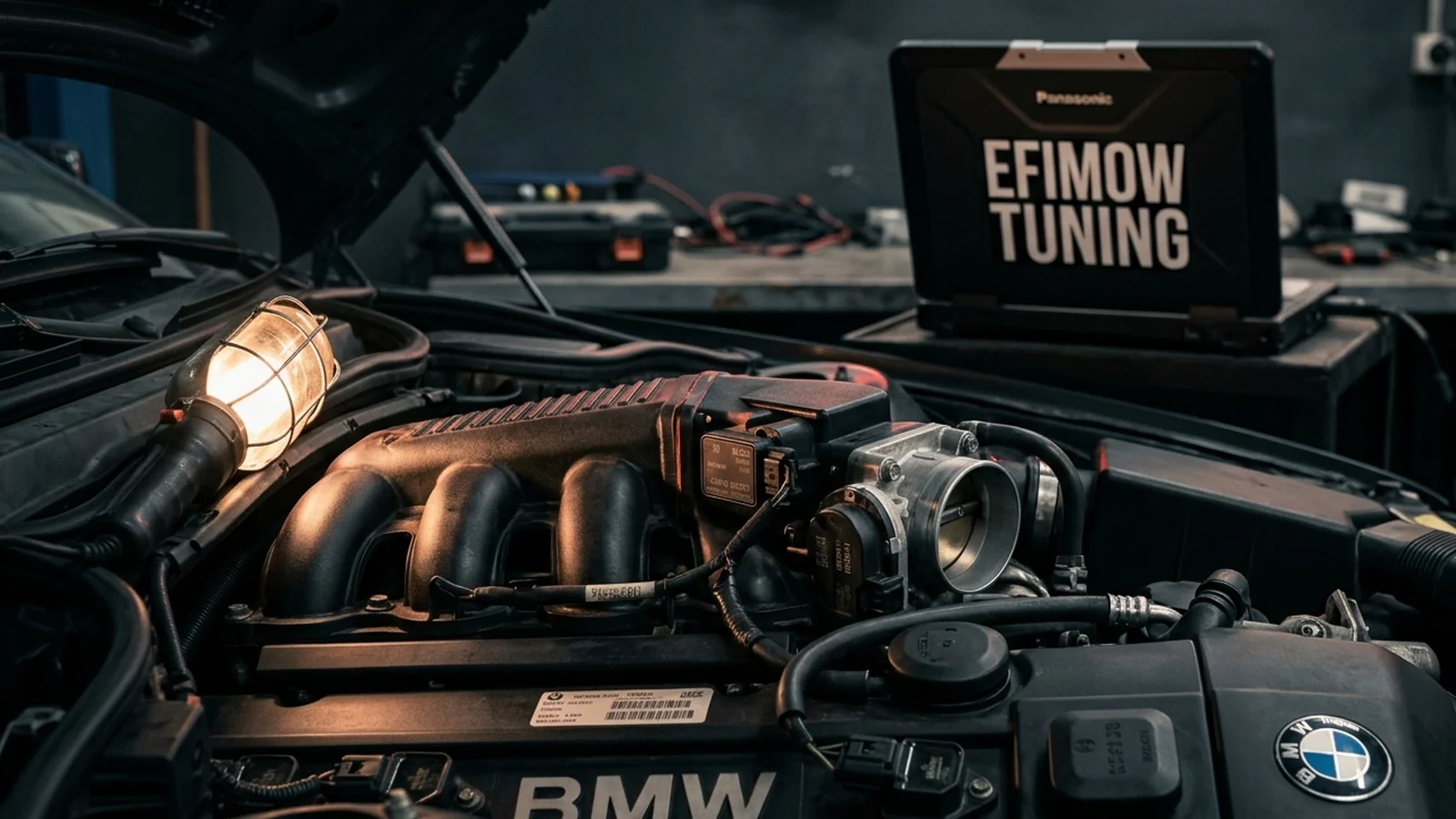
Both units work with port injection. The DME measures intake air mass via the hot-film air-mass meter, calculates injection quantity and ignition angle from it and controls the mixture via the lambda sensors. On top of that come control of the double VANOS for the intake and exhaust camshafts, idle control, knock control via knock sensors and (on the M54) the electronic throttle.
Because there is no turbocharger, the biggest lever of modern power tuning is missing: boost. More air only gets into the cylinder through better charging, and that is determined by intake, camshafts and exhaust. Software can use that charge better, but it cannot make it bigger.
What software realistically delivers on the M52TU and M54
In practice, the gain on a healthy engine is around 6 to 8 percent power and roughly 10 percent torque: on the 330i, from 231 to approx. 247 hp. But on these engines something else is more noticeable than peak power:
- Throttle response: The M54's pedal map is fairly reserved from the factory. A more direct curve makes the car feel livelier day to day, without changing the power.
- Ignition and mixture: At full load, the ignition angle can be tuned for high-octane fuel; knock control stays active and pulls ignition when necessary.
- Torque curve: The transition between VANOS positions and the curve in the mid-range can be smoothed.
- Limiters: Rev and speed limiters are parameters. If you change them, you have to observe the tyre speed rating and registration requirements.
Stage 2 means hardware on these engines: headers and/or a 200-cell sports catalytic converter. According to the product page, the reference value for the M54B30 is then approx. 259 hp. Exhaust systems need approval or an expert report.
Before tuning: check the condition
Most cars with MS42 and MS43 are now 20 years old or more. Before we adjust a file, the engine should run cleanly. Software cannot program away a fault, and tuning a sick engine is wasted work. Typical points we see again and again on these engines:
- Crankcase ventilation: A clogged ventilation valve leads to oil consumption, unmetered air and a rough idle.
- Unmetered air: Cracked hoses and seals in the intake falsify the air-mass reading.
- Air-mass meter and lambda sensors: Ageing sensors deliver inaccurate values, and mixture control then works against the calibration.
- VANOS seals: Hardened seals in the double VANOS cost noticeable torque in the low and mid-range.
- Cooling system: Plastic parts on the water pump, thermostat and expansion tank age and should be in good order.
A fault memory without entries and a smooth idle are the best starting point. Often the repair alone brings back part of the "lost" responsiveness.
Typical questions from the workshop
Do I need premium fuel after tuning? The calibration is designed for high-octane fuel. With a lower octane rating, knock control intervenes earlier and pulls ignition. The engine protects itself, but loses part of the gain in the process.
Does an open air filter add anything? On the M52TU and M54, hardly anything measurable on its own. The charge of a naturally aspirated engine depends on the entire intake and exhaust path, not on a single filter. The audible difference is usually bigger than the noticeable one.
Can I go back to stock? Yes. The original file is backed up before the first write and can be flashed back at any time. Keep it safe, even when you sell the car.
Does fuel consumption change? Hardly, with the same driving style. If you regularly use the extra power, you will use more fuel, but that is down to your right foot, not the software.
Is it worth it on a 320i? The small M52TU and the M54B22 benefit by a similar percentage to the 3.0-litre. The gain in absolute horsepower is smaller, but the more direct response is just as noticeable.
Process and price
For BMW, tuning runs online: you configure your car, pay only for hardware and a €5 deposit today, read out the original file with a K-DCAN cable and upload it in the customer portal. We adjust the file by hand, usually within 48 hours. Only then do you pay for the software and flash it yourself via OBD.
According to the product pages, the software for MS42 and MS43 costs from €150 for Stage 1 and €200 for Stage 2, for example on the BMW 330i (E46) or the BMW 530i (E39). The exact price for your combination of stage and extras is shown in the configurator.
Legally: the software change voids your vehicle's type approval; the software is intended exclusively for motorsport (motorsport notice).
Conclusion
MS42 and MS43 are solid, well-understood control units for two of BMW's most popular naturally aspirated engines. If you see tuning there as fine-tuning (more direct response, a cleaner torque curve, a few extra horsepower), you will be satisfied. If you expect double-digit percentage gains, you need hardware or a different engine. Where the MS4x units sit in the history of BMW engine management is shown in our overview of DME generations.