
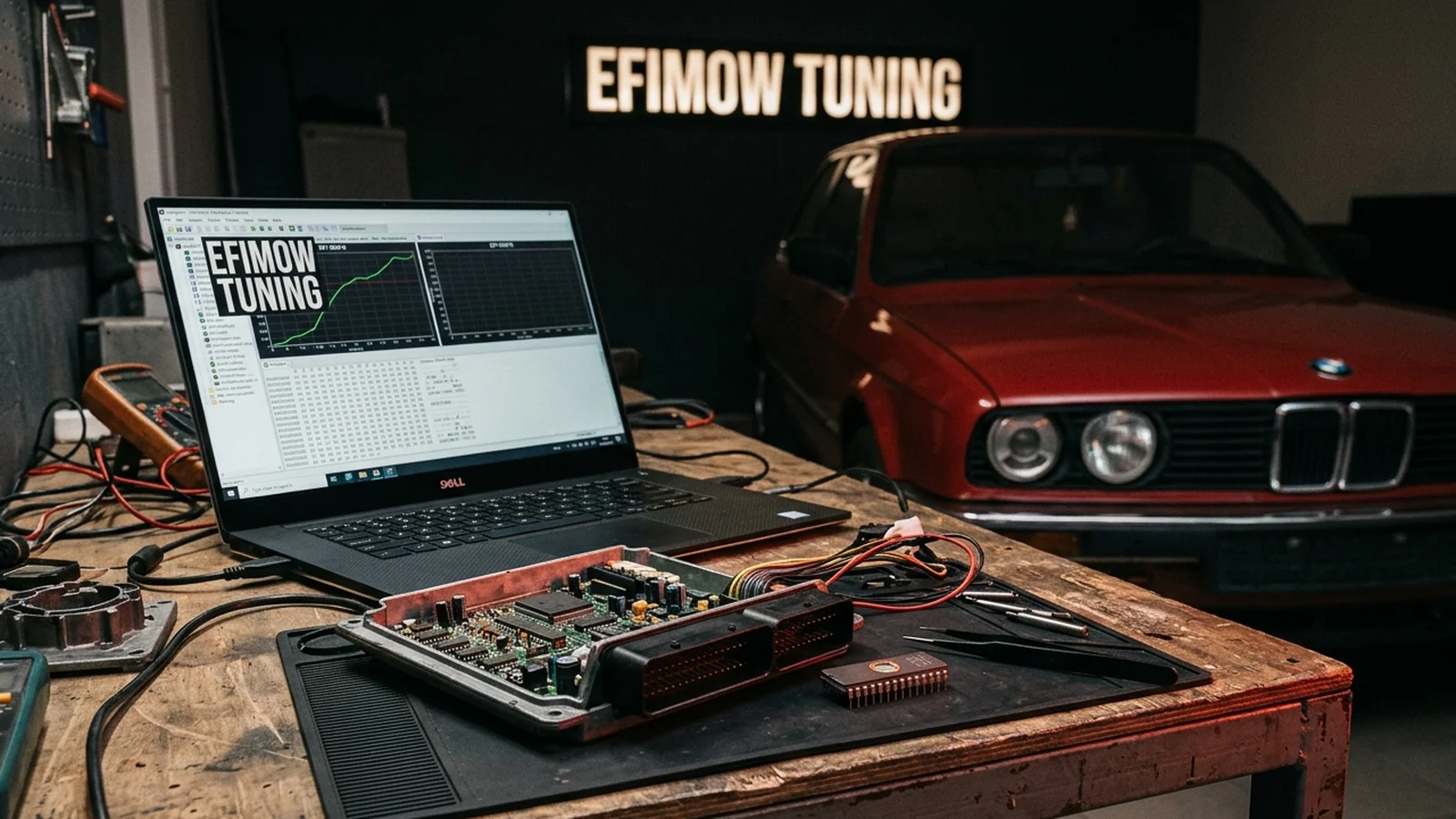
Motronic M1.x to M5.2: BMW Classics from the EPROM Era
From the first Motronic in the 732i via M1.3, M1.7 and M3.x to the M5.2 in the V8: how BMW classics are controlled and what tuning means there today.
October 26, 2026 by Leo Efimow
If you drive a BMW from the 1980s or early 1990s, you are driving a piece of electronics history. In 1979 the BMW 732i of the E23 series was the first production car with Bosch Motronic, a digital control system that combined injection and ignition in one unit. At BMW this ECU is still called the DME, Digital Motor Electronics. Over the M1.x, M3.x and M5.2 generations Bosch developed the Motronic further, until at the end of the 1990s it was replaced by ECUs with electronic throttle and, later, a completely different architecture. In this article we assign the generations to the engines and explain what tuning means on these classics today. How the path from chip to flash memory developed in general is described in our article From EPROM to flash.
Motronic M1.x: the beginnings
The first Motronic generation controlled the six- and four-cylinder engines of the 1980s. In practice we mainly come across three variants:
- M1.0 and M1.1: the early systems, among others in the M20 and M30 of the first years, for example in the E28, E30 and E32.
- M1.3: from around 1987/1988 in the M20 and M30 six-cylinders, for example in the E30 320i and 325i, in the early E34 520i and 525i or in the E32 and E34 with 3.0- and 3.5-litre engines.
- M1.7: for the M40 and M42 four-cylinders, for example in the E30 316i and 318i, the E30 318is and the early E36 four-cylinders. The M1.7.2 variant also controlled the first M43s.
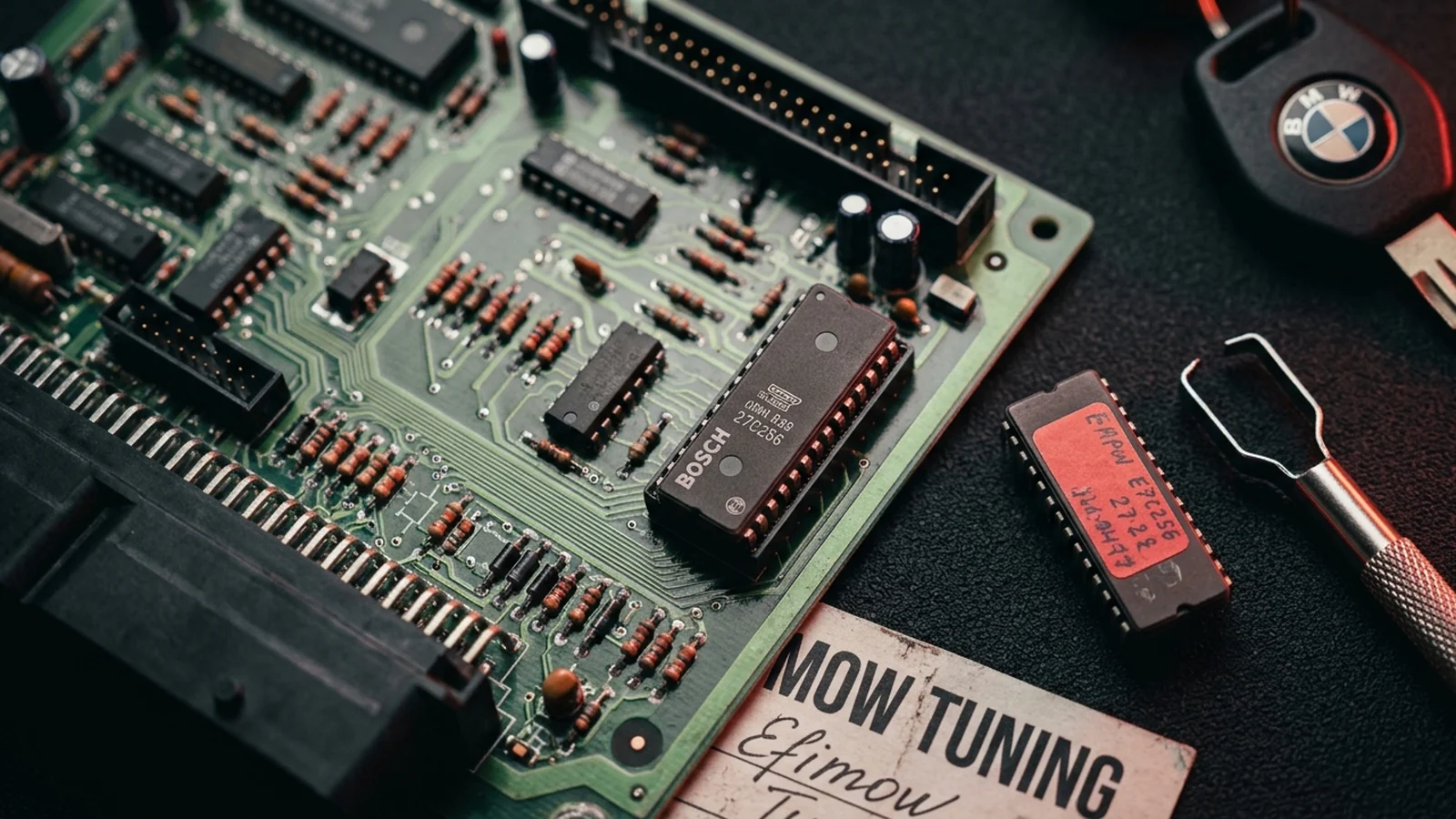
Typical of this generation is an air flow meter with a vane flap that measures the intake air mechanically, and a comparatively simple structure of maps for injection and ignition. The entire software fits into a single memory chip, an EPROM.
Motronic M3.x: four valves and Vanos
With the M50 six-cylinder, BMW's first volume six-cylinder with four valves per cylinder, the Motronic M3.1 arrived in 1990. It is found in the M50 without Vanos, for example in the E34 520i and 525i 24V and in the early E36 320i and 325i.
From 1992 the M50 received variable camshaft timing, Vanos, and with it the Motronic M3.3.1. A related variant of the M3.3 also controlled the M60 V8, for example in the E32 and E34 with 3.0- and 4.0-litre engines and in the early E31 840Ci. With the M3.x the control system became more extensive; from the M3.3.1 onwards Vanos control was added. The memory, however, remained an EPROM, either socketed or soldered in depending on the unit.
From the mid-1990s Siemens took over engine management on the M52 six-cylinders with the MS41 family. At BMW the Bosch line continued mainly on the V8s.
Motronic M5.2: the transition to flash
The Motronic M5.2 controls the first version of the M62 V8 from around 1996, for example in the E38 735i and 740i, the E39 535i and 540i and the E31 840Ci with 4.4 litres. It already belongs to the generation with flash memory: the software can be rewritten over the diagnostic line without swapping a chip. With the revised M62TU from 1998 BMW then switched to the ME7.2 with electronic throttle, and that marks the end of the classic Motronic era on the BMW V8s.
Chip tuning in the literal sense
On the M1.x and M3.x, tuning means exactly what the term says: the chip with the software is swapped for a chip with adapted software. For this the ECU is removed and opened, the original content is backed up, and the adapted software goes onto a new chip that matches the unit electrically and mechanically. The original EPROM is preserved. With classics in particular, that matters: if you want to return the car to its delivery condition later, you simply plug the original chip back in.
On the M5.2 with flash memory, by contrast, the route runs through the diagnostic interface as on later BMWs; the ECU does not have to be opened.
What tuning delivers on the classics
All these engines are naturally aspirated. Without a turbocharger there is no boost to raise; the reserves lie in ignition timing and mixture. The gains are correspondingly moderate, typically in the single-digit percentage range for NA engines. For the E39 540i with M62 and Motronic M5.2, the product page gives a calculated guide value for Stage 1 of around 306 hp and 462 Nm instead of 286 hp and 420 Nm. According to the product page, Stage 1 there starts at €170.
What you notice more than the peak output on many classics is the driving feel: sharper response and a smoother rev range. The ignition has to suit today's fuel. If you run optimised ignition timing, you should fill up with Super Plus (98 RON).
Before tuning: 30-year-old electronics
With a classic, condition decides far more than the software. In practice we see the same points again and again:
- Air flow meter: on vane-type meters the wiper track wears over time. That leads to hesitation and wrong mixture values.
- Sensors and connectors: temperature sensors, throttle switches and contacts in the wiring harness age. Corroded connectors are a common cause of inexplicable misfires.
- Ignition: distributor cap and rotor on engines with a distributor, ignition leads, plugs and coils should be in order.
- Air leaks and idle: porous hoses and a dirty idle control valve distort mixture formation.
- The ECU itself: components on the circuit board, such as capacitors, can age after decades. A look inside the opened unit is part of the process on the M1.x and M3.x anyway.
An engine that runs cleanly cold and warm is the prerequisite. Tuning is no substitute for restoration.
Classics that are not in the configurator
In the configurator you will find the BMW model series from the E36 onwards, including cars with M5.2 such as the E38, E39 and E31. Many genuine Motronic classics such as the E30, E32 or E34 are not listed there as products. If you drive such a car, just get in touch and describe model, engine and ECU. We will then clarify what is possible and sensible.
The software change voids your vehicle's type approval; the software is intended for motorsport use only (see the motorsport notice). That applies to classics just as much as to current cars.
Conclusion
The Bosch Motronic controlled BMW engines from 1979 until the end of the 1990s: M1.x for the M20, M30, M40 and M42, M3.x for the M50 and M60, M5.2 for the first M62. Up to the M3.x the software sat in an EPROM, and tuning meant swapping the chip. With the M5.2 the transition to flash memory began at BMW. On all these NA engines the gains are moderate, and the condition of sensors, ignition and ECU matters more than any map change. If you back up the original and get your classic in order first, you get a car that feels fresher and can still return to its original condition at any time.