
From EPROM to Flash: How Chip Tuning Has Evolved
In the 1990s, tuning meant desoldering a memory chip. Today it's a software process over the diagnostic port. A technical look at 30 years of ECU modification.
May 6, 2026 by Leo Efimow
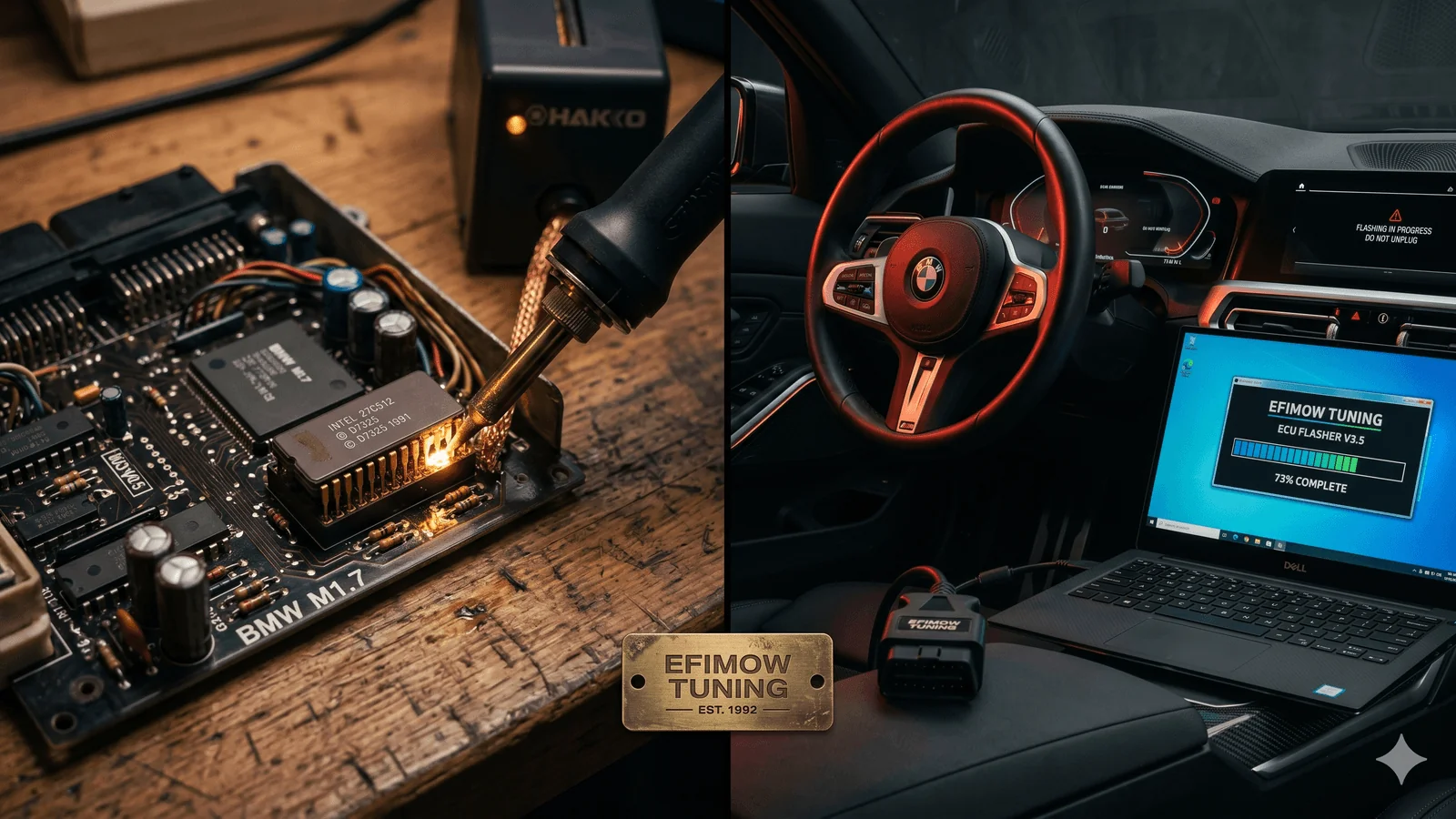
When people say "chip tuning" today, almost no one has held an actual chip in their hands in years. The term comes from an era when a power upgrade was a hands-on craft: pull the ECU, open the housing, lift a small memory chip from its socket (or desolder it from the board), install a different one, and you were done. Today the same idea has become a software operation that runs over the diagnostic port or a bench connection and is finished in minutes. Roughly thirty years of progress in semiconductors, vehicle networks, and emissions law sit between those two worlds. To understand why modern remapping looks so different from what it did two decades ago, it helps to retrace that path.
The EPROM era: chip tuning in the literal sense
Digital engine management arrived in the late 1970s. Bosch introduced the first Motronic in 1979, combining ignition and fuel injection in a single control unit. Back then, the maps were stored in an EPROM, an erasable, UV-light-resettable chip, typically housed in a 28-pin ceramic package with a quartz window on top. Common parts like the 27C256 (256 kbit / 32 KB) or the 27C512 (512 kbit / 64 KB) were enough to hold every map an engine needed.
By the 1990s the workflow was largely standardised. On a BMW E30 with Bosch Motronic 1.3 (introduced in 1988), the EPROM sat in a socket inside the ECU: pry it out, erase it under a UV lamp, write the new image with an EPROM programmer, plug it back in. On later 1990s and early-2000s BMW units (the Siemens MS41 in the E36 or the MS43 in the E46 with the M54 inline-six), the chip was soldered down. That meant desoldering, reprogramming, and resoldering. The shop needed a soldering station, a hot-air rework setup, a universal programmer, and patience.
By today's standards the file sizes were tiny. A complete Bosch EDC15 calibration was typically 512 KB; an ME7 image a little larger. Yet they held every map the engine relied on: injection quantity, ignition timing, target lambda, boost-pressure request on turbo cars. Anyone who knew the addresses could tweak values right in a hex editor. Tools like WinOLS and TunerPro became the standard because they translated those raw bytes back into readable 2D and 3D tables, still the foundation of any serious map work today.
The break: OBD-II forces standardisation
The decisive turning point came not from the tuning industry but from regulators. In the United States, OBD-II was mandatory on every new vehicle from model year 1996. The EU followed with directive 98/69/EC: from 1 January 2001, EOBD (Europe's flavour of OBD-II) was required for all new gasoline passenger cars, and from 1 January 2004 for all new diesel passenger cars. From that point on, a standardised 16-pin connector, the ISO-15765 CAN protocol, and a mandatory set of diagnostic data were available in every new vehicle.
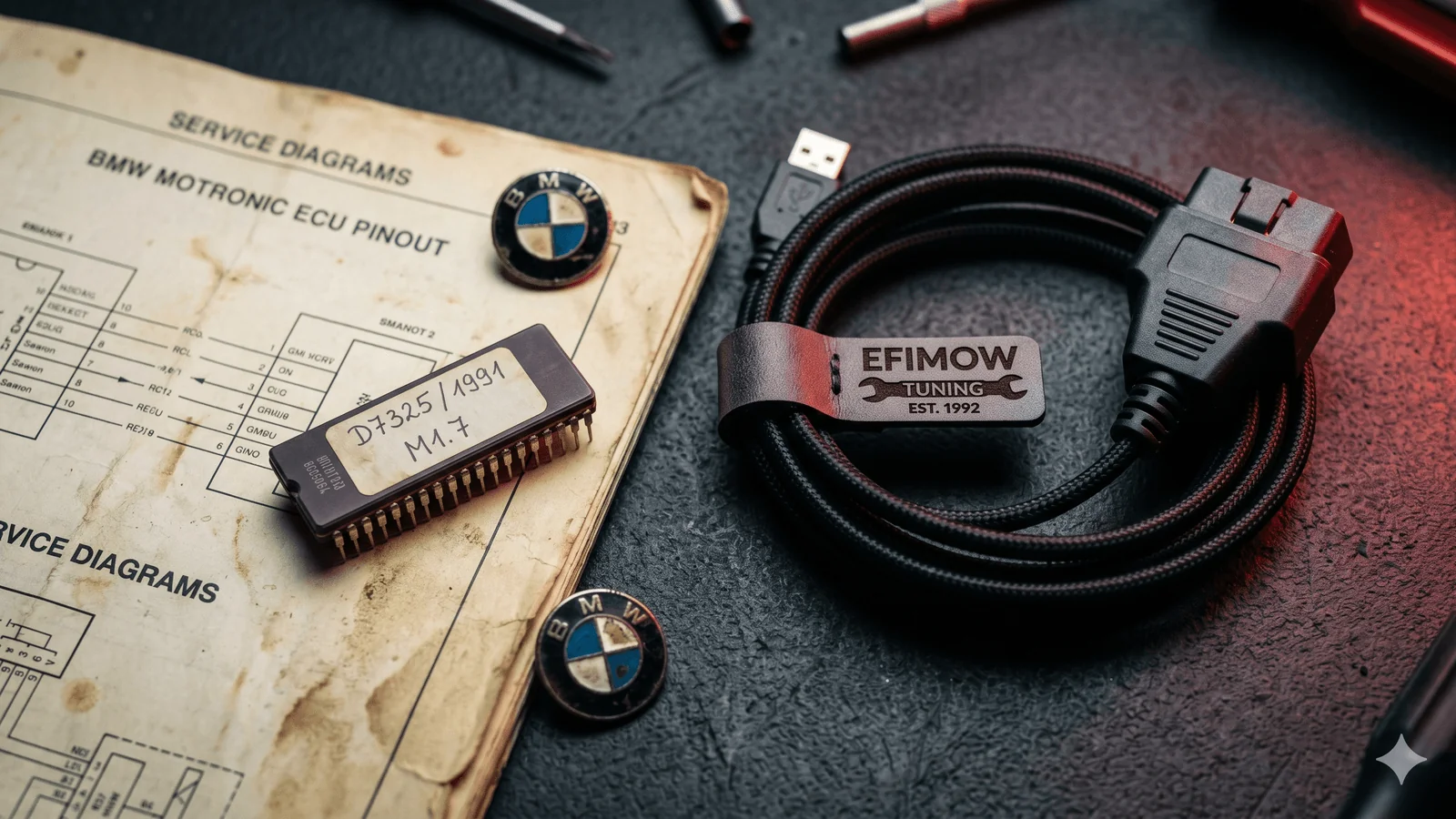
For tuners, this was a breakthrough. Suddenly there was an official path into the ECU that needed no screwdriver and no soldering iron. What used to require an invasive teardown to read the memory contents could now be done by clipping a cable into the centre console, downloading the entire program, modifying it on a PC, and writing it back through the same port. The first commercial tools (KESS, K-TAG, later Autotuner) automated exactly this workflow.
ECUs themselves got more capable in parallel. Discrete EPROM chips gave way to flash memory built directly into the microcontroller, growing from 256 KB on early EDC15 units, to 1–2 MB on ME7 and EDC16, to substantially larger calibration files on EDC17 and MED17. More memory meant more functions, more maps, finer resolution, and more places where tuning could intervene.
From a single calibration file to a vehicle network
The ECU's role shifted as the software era matured. In the 1990s, engine management was often an island: one input from the throttle pedal, a handful of sensors, a handful of actuators, done. In a modern BMW the ECU is deeply embedded in a bus network. It exchanges data on millisecond timescales with the transmission control unit (TCU), the ABS and ESP modules, the exhaust aftertreatment system, and the chassis electronics. A torque request today is no longer formed inside the engine alone. It is negotiated jointly with the gearbox and the traction-control logic.
On the silicon side, modern BMW DMEs in the MG1 and MD1 families are built around an Infineon TriCore Aurix microcontroller. The TC3xx generation packs up to six 32-bit cores at 300 MHz; the newer TC4x family pushes to 500 MHz. Compared with the single-core chips of the nineties, that is several orders of magnitude more compute. The same silicon underpins the Bosch MG1CS-series ECUs found in the G20, G30 and G05.
Greater complexity brought write protection. From the BMW G-series onward, classic OBD-port flashing is often no longer possible on Bosch MG1/MD1 hardware: the ECU expects a cryptographically signed image, multi-stage bootloaders (SBOOT, CBOOT) verify those signatures on every start-up, and the production keys aren't public. In practice that means many cars need bench mode or boot mode: the unit comes out of the car, sits on the workbench with a power supply and a dedicated adapter, and is flashed through a route that bypasses the bootloader.
In a sense, the loop has partly closed. Tuning a modern MG1CS024 DME often means sitting at a workshop bench again with the ECU in front of you, no longer with a soldering iron, but with a bench harness, a stable 12-volt supply, and a tool that can talk to the bootloader. The instruments are digital, but the workflow is once again hardware-adjacent.
Bottom line
Three decades of ECU modification trace a single line: hardware has moved into the background, software into the foreground. In the 1990s tuning was a soldering job with a 64 KB EPROM in your hand. In the 2000s it became an OBD operation through a standard connector. In the 2020s it is a mix of bench-mode hardware, cryptographic know-how, and disciplined data analysis. Only the name has stayed. The "chip" itself is no longer a part you swap. It is a high-performance compute unit whose tables you know, whose protections you respect, and whose behaviour you change without ever opening the engine.