
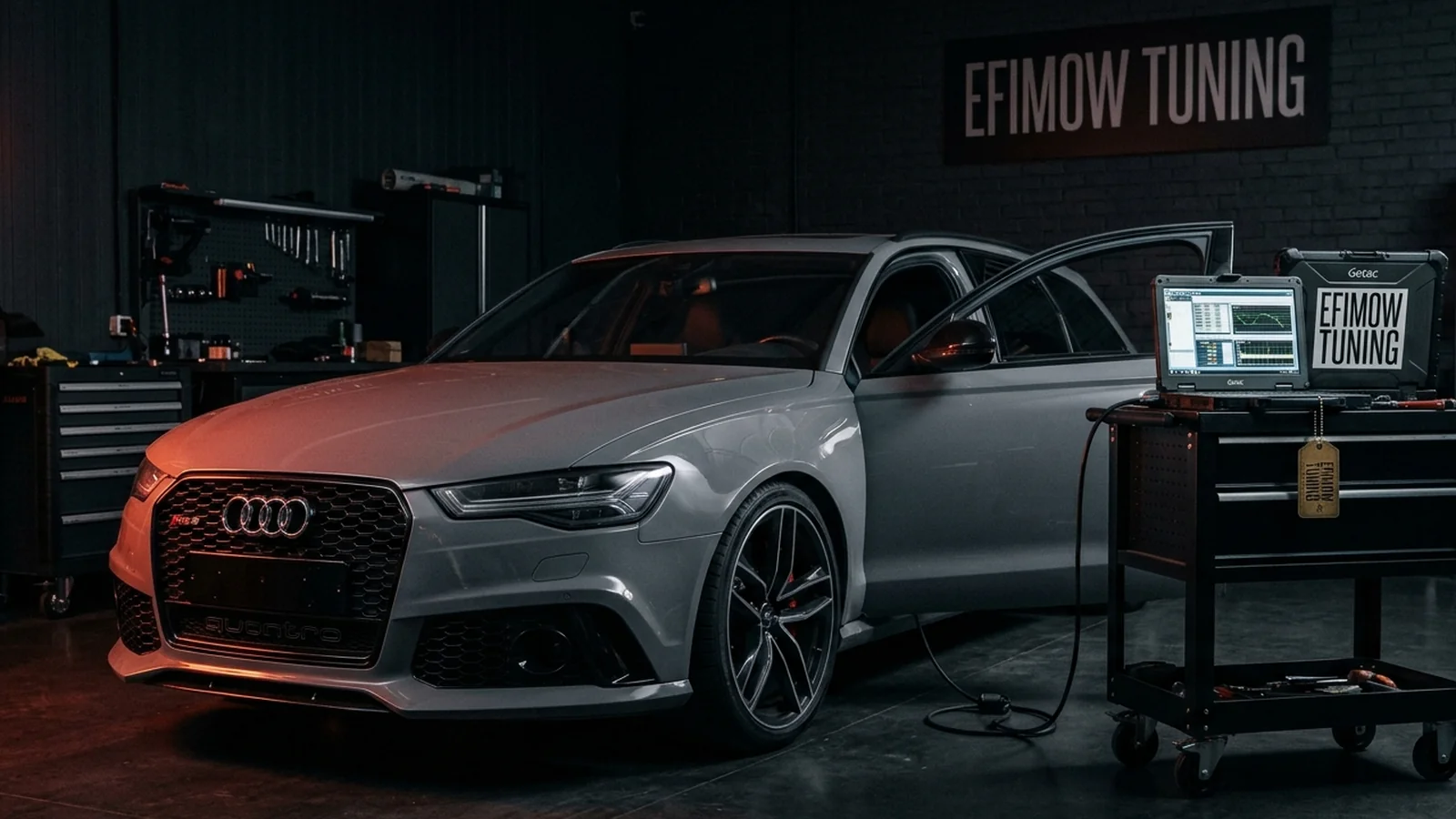
Audi RS3, RS4, RS6: Optimising High-Performance Engines Sensibly
Five-cylinder, V8 without turbo, twin-turbo: what software realistically adds on Audi RS3, RS4 and RS6, which ECUs are fitted and where the limits lie.
October 25, 2026 by Leo Efimow
An Audi wearing an RS badge does not leave the factory crying out for more power. The RS3, RS4 and RS6 are among the strongest production cars in their classes, their engines were developed by quattro GmbH and Audi Sport with performance in mind, and cooling and brakes are sized to match. Even so, these cars turn up in tuning workshops all the time. The reason: many RS engines are turbocharged TFSI units with noticeable reserves. And where there are none, as with the high-revving naturally aspirated V8s, it pays to take an honest look at what software can actually do. In this post we go through the generations, place the ECUs and show where the limits are.
Three model lines, very different engines
"Tuning an Audi RS" means completely different hardware depending on the year. The overview below is based on the vehicle data in our catalog:
| Model | Years | Engine | ECU |
|---|---|---|---|
| RS3 (8P) | 2011–2012 | 2.5 TFSI five-cylinder (CEPA, 340 PS) | Bosch MED9.1.5 |
| RS3 (8V) | 2015–2020 | 2.5 TFSI five-cylinder | Bosch MED17.1.62 |
| RS4 (B5) | 2000–2001 | 2.7 V6 biturbo (381 PS) | Bosch ME7.1 |
| RS4 (B7) | 2005–2008 | 4.2 V8 FSI naturally aspirated (420 PS) | Bosch MED9.1 |
| RS4 (B8) / RS5 | 2010–2016 | 4.2 FSI V8 naturally aspirated | Bosch MED17.1.1 |
| RS6 (C5) | 2002–2004 | 4.2 V8 biturbo (450/480 PS) | Bosch ME7.1 |
| RS6 (C6) | 2008–2010 | 5.0 V10 biturbo (579 PS) | Bosch MED9.1 |
| RS6 (C7) / RS7 | 2013–2018 | 4.0 TFSI V8 biturbo | Bosch MED17.1.1 |
That gives two fundamentally different worlds: forced-induction engines, where the ECU can release real reserves through boost, cylinder charge and ignition timing, and naturally aspirated engines, where software is only fine-tuning.
Turbo RS: where the reserves are
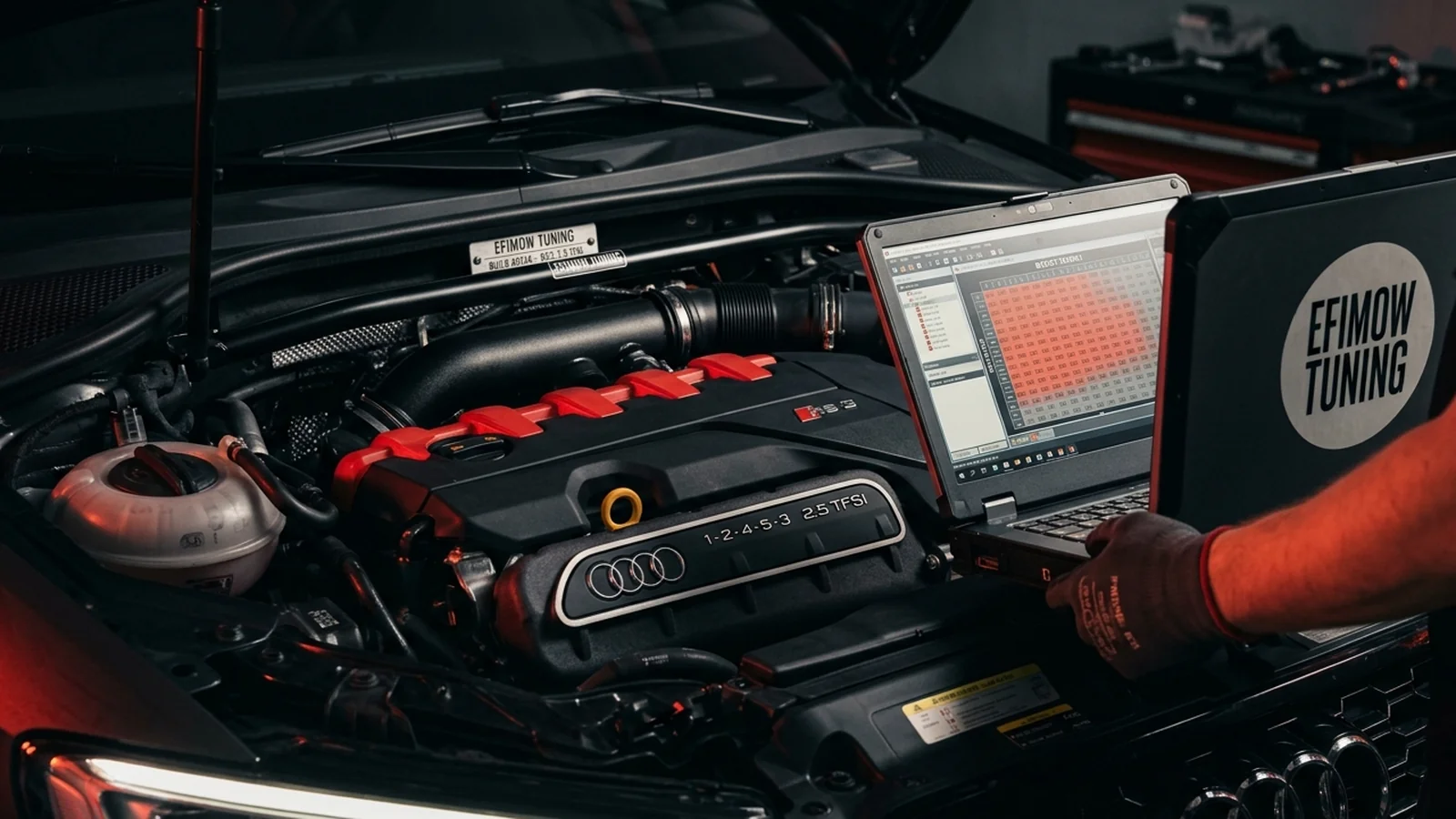
The five-cylinder in the RS3, the 4.0 TFSI in the RS6 C7 and the V10 in the RS6 C6 are all turbocharged. Here a Stage 1 calibration works on the familiar levers: boost targets, charge and torque limiters, ignition advance and the wastegate control curves. For turbocharged TSI/TFSI engines with MED17 or MED9, our data lists 20 to 35 percent more power as a typical guide value, and up to 40 percent more torque. For the older ME7 biturbos such as the 2.7 in the RS4 B5, the guide values are 25 to 40 percent.
These ranges are not a promise for your car. On engines that already make 450 PS or more from the factory, it is often not the engine itself but the periphery and the drivetrain that limit the result:
- Intake air temperature: the 4.0 TFSI with its turbos inside the V ("hot V") and the five-cylinder in the compact RS3 nose heat up quickly in summer and on track. As intake temperature rises, knock control pulls timing and the extra power shrinks.
- Gearbox: the seven-speed DSG in the RS3 and the eight-speed automatic in the RS6 have their own torque limits. If you feed in significantly more torque, you need to know those limits.
- Fuel: the calibration has to suit the octane you actually use. A file that only runs cleanly on the best fuel is not a good file for daily use.
- Maintenance: spark plugs, coils, the charge-air path and vacuum lines should be in good shape before more boost goes in.
The naturally aspirated cars: RS4 B7, RS4 B8 and RS5
The 4.2 V8 FSI engines rev high and sound fantastic, but there is no turbo to turn up. Software can optimise ignition timing and cylinder charge in individual load ranges, sharpen the throttle and raise the rev limiter moderately. For naturally aspirated engines our data lists 3 to 8 percent as a typical guide value. That is noticeable, but not a leap. If you want significantly more from an RS4 B7 or B8, you end up with mechanical changes and with effort out of all proportion to a software adjustment.
To be honest: for many owners of these engines, the sharper response is the real gain, not peak power.
Which additional options exist
Besides the power increase itself, our data lists several options for the Bosch MED17 ECUs of the VAG group. Directly bookable are, among others, a sharper throttle map (Sharp Throttle), removal of the top-speed limiter, a moderate rev-limiter increase and suppressing individual, non-emissions-related fault codes (DTC). On request (meaning depending on the software version), ECO tuning, Launch Control and No-Lift Shift are possible.
The hardcut limiter and (depending on software) pops & bangs and the popcorn limiter are intended exclusively for motorsport. They raise the thermal load on catalytic converter and turbocharger and have no place on public roads; details are in the motorsport notice.
For the Vmax removal: tyres must be rated for the new top speed, and the change has to be registered.
What is not up for discussion
On the newer RS models with a gasoline particulate filter, and on every model with catalytic converters and lambda sensors, the same rule applies: these components stay active. Removing or disabling the OPF, Kat or secondary air system is emissions tampering and prohibited on public roads. Fault codes from emissions components are not a case for "suppression" either.
Legally, for any software change: the software change voids your vehicle's type approval; the software is intended for motorsport use only.
Access to the ECU
Many RS ECUs of the MED9 and MED17 generations can be read and written through the OBD port. Our data does note, however, that write protection became common on the VAG MED17 units from around 2012, and that later versions partly require bench or boot access. Whether your RS3 8V or RS6 C7 works via OBD or the ECU has to come out depends on the specific software version. We clarify that before you get an appointment.
The process is the same for all non-BMW vehicles: either you come to us in Stödtlen on a date of your choice, or you send in the removed ECU. The price is the same in both cases, and booking is online. It depends on the ECU generation, plus surcharges for strong engines, newer model years and ECUs that have to be opened. The configurator shows the exact price for your model, for example for the RS3 8V with the 2.5 TFSI or the RS6 C7 with the 4.0 TFSI.
Check first: a checklist for RS drivers
Before we work on an RS engine, a short check is worthwhile:
- Fault memory: clear up stored misfires or boost deviations first.
- Ignition: plugs and coils on schedule, on turbo engines rather earlier.
- Charge-air path: check hoses, clamps and intercooler for leaks.
- Gearbox: know the shift quality and oil-change history of the DSG or automatic.
- Brakes and tyres: more power means more energy that has to be dissipated again.
Conclusion
Audi RS is not just Audi RS. The turbocharged engines (the five-cylinder in the RS3, the 4.0 TFSI in the RS6 C7, the V10 in the RS6 C6 and the old biturbos) have real reserves that a clean calibration with active knock control and component protection can use. The V8s in the RS4 and RS5 gain mostly in response, less in peak power. In both cases, condition, cooling and drivetrain decide the result more than any percentage.
If you want to know what applies to your RS model, select it in the configurator. There you will see ECU, options and price before you book an appointment.