
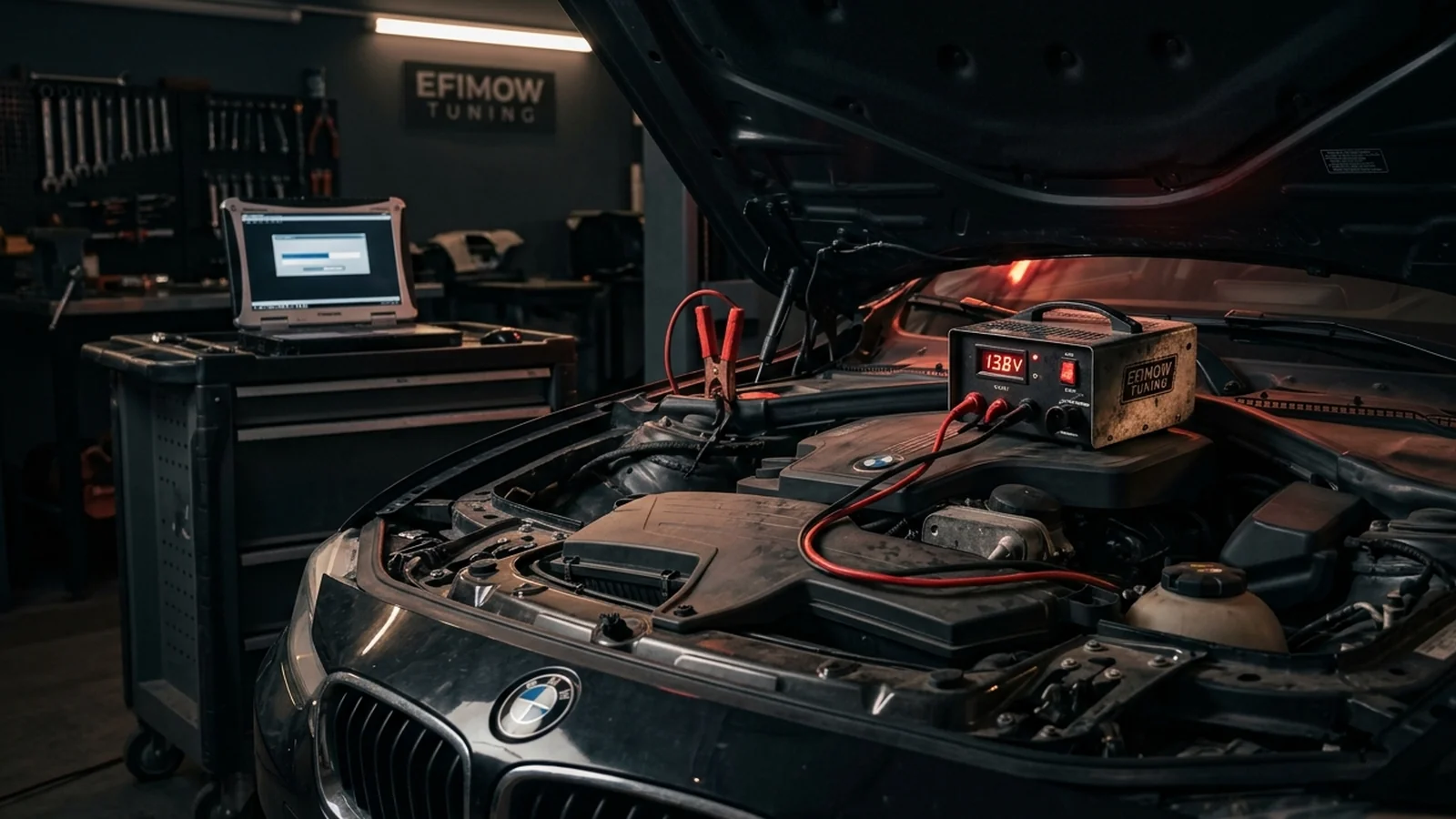
Voltage While Flashing: Why a Battery Charger Is a Must
A weak battery is one of the most common causes of aborted flashes. Why the supply voltage must stay stable and how to support your car properly.
October 26, 2026 by Leo Efimow
When something goes wrong during flashing, it is rarely the file and almost never the ECU. Far more often the cause is mundane: the battery was weaker than it looked. If you read and write your car yourself via OBD, the first thing to think about is not maps but volts and amps. This post explains why supply voltage matters so much while flashing, what a suitable charger has to deliver and how to prepare so that voltage is simply no longer an issue.
Why flashing puts so much load on the battery
While an ECU is being read or written, the car sits with the ignition on but the engine off. That is the key point: the alternator is not charging, everything runs from the battery. At the same time, a large part of the vehicle electronics is awake. Control units communicate, the instrument cluster is lit, pumps and fans may run, and depending on the car the interior lights or blower stay active.
A battery that starts the engine without trouble in the morning can still lose noticeable voltage after half an hour in this state. Starting demands a short, high current. Flashing demands a moderate current over a long time. Those are two different loads, and an older or partly discharged battery often copes with the second one worse than you would expect.
What happens when the voltage is too low
ECUs and flash tools monitor the supply voltage. If it drops below a threshold, one of three things typically happens:

- The tool refuses to start and reports low voltage. That is the harmless case.
- The process aborts halfway, because communication drops or the ECU refuses the write.
- Individual control units log undervoltage faults in their fault memory, even though the flash itself worked.
The middle case is the unpleasant one. An aborted write leaves an ECU that is no longer fully programmed, and the car usually will not start afterwards. In many cases this can be solved, but it costs time and nerves. What to do in that situation is covered in Flash aborted: what happens and what comes next. Much better if it never gets that far.
Why "recommended" means "mandatory" in practice
Our product pages list the battery charger as "recommended for long flash procedures". From the workshop's point of view: you never know in advance exactly how long the process will take. Reading takes different amounts of time depending on ECU and tool, and then there is preparation, possible repeats and later the write-back. On E-series cars connected via the slower K+DCAN cable it takes noticeably longer. Anyone who only connects the charger for "long" procedures often does not have it connected when it matters.
Dealer workshops never program ECUs without a support power supply connected. That is not overkill, it is standard. The same applies to you at home: the charger is part of the basic kit, just like laptop and cable.
What a suitable charger must be able to do
Not every charger is suitable. The key points:
| Criterion | What matters |
|---|---|
| Output | The unit must deliver at least as much current as the awake car consumes. Small maintenance chargers for winter storage often deliver too little. |
| Battery type | Many BMWs have an AGM battery. The charger should support this type and offer a matching mode. |
| Stable output voltage | A unit that holds the voltage steady is better than one that pulses heavily or keeps switching between charging and pause phases. |
| Connection | Connect at the jump-start points in the engine bay or at the battery, as your car's owner's manual specifies. |
If you are not sure whether your charger is strong enough, watch the voltage display of your flash tool or a simple multimeter. If the voltage stays stable or rises slightly over time with the ignition on and the charger connected, the unit delivers enough. If it slowly drops despite the charger, it is too weak.
Preparation: take every voltage risk out of the equation
A few steps before you start settle the matter:
- Charge the battery beforehand. Ideally connect the charger some time before flashing so the battery goes into the process fully charged.
- Switch off consumers. Lights, radio, air conditioning, seat heating, rear window heating: anything not needed stays off.
- Leave doors and lids alone. Every opening wakes further control units. Prepare everything, sit in the car or place the laptop within reach, and then leave things as they are.
- Laptop on its power adapter. The laptop is part of the power supply too. A laptop that shuts down mid-process because its battery is empty is just as fatal as an empty car battery.
- Disable power saving on the laptop. Standby, hibernation and automatic switching-off of USB or network ports off. Install or pause Windows updates beforehand.
- Cable tight and still. The OBD cable sits firmly in the socket and is not moved during the process.
The flash guide in the customer portal summarises the rules for reading and writing back as well: support the battery, laptop on mains power, do not move the cable, do not interrupt the process. The full process is described in the post about the customer portal.
Typical mistakes from practice
Some patterns we see again and again:
- "But the battery is new." A new battery that never got fully charged after a few short trips is still not full.
- Charger connected but not switched on, or in the wrong mode, for example maintenance mode with very low current.
- Jump-starter booster instead of a charger. A booster is built for short, high currents, not for steady supply over a longer period.
- Running the engine to support the battery. The engine does not run while flashing. The tool specifies what state the car must be in. Stick to it.
- Laptop on battery because the socket was too far away. An extension lead costs little.
Reading too, not just writing
Many people think voltage only matters during write-back. An aborted read is less dramatic, because nothing in the ECU is changed. But in the worst case it gives you an incomplete file that you then upload to the portal. That leads to follow-up questions and delays. Reading is also the moment your original file is created, the basis for everything that follows. How to back it up properly is described in The original file. Treat reading with the same care as writing.
Legal framework
Flashing modified engine software voids your car's type approval. Our calibrations are intended exclusively for motorsport. The details are in the motorsport notice.
Conclusion
A stable supply voltage is the simplest and most effective insurance against an aborted flash. A sufficiently strong charger, consumers switched off, a laptop on mains power and a cable that stays still: that is all it takes. Prepare it cleanly once and you flash relaxed. What else you need for flashing is shown for your car in the configurator, and the glossary entry power supply sums up the essentials.