
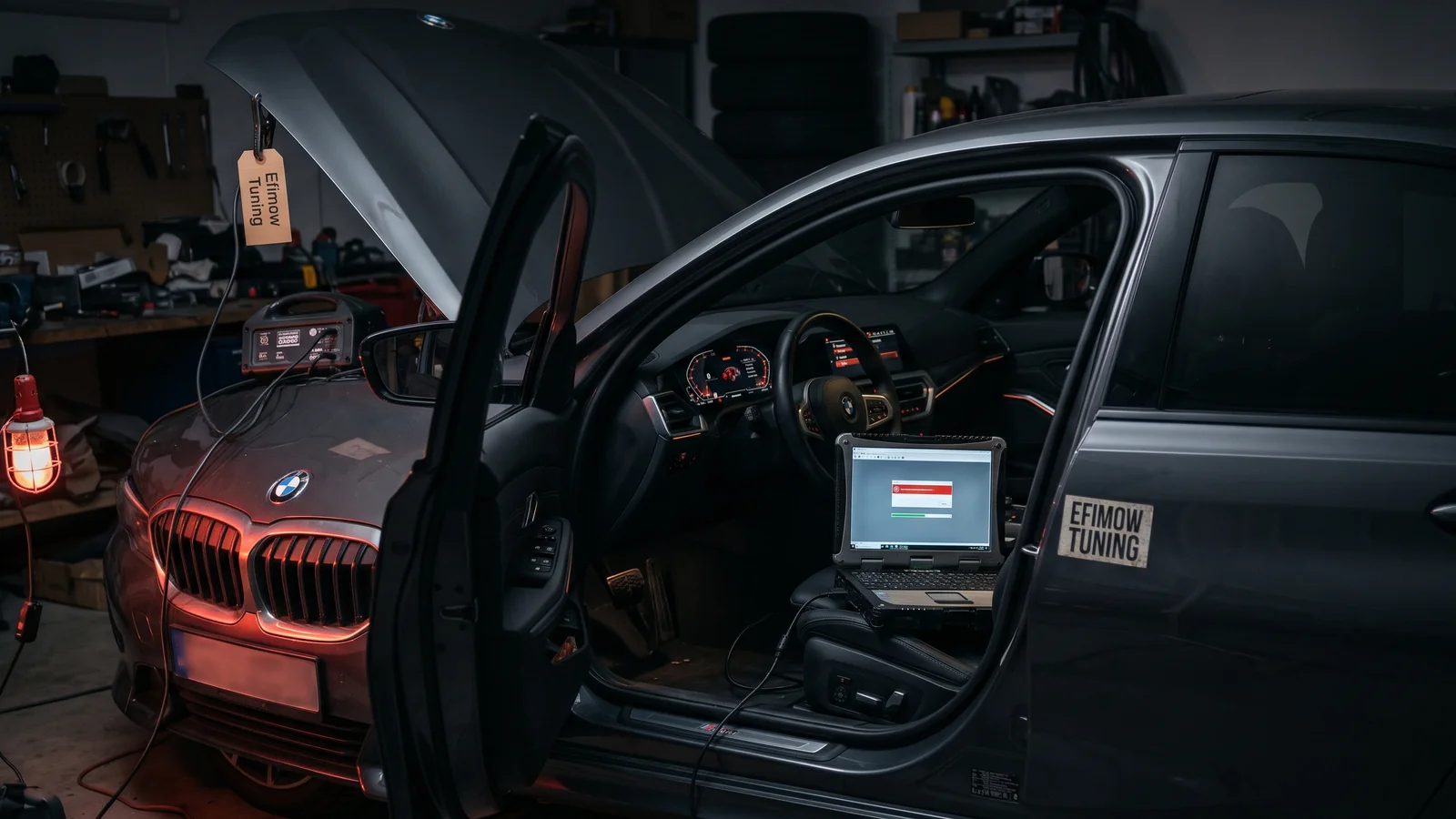
Flash Aborted: What Happens and What Comes Next
The flash aborts and the car will not start. What happened inside the ECU, why staying calm matters most and which steps are right now.
October 26, 2026 by Leo Efimow
The progress bar stops, an error message appears, the instrument cluster lights up like a Christmas tree and the engine will not start. An aborted flash is one of those moments when you want to do something immediately. In most cases that is exactly the mistake. Aborts are rare, but they happen, and in many cases they are a solvable problem, as long as you do not make things worse in the first few minutes. This post covers what happens during an abort, how to react correctly and how to avoid getting there in the first place.
Reading or writing: two very different cases
First, it is worth asking when the abort happened.
While reading, nothing in the ECU is changed. The tool only takes data out. If this process aborts, the file you read is incomplete and unusable, but the ECU itself is as a rule unchanged. Do not upload an aborted read to the portal; get in touch before trying again, especially if the car behaves unusually afterwards.
While writing, things are different. During a write, the previous content of a memory area is erased and replaced by the new one. If that is interrupted halfway, the area is neither old nor new but incomplete. The ECU recognises this and does not start the engine software. For you this looks like this: the car does not start, many control units report communication faults and the instrument cluster shows warnings.
Why it is usually not a write-off
That sounds dramatic, but it is a state ECUs are designed for. Even at the dealer a programming session can abort, for example due to a voltage drop. Modern ECUs are therefore built to recognise incomplete software instead of simply running with half the data. In many cases such an ECU can be restored.
Whether and how that works in the individual case depends on the ECU, the tool and the moment of the abort. That is not a job for trial and error on your own, but for an assessment with all information on the table. That is exactly why the first few minutes matter so much.
The first minutes: what you should do
- Stay calm. Nothing is broken just because the progress bar stopped. Most follow-on damage comes from hectic reactions, not from the abort itself.
- Do not unplug anything. The OBD cable stays in the socket, the laptop stays connected, the battery is not disconnected. The ECU is not removed either.
- Keep the voltage up. The charger stays connected and switched on. If none was connected yet, now is the right moment to connect one so the battery does not discharge further.
- Do not close the laptop. The tool stays open, the laptop on mains power. Do not shut the lid and do not restart it.
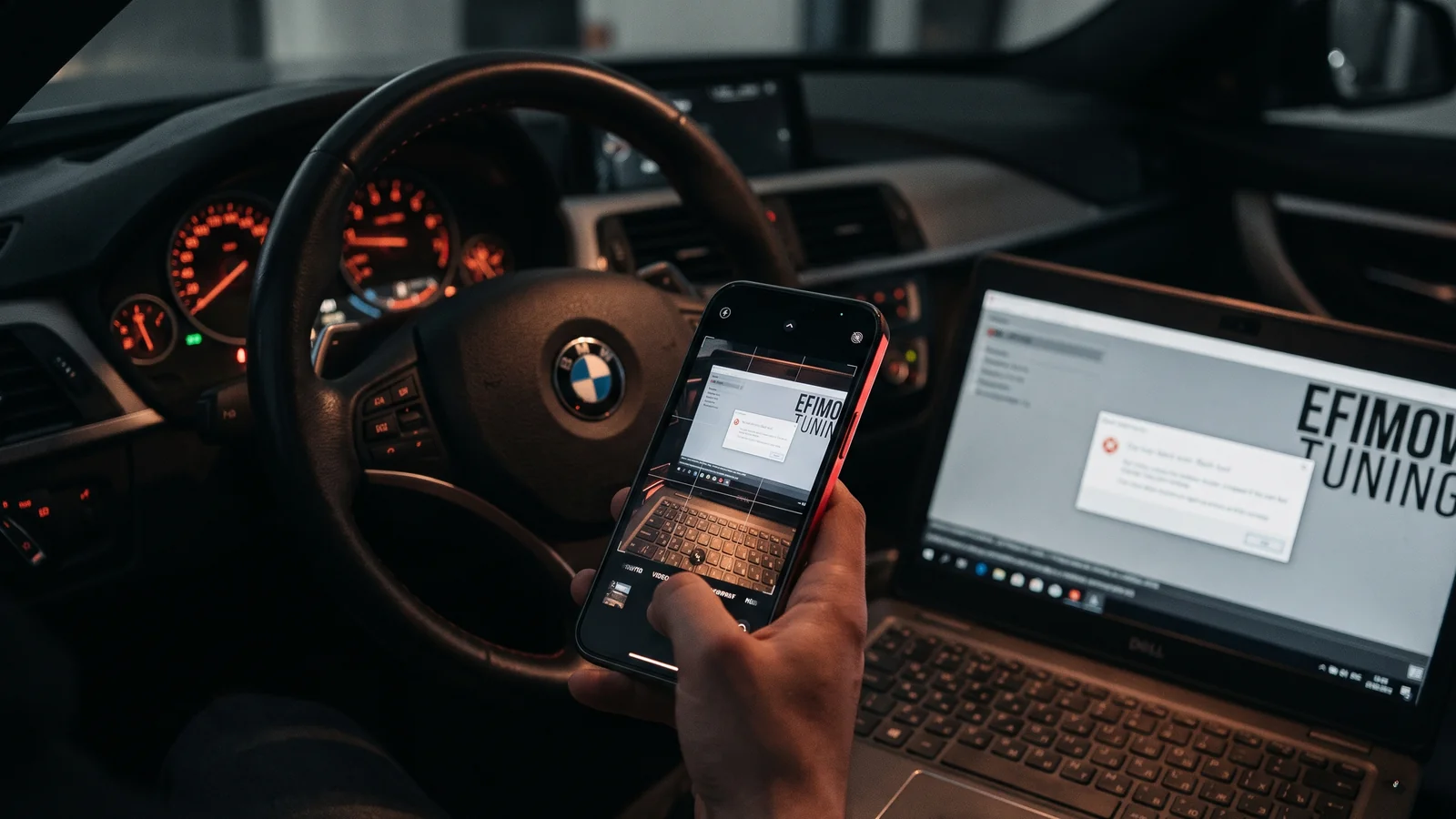
- Document. Take a photo or screenshot of the error message. Note the percentage, whether you were reading or writing and what you see on the car.
- Contact us. Get in touch before doing anything else.
What you should not do
Just as important is what you leave alone:
- Do not retry blindly. Clicking "try again" five times in a row without knowing the cause rarely improves things.
- Do not flash other files. No file from a forum, no file from another car, no "rescue file" of unknown origin.
- Do not try another tool just because it happens to be available. Different tools work differently, and switching in the middle of a problem makes the assessment harder.
- No workshop update on suspicion. If a workshop flashes new software without knowing the history, it is unclear afterwards which version is in the ECU.
- Do not tow-start or keep cranking. As long as the engine software is incomplete, it achieves nothing.
How to report the problem
For exactly this case, the customer portal has a "Report flashing problem" function. Describe as precisely as possible what happened, for example "aborted at 73 %, error message XYZ". Also helpful:
- which tool and which cable you used,
- whether a charger was connected,
- whether the laptop was on mains power,
- whether it happened while reading or while writing back,
- your photo or screenshot of the error message.
The more precise the details, the faster the cause can be narrowed down. If it is urgent, also use the contact page. How the portal is structured overall is described in From upload to download.
Why the original file is worth its weight in gold now
At the latest now it becomes clear why the original file matters so much. It is the known, working state of your ECU. With it, an abort is in most cases much easier to resolve than without it. If you backed it up cleanly (unchanged, clearly named, in at least two places), you have a big advantage in this situation. How to do that is described in The original file.
The most common causes
In practice it is almost always the same triggers:
| Cause | Typical picture |
|---|---|
| Supply voltage too low | Abort after a longer runtime, often without a charger or with a charger that is too weak |
| Connection lost at the cable | Loose plug, cable moved, poor cable or adapter |
| Laptop goes to sleep | Power saving, empty battery, lid closed |
| Windows update or restart | An update starts in the middle of the process |
| Virtual machine | USB or network connection briefly drops between host and VM |
| Outside interference | Door opened, ignition touched, someone gets in |
Almost all of these causes can be ruled out beforehand.
Prevention is easier than rescue
The checklist before every flash is short:
- a charger with sufficient output connected and switched on (more in Voltage while flashing),
- laptop on mains power, power saving and updates off,
- a suitable, decent cable, plugged in firmly,
- consumers in the car off, doors closed,
- time planned in, no flashing on the side,
- original file backed up beforehand.
Legal framework
Flashing modified engine software voids your car's type approval. Our calibrations are intended exclusively for motorsport. The details are in the motorsport notice.
Conclusion
An aborted flash is unpleasant, but in many cases solvable, provided you stay calm, unplug nothing, keep the voltage up and get in touch with a precise description before trying anything further. We then work out the rest together. And the best strategy remains preparation: with a charger, a stable laptop and a decent cable, it usually never gets that far.