
Mercedes Petrol Engines with ME9.7 and MED17.7: What Works via OBD
Bosch ME9.7 and MED17.7 run Mercedes petrol engines from M272 to M274. What works via OBD, which options exist and where non-turbo engines stop.
October 25, 2026 by Leo Efimow
If you drive a Mercedes petrol model built between 2005 and 2020, there is a good chance one of two Bosch ECUs sits under the bonnet: the ME9.7 or the MED17.7. The older ME9.7 mainly controls the naturally aspirated V6 and V8 engines of the M272 and M273 series, the MED17.7 the turbo generation from the M270/M274 four-cylinder up to the twin-turbo V8. In many vehicles, both families can be read and written through the OBD port. In this post we explain what that means in practice, which engines are behind them and why the difference between naturally aspirated and turbo decides everything when tuning.
Two ECUs, two engine generations
The two ECUs mark a generational change at Mercedes-Benz: away from large-displacement naturally aspirated engines, towards smaller, turbocharged direct-injection units. Our vehicle catalog assigns the engines like this:
| ECU | Engines | Typical models |
|---|---|---|
| Bosch ME9.7 / MED9.7 | M272 V6 (2.5, 3.0, 3.5), M273 V8 (4.6, 5.5), M156 6.2 V8 AMG | C-Class W203/W204, E-Class W211/W212, CLS W219, S-Class W221, ML W164, SL R230 |
| Bosch MED17.7 | M270 and M274 four-cylinder turbo, M271 EVO, M276 V6, M278 V8 biturbo, M157 and M133 AMG, M177/M178 V8 biturbo | A/B/CLA/GLA, C-Class W204/W205, E-Class W212/W213, GLC X253, ML W166, S-Class W222, AMG GT |
The CGI versions of the 3.5-litre V6 (M272 DE35) with petrol direct injection appear in our data partly as MED9.7, partly as ME9.7. Technically they belong to the same family.
ME9.7: the naturally aspirated generation
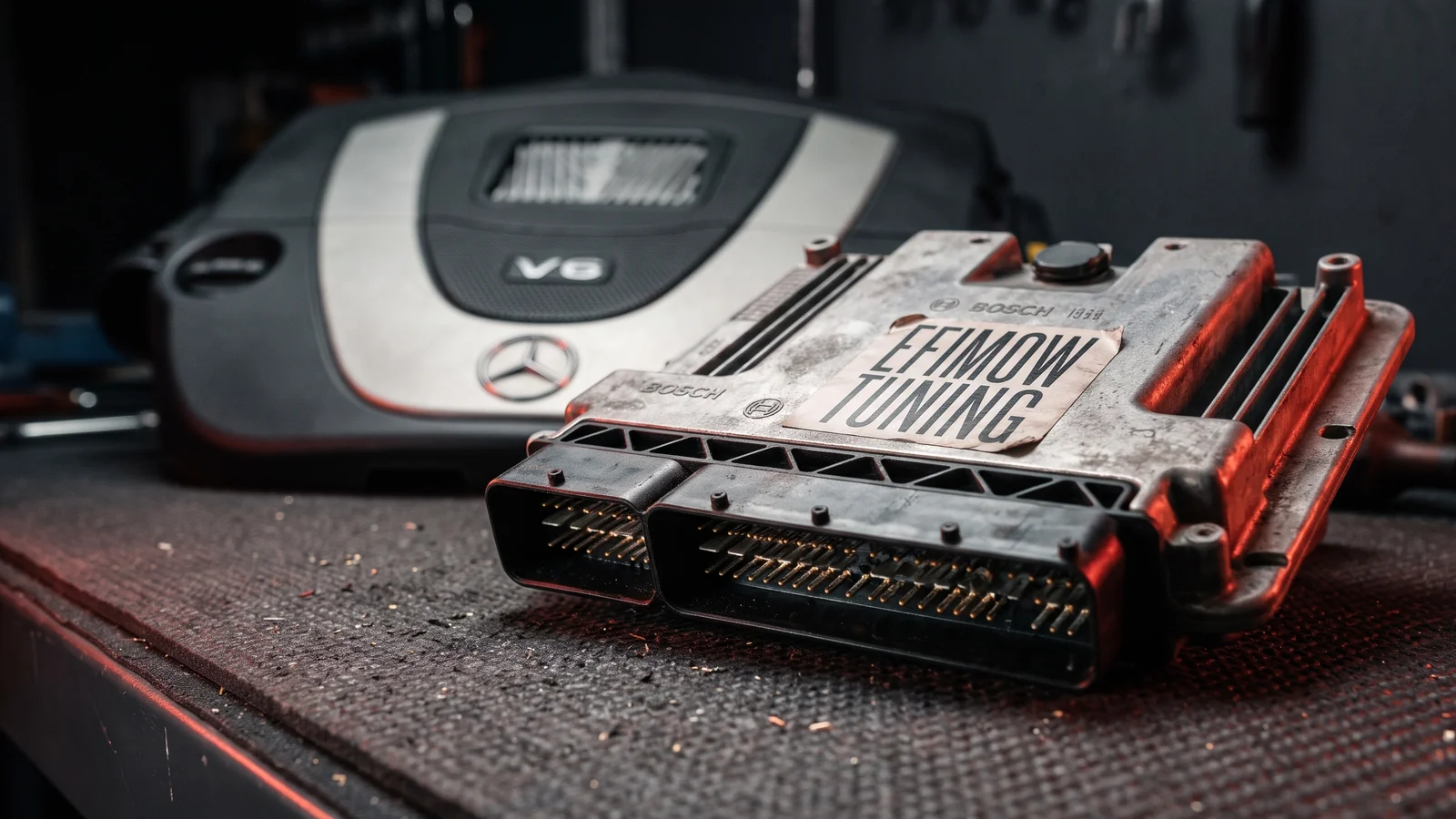
The ME9.7 is a classic Bosch Motronic ECU for naturally aspirated engines with an electronic throttle. It controls cylinder charge, ignition timing, injection and camshaft adjustment. For tuning, that means there is no boost to turn up. What remains is fine work on ignition timing and charge in individual load ranges, on the throttle map and on the limiters.
For Mercedes engines with the ME9.7 our data lists 3 to 8 percent more power and torque as a typical guide value. Honestly, that is not much, but it is noticeable, especially where the stock calibration is conservative in the low and mid rev range. Many drivers of an E 350 or CLS 350 notice the difference more in sharper response than in peak power.
If you expect more from an M272 or M273, you should know this beforehand. Software does not turn a naturally aspirated engine into a turbo.
MED17.7: the turbo generation
The MED17.7 is a different story. The engines of this generation are mostly turbocharged: the 1.6 and 2.0-litre M270/M274 four-cylinder, the 1.8-litre M271 EVO, the V6 M276 in its biturbo versions, the V8 M278 and the AMG engines M133, M157 and M177/M178. Here a Stage 1 calibration works with boost targets, cylinder charge, ignition timing and torque limiters.
For the turbo engines with the MED17.7, our data lists 15 to 30 percent more power and torque as a typical guide value. Where exactly your engine ends up depends on power level, condition and fuel quality. Especially with the four-cylinders, which are offered in several power levels on largely identical hardware, the smaller versions usually sit further from the limit.
What works via OBD
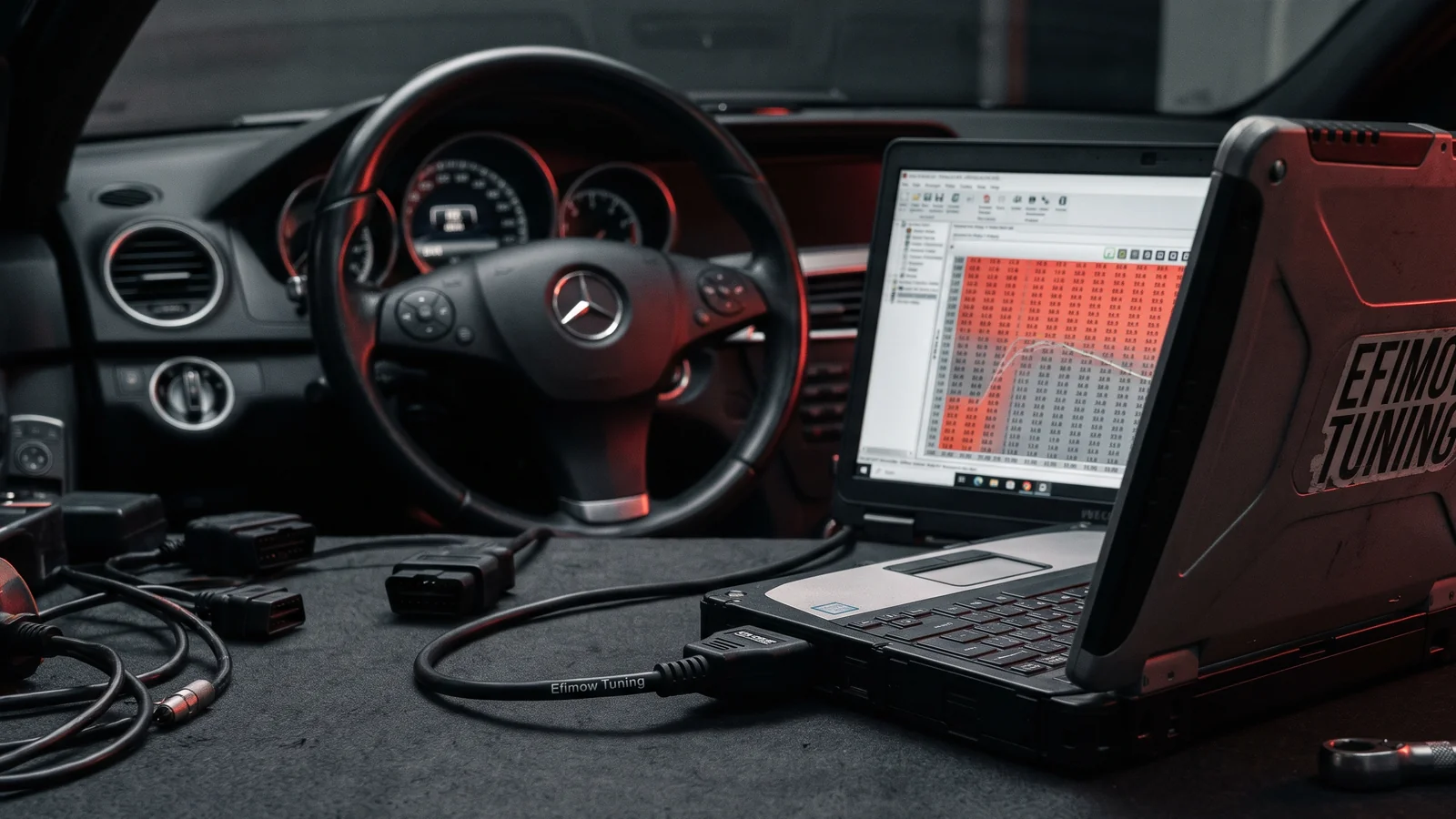
For most of the engines mentioned, our catalog lists access through the OBD port. That means the ECU stays in the car, is read through the diagnostic connector, the original file is saved, modified and written back. No removal, no opened housing. Whether this is how it works on your car depends in the end on the specific software version, which is why we check the identification before the appointment.
OBD access also helps on the way back: the saved original file can be written back the same way.
Which options exist
Besides the power increase, our data lists additional options for both families. This is where naturally aspirated and turbo engines differ clearly:
ME9.7 (naturally aspirated):
- directly bookable: Sharp Throttle (sharper throttle map), Vmax removal, rev-limiter increase, suppressing individual non-emissions-related fault codes (DTC)
- on request: ECO tuning, Launch Control and No-Lift Shift (of limited use on naturally aspirated engines)
MED17.7 (turbo):
- directly bookable: Stage 1+, Stage 2+ with suitable hardware, ECO tuning, Sharp Throttle, Vmax removal, rev limiter, DTC suppression, Launch Control
- on request: No-Lift Shift on manual gearboxes
For both families there are also functions such as the hardcut limiter, pops & bangs or the popcorn limiter. These are intended exclusively for motorsport, put thermal stress on catalytic converter and turbocharger and do not belong on public roads. More on this in the motorsport notice.
What the software leaves alone
Catalytic converters, lambda sensors, the gasoline particulate filter on newer models and all diagnostic functions for emissions components stay active. Disabling or removing these components is emissions tampering and prohibited on public roads. Knock control and component protection also remain in place with a clean calibration. They are matched to the new load points, not deactivated.
Legally: the software change voids your vehicle's type approval; the software is intended for motorsport use only.
Check known weak points before tuning
On older Mercedes petrol engines it pays to look at known issues before adding load:
- M272/M273: on early model years, wear in the balance-shaft and camshaft drive area is well known. A related fault entry should be sorted out before tuning.
- M271 supercharged and M271 EVO: the timing drive should be in good order; our data explicitly points this out.
- Turbo engines M270/M274/M276: spark plugs and coils on schedule, charge-air path tight.
- In general: read the fault memory, check misfires and mixture adaptations.
What it costs
The price depends on the ECU generation, plus surcharges for strong engines, newer model years and ECUs that have to be opened. Two worked examples from the catalog: for the C 350 with the 3.5 V6 (W204) with ME9.7, Stage 1 starts at €170; for the C-Class W205 with the M274 turbo with MED17.7 at €250. For the E-Class W213 and GLC with the M274, the model-year surcharge applies, so Stage 1 starts at €300 there.
The process is the same for all non-BMW vehicles: you come to us in Stödtlen on a date of your choice or send in the removed ECU. The price is the same in both cases, and booking is online.
Conclusion
ME9.7 and MED17.7 stand for two very different tuning situations. The naturally aspirated engines with ME9.7 gain small but noticeable improvements, mainly in response. The turbo engines with MED17.7 have clearly larger reserves and a wider range of options. In both cases OBD access is possible on many vehicles, which keeps the job quick and reversible.
Which ECU is in your Mercedes and what it costs is shown in the configurator once you have selected model and engine.