
Diesel Smoke Limitation: Why Software Has Limits
What the smoke limiter in a diesel ECU does, how it links to air mass and boost, and why a good tune respects it instead of flattening it.
October 26, 2026 by Leo Efimow
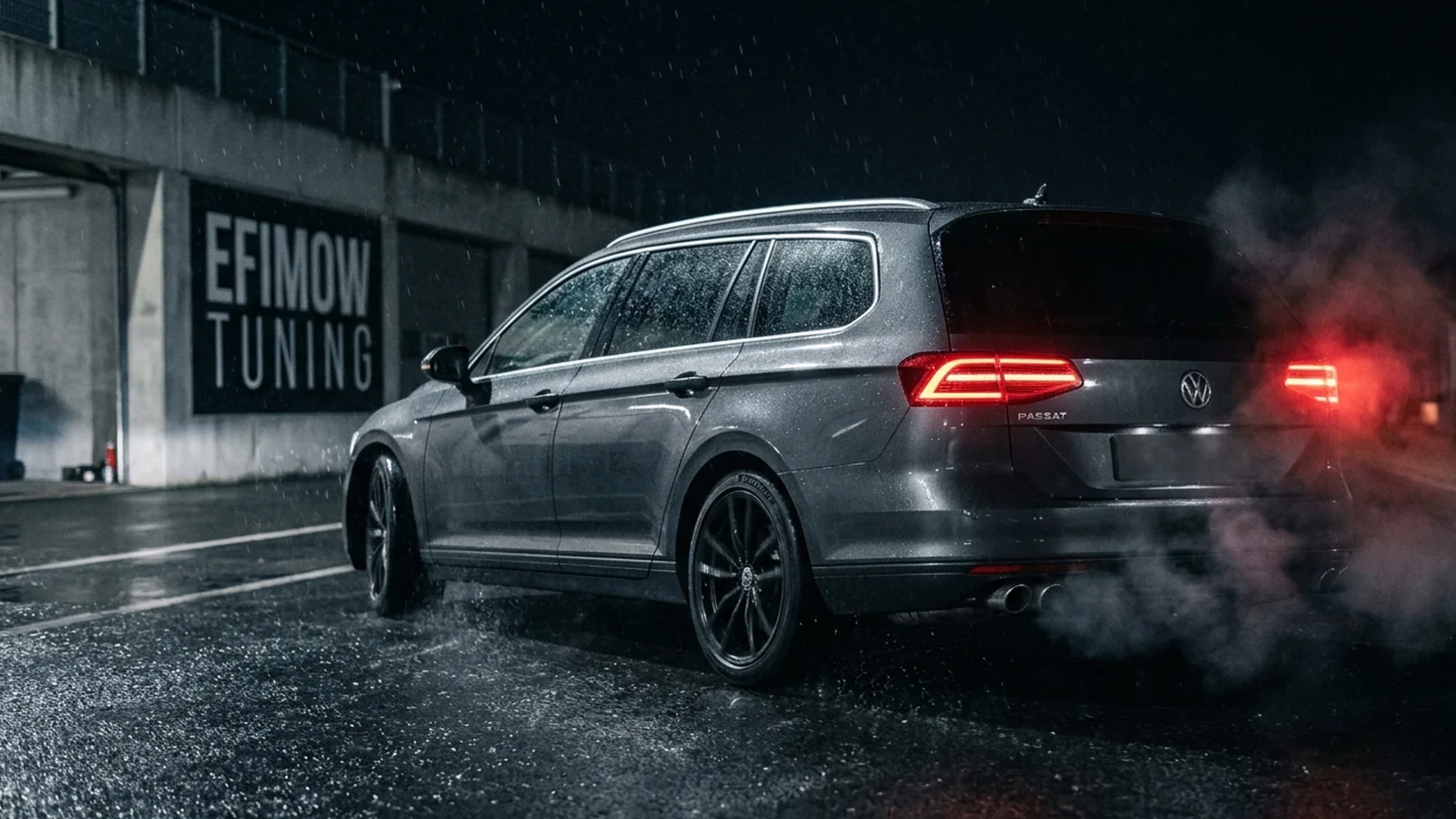
If you have ever driven behind a badly tuned diesel, you know the black cloud under acceleration. It is the visible sign that more fuel was injected than the available air could burn. To prevent exactly that, every modern diesel control unit has a protective function: the smoke limiter. It is one of the reasons why a diesel cannot get unlimited power through software, and one of the best tests of whether a tuning file has been done properly.
Why a diesel produces soot at all
Unlike a petrol engine, a diesel always runs with excess air. So there is more air in the combustion chamber than would theoretically be needed for the injected quantity. Even so, it can produce soot. The fuel is sprayed directly into the hot, compressed air and burns where it meets oxygen. The tighter the overall ratio of air to fuel, the more zones in the chamber get too little oxygen. There the fuel does not burn completely, and soot forms.
The decisive quantity is therefore not the injection quantity alone but its ratio to the air mass. It is expressed as the air-fuel ratio lambda. On a diesel it is always above 1. If it gets too small, soot rises sharply.
What the smoke limiter does
At its core the smoke limiter is a simple rule: for each measured air mass and engine speed, at most a certain quantity of fuel may be injected. More air, more permitted fuel. Less air, less fuel. In doing so it sets a minimum air-fuel ratio that the engine must not fall below.
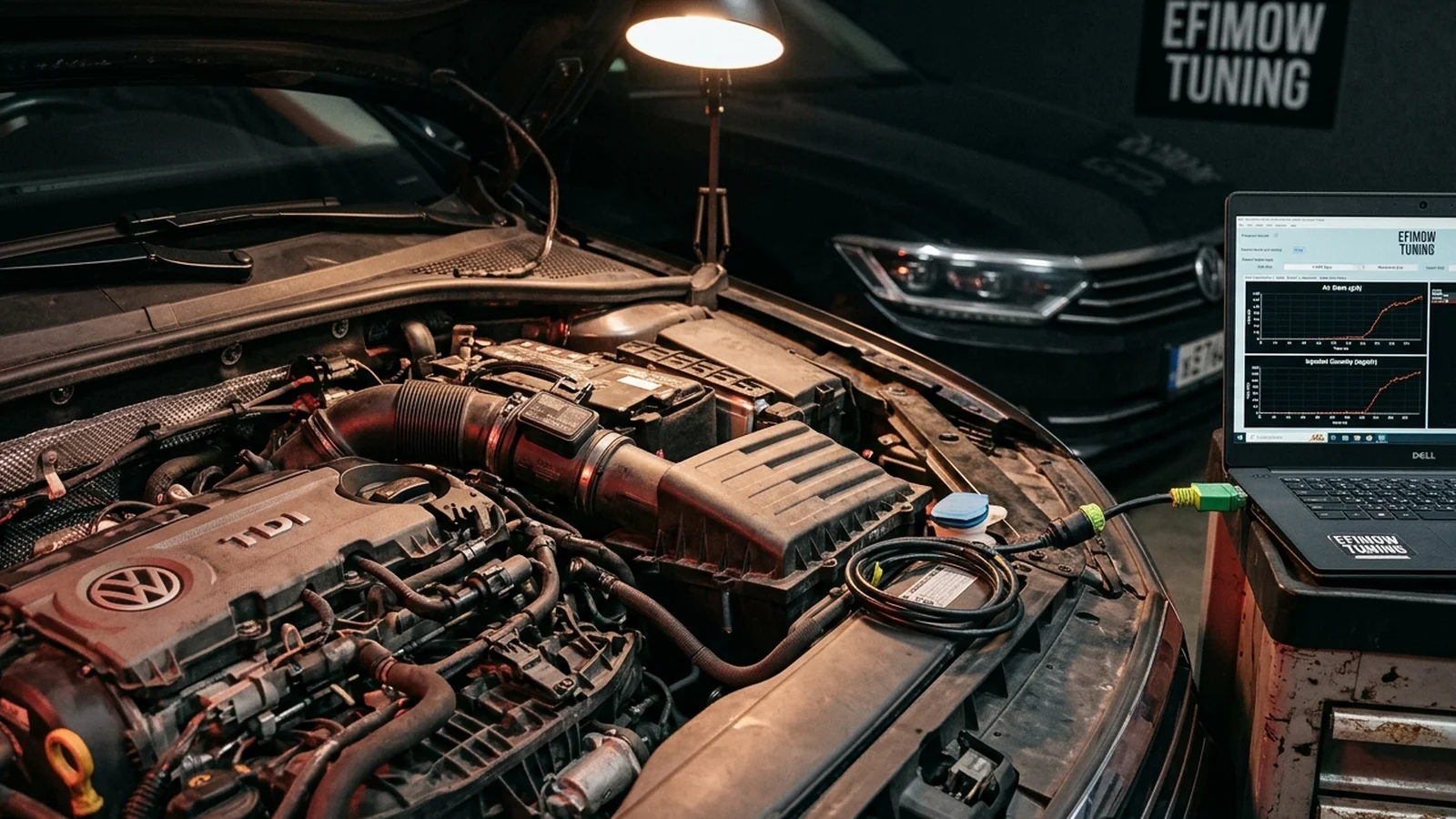
Depending on the engine, the control unit measures the air mass via the mass air flow sensor, via boost pressure or via a model combining both. So the smoke limiter does not react to a fixed number but to the actual situation in the engine.
That has an important property: the smoke limiter gives way by itself when conditions allow. When the turbo builds boost and more air flows, more fuel may come too. When air is missing, for example when pulling away before boost has built up, it holds the quantity back.
One link in a chain of limiters
The smoke limiter does not work alone. Between your right foot and the injector there are several limits in series:
| Stage | What it limits | Purpose |
|---|---|---|
| Driver demand | What you request with the pedal | Driving feel |
| Torque limit | Maximum torque over engine speed | Design of gearbox and drivetrain |
| Component protection | e.g. turbocharger at high altitude, temperatures | Protection against overspeed and overheating |
| Smoke limiter | Fuel in relation to air | Soot and exhaust gas temperature |
What arrives in the end is always the smallest value. The tightest cap decides. That also explains why software that raises only one limit often achieves little: the next one simply takes over.
Two kinds of limits have to be kept apart. The torque limit is a design decision by the manufacturer; raising it is the actual core of a tune. The smoke limiter and component protection, on the other hand, are protective functions with a physical input: air mass, ambient pressure, temperature. They are built to move along with conditions.
What a good tune does with the smoke limiter
More power from a diesel means more fuel. For it to burn cleanly, it also needs more air. A good tune therefore proceeds in this order: air first, then fuel, and only as much fuel as the air can carry.
In practice that means:
- The smoke limiter stays a smoke limiter. If it has to be adjusted, then along the air mass, so that it keeps moving with the air. A blanket increase across all ranges takes away exactly this property.
- Sometimes it does not need touching at all. If in the stock file it sits far enough above the torque cap, the factory reserve is sufficient. Whether it needs adjusting is not a matter of taste; it follows from the data.
- The pull-away range stays stock. With little air and low revs an increase brings hardly any power but a lot of smoke.
- The manufacturer is a good yardstick. Many diesel engines come from the factory in several power tiers with the same hardware. What the manufacturer itself permits for the stronger variant is a reasonable frame. More in the article Why manufacturers sell the same engine in five different power tiers.
Why good software does not change the everyday range at all is explained in the article Good diesel software only changes high load.
The anti-pattern: lying to the control unit
There is a second route to more fuel, and it is widespread: instead of changing the limits, you make more fuel flow for the same requested quantity. Many tuning boxes do exactly this by faking sensor signals. In software the same effect can be produced by bending the conversion from quantity to injection time.
That feels like more power. The catch: all limits keep calculating with the quantity the control unit believes it is injecting. The smoke limiter then underestimates the real quantity; the protection is not switched off but detuned. That is harder to notice than an obviously disabled function. More in the article Inside a tuning box: how sensor signals get faked.
The better rule: if you want more fuel, raise the limits and leave the quantity model alone. Then the control unit knows at all times what is really being injected.
How to notice a calibration that is too rich
- Visible smoke at full load, especially on older diesels without a particulate filter.
- More frequent regenerations on vehicles with a particulate filter, because the soot is caught there instead of becoming visible.
- High exhaust gas temperatures that load turbocharger and manifold.
- Sluggish power build-up despite a high quantity, because unburnt fuel does no work.
The particulate filter in particular makes a bad calibration invisible. The soot is still there; it just ends up in the filter.
Conclusion
The smoke limiter is not a brake a tuner should get rid of as quickly as possible. It is a rule that couples fuel to air, and that is exactly what makes it valuable. Good software respects this coupling: more air first, then more fuel, protective functions with their true reference. What makes sense for your vehicle you can see in the configurator. The term itself is in the glossary under Rauchbegrenzung.