
N47 Timing Chain: What Tuning Has to Do with It and What Not
The well-known BMW N47 timing chain issue explained calmly: causes, symptoms, affected years and what you should check before tuning.
October 26, 2026 by Leo Efimow
Hardly any BMW engine has such a well-known weak point as the N47. Anyone looking at a 118d, 320d or 520d from 2007 onwards will sooner or later come across the timing chain topic. Forums sometimes make it sound as if every N47 were a ticking time bomb, and as if tuning would bring the end even sooner. Neither is quite true. In this article we put the failure pattern into perspective calmly: what is behind it technically, which engines were particularly affected, how you recognise problems and what role software tuning actually plays.
What is different about the N47
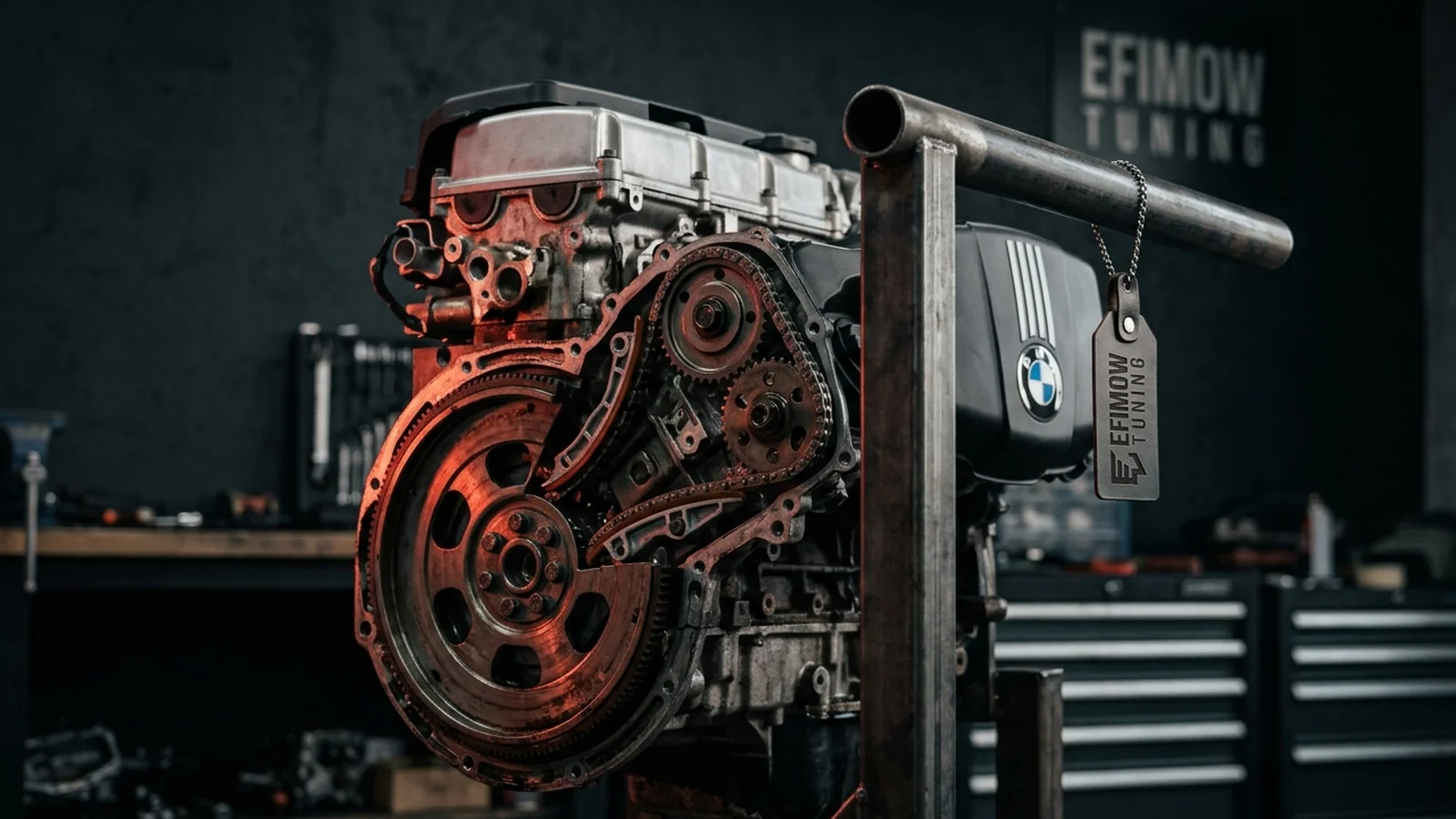
The N47 is a 2.0-litre four-cylinder diesel that BMW used from 2007 as the successor to the M47, among others in the E87, E9x, E60, F20, F30, F10 and the X models of that period. Like many modern engines it has a timing chain instead of a timing belt. The chain drive turns the camshafts and the high-pressure pump and has to make sure that crankshaft and camshafts run exactly in sync.
The special feature is its position: on the N47 the chain drive does not sit at the front of the engine but on the gearbox side, at the rear between engine and gearbox. That saves length, but it has an unpleasant consequence: for work on the timing chain the engine usually has to come out. A repair is therefore laborious and expensive, considerably more expensive than on an engine with a front-mounted chain drive.
The failure pattern
The well-known problem is elongation and wear of the chain drive. Over time the chain stretches, and guide rails and tensioner wear. If this goes unnoticed, in the worst case the chain can jump teeth or break. On a diesel, with its tight clearances between pistons and valves, that usually means serious engine damage.
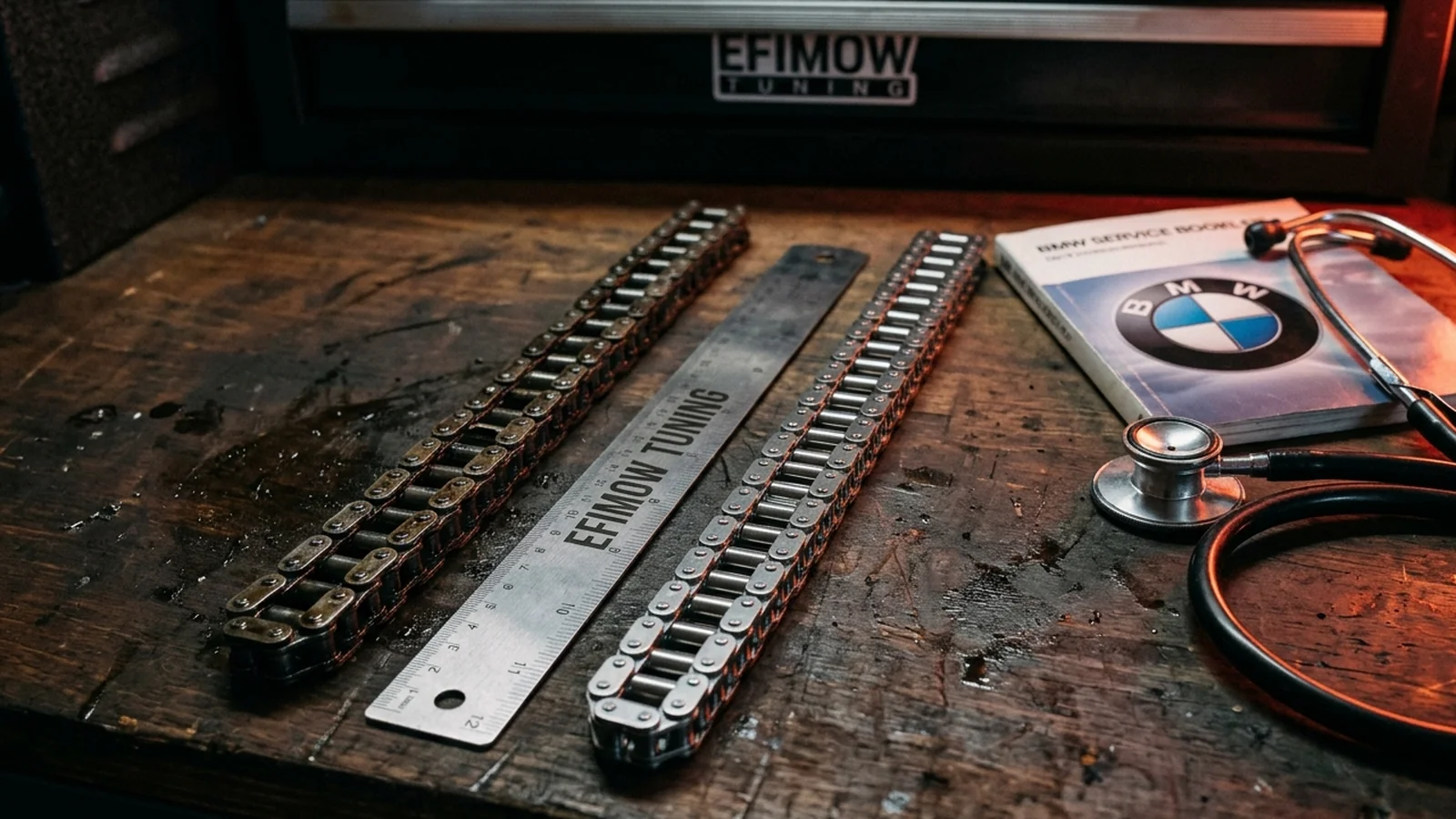
The causes most often cited are the design of the components in the early production years, such as sprockets, tensioner and guides. Long oil change intervals and frequent short trips also accelerate wear. According to general knowledge, engines from the first production years, roughly 2007 to 2009, were particularly affected. BMW revised the components in the course of production. Later engines are considered much less susceptible, although a residual risk exists there too at high mileages.
Important for perspective: by no means every N47 is affected. Many engines run without problems well beyond 200,000 kilometres. The problem is real, but it is not automatic.
How you recognise a problem
The typical warning sign is a noise. A stretched chain usually makes itself heard as a rattling, grinding or high-pitched whine coming from the area between engine and gearbox. It is often most audible at idle or low engine speeds, sometimes only when the engine is warm. Because the noise comes from the rear, it is easily confused with noises from the clutch, dual-mass flywheel or ancillaries.
If you hear such a noise, have it checked by a specialist workshop before carrying on as before. A workshop with N47 experience can assign the noise specifically. Whether goodwill is possible for your car can only be answered by BMW based on the VIN and the service history.
What tuning has to do with it
Now to the real question: does software tuning load the timing chain? The honest answer is nuanced.
What speaks against a direct connection: the timing chain does not transmit engine power to the gearbox. It drives the camshafts and the high-pressure pump. A large part of the load comes from the valve train, and that does not change with a software calibration: an engine with 220 instead of 184 hp opens its valves just as far and just as often as before. The well-known failure pattern also occurred just as much on cars that were never tuned.
What has to be said honestly all the same: tuning changes how the engine operates. More torque means higher combustion pressures, and if you call on the extra power often, you run the engine under more load overall. That mainly affects the crank drive, bearings, turbocharger and clutch. If rail pressure is raised, the high-pressure pump also needs a little more drive torque, and that runs through the chain drive. One more reason for a moderate calibration. Nobody can seriously promise that tuning has no influence whatsoever on the chain's service life, just as nobody can prove the opposite.
What really counts in practice: tuning does not repair a chain that is already damaged. An engine that already rattles is not a candidate for more power but for the workshop. What matters is condition and maintenance, not the software.
Our recommendation before tuning an N47
Before you have an N47 calibrated, we recommend:
- Listen carefully. At idle and at low revs, cold and warm. If there is rattling or whining from the rear of the engine, have it checked first.
- Check the service history. Has the timing chain already been replaced? For cars from the early years that is important information.
- Change the oil in good time. An oil with BMW approval and an interval that is rather shorter than the maximum are kind to chain and tensioner. What makes sense after tuning is described in the article on oil change intervals after tuning.
- Warm the engine up. Full load only with oil at operating temperature; that applies to every turbodiesel.
- Keep your goals realistic. A Stage 1 that adjusts the torque structure cleanly and leaves the protective functions active is something different from the maximum at any price.
As a guide value, the product page for the F30 320d with N47 gives around 230 hp and 505 Nm for Stage 1 instead of 184 hp and 380 Nm. How the EDC17 works in the N47 and N57 is explained in the article on the EDC17 in the F series.
If the chain has already been replaced
Many N47s from the early years have meanwhile had their chain drive replaced once, often with revised parts. That is not a bad starting point for tuning, quite the opposite: a freshly renewed chain drive with an invoice to prove it is one of the best pieces of information you can have about your engine. It only matters that all associated parts such as tensioner and guide rails were replaced during the repair and that the engine has been properly maintained since. Keep the invoice; it will also help you when you sell the car later.
Legal note
The software change voids your vehicle's type approval; the software is intended for motorsport use only (see the motorsport notice). We make no statements about warranty or goodwill; in each individual case BMW or the seller is responsible for that.
Conclusion
The N47 timing chain is a real, well-documented failure pattern that mainly affected engines from the early years and is encouraged by long oil change intervals. Software tuning is not the cause, because the chain drives the valve train and the high-pressure pump, not the car. But it is not a solution either: an engine with a noticeable chain noise belongs in the workshop first. If your N47 is healthy, properly maintained and you warm it up, there is nothing against a moderate calibration. In the configurator you can see which engine and ECU are stored for your model.