
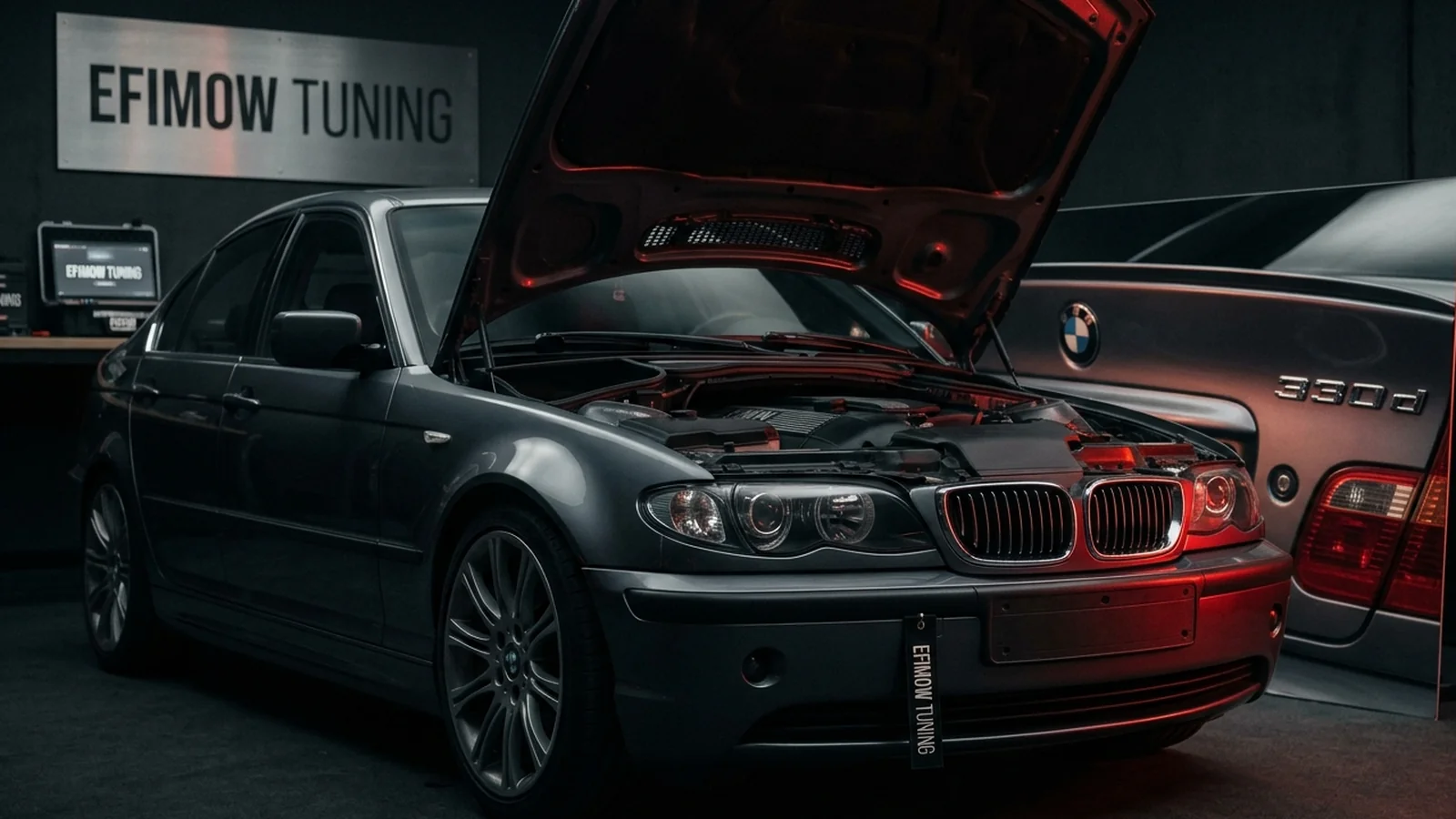
EDC15 in the E46 330d and E39 530d: Tuning the Early M57
The early M57 with Bosch EDC15 in the E46 330d, E39 530d and X5 3.0d: what the ECU controls, what is realistic and what to check first.
October 26, 2026 by Leo Efimow
The early M57 has a special reputation. When BMW presented the E39 530d in 1998, it was one of the first common-rail six-cylinders in the executive class, and suddenly a diesel drove as refined as a petrol engine. Shortly afterwards the engine went into the E46 330d, the E38 730d and the X5 3.0d. Many of these cars are now more than 20 years old and have over 300,000 kilometres behind them, yet they still run. This first M57 generation is controlled by the Bosch EDC15, called DDE4 at BMW. This article covers what this ECU controls, what tuning realistically delivers here and what you should check beforehand.
Which vehicles are affected
The EDC15 is found in the M57 engines up to the facelift around 2003. Typical vehicles are:
- E46 330d (2000 to 2003) with 184 hp and 390 Nm
- E39 530d (1998 to 2003) with 184 hp, 193 hp after the facelift
- E39 525d (2000 to 2003) with the 2.5-litre M57 and 163 hp
- E38 730d with 184 or 193 hp
- X5 3.0d (E53) up to 2003 with 184 hp
The four-cylinder M47TU with 150 hp, for example in the E46 320d from 2001 or the X3 2.0d, also runs on an EDC15 variant. The upper boundary matters: the E46 330d from 2003 with 204 hp and the X5 3.0d with 218 hp already have the revised M57TU and therefore the EDC16. For those cars, see our article on the EDC16 in the E60, E87 and E9x. If you are unsure which version you have: the configurator shows the stored ECU for every engine.
What the EDC15 controls in the M57
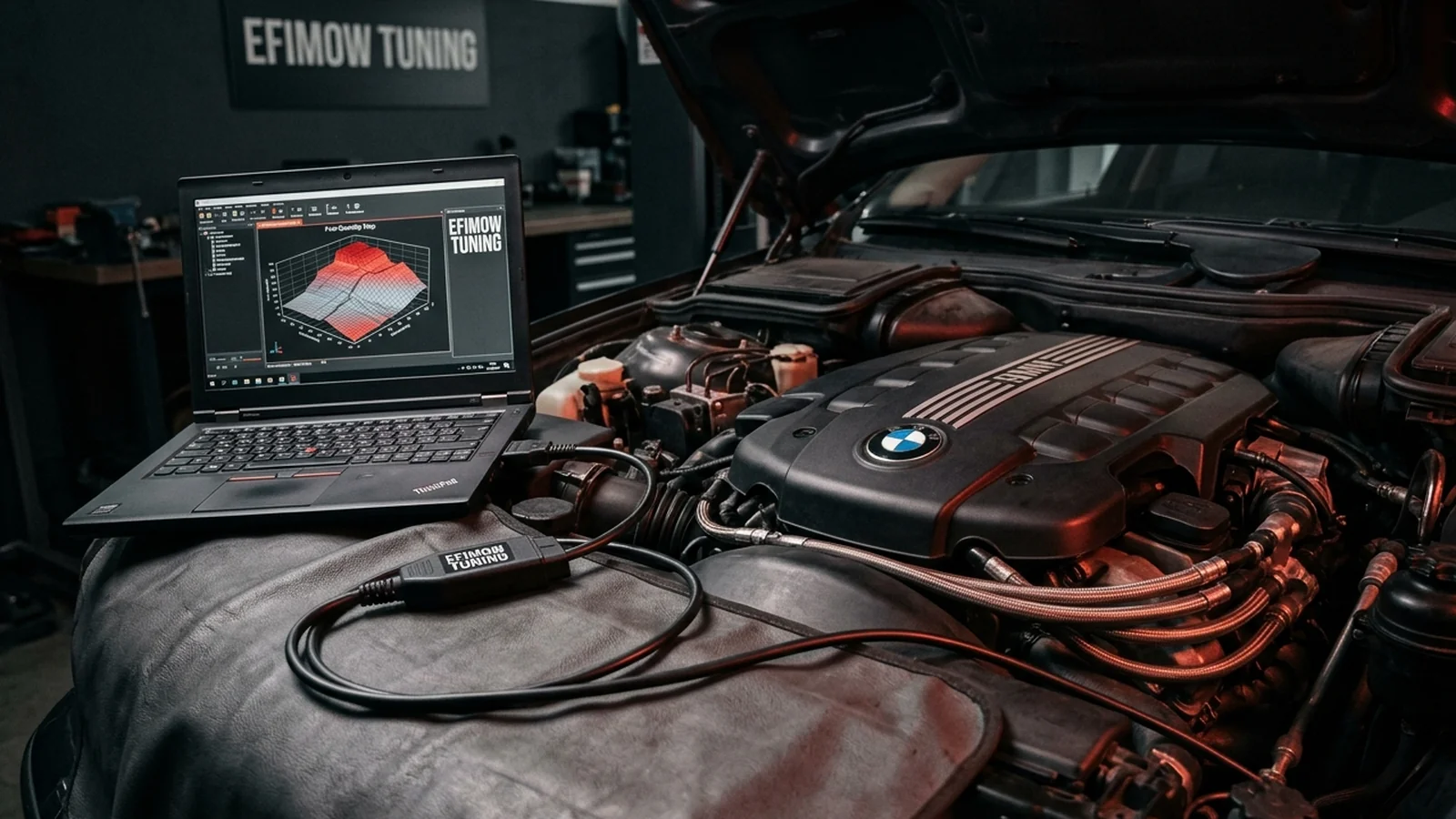
The EDC15 is a diesel control unit of the first common-rail generation. It determines how much fuel is injected at which moment, what pressure is present in the rail and how much boost the turbocharger should deliver. On top of that come exhaust gas recirculation, the glow system and communication with the gearbox and stability control.
The most important difference from later ECUs lies in the calculation logic. At its core, the EDC15 still thinks in injection quantities: pedal position and engine speed produce a quantity request, which then passes through several limits, for example depending on the measured air mass (smoke limitation) or on boost pressure. From the EDC16 onwards, by contrast, the ECU first calculates a target torque. For tuning this means: calibrating an EDC15 is more manageable, but it requires care, because quantities, rail pressure, boost and start of injection have to match one another. Anyone who simply adds quantity without bringing air and rail pressure along mainly gets more soot and higher exhaust temperatures.
As a rule these early M57s do not yet have particulate filters. Exhaust gas recirculation is present, however, and is part of the type approval. It stays active with a reputable calibration; disabling it by software is emissions tampering and prohibited on public roads.
What tuning realistically delivers on the early M57
The M57 has decent factory reserves, because the same engine was offered in several power levels. For the E46 330d, the product page gives a calculated guide value for Stage 1 of around 230 hp and 515 Nm, starting from 184 hp and 390 Nm stock. Stage 2 with an improved intercooler and/or downpipe with sports catalytic converter is listed there at around 248 hp and 566 Nm. The E39 530d with the same engine has corresponding figures.
What you notice most with this engine is the torque gain in the mid-range. A good part of it does not come from peak power but from earlier and smoother boost build-up. Especially on a car of this age, that is the real benefit: the car pulls far more confidently when overtaking, without the engine constantly working at its limit.
The figures are guide values, not a guarantee. How much actually arrives depends heavily on the condition of the engine, and after 20 years that varies a lot.
Before tuning: condition decides
An early M57 car is not a new car. Before you adapt the software, an honest check pays off. In practice we see the same points on these cars again and again:
- Air mass meter: an aged air mass meter reports too little air. The ECU then limits the quantity, the engine feels flat, and tuning cannot develop its potential.
- Turbocharger and boost control: play in the turbo, sticky guide vanes or leaking lines lead to fluctuating boost. That should be fixed first.
- Injectors: worn injectors show up as a rough idle, starting problems or smoke. More quantity will not make that better.
- Intake tract and EGR: carbon build-up in the intake costs power and distorts the air measurement.
- Clutch and dual-mass flywheel: on manual cars this is the most common weak point after tuning. If the clutch already slips at full load in stock form, it certainly will with 120 Nm more.
- Automatic gearbox: the automatic of this generation also has limited reserves. Clean fluid and smooth shifts are the prerequisite.
A fault memory read with no entries and a short test drive with an eye on boost and air mass tell you more here than any mileage on the registration papers.
How the tuning works
With the EDC15 in a BMW everything runs through the OBD port; the ECU stays in the car. You order online, read out the original software yourself with a suitable cable and flasher tool and upload it in the customer portal. We adapt the file, usually within 48 hours. Only when the file is finished do you pay for the software; today you only pay for the hardware, if you order it, and a €5 deposit. According to the product page, Stage 1 for the E46 330d starts at €175.
A practical tip for older cars: connect a battery charger while reading and writing. A weak battery is the most common cause of aborted procedures on 20-year-old cars. Your original file remains saved, and you can return to stock at any time. You can find more about the ECU itself on the page for the DDE4 (EDC15C4).
Legal framework
The software change voids your vehicle's type approval; the software is intended for motorsport use only (see the motorsport notice). That applies to a modern classic just as much as to a new car. Flashing the stock software back later does not legally undo any use on public roads in the meantime.
Conclusion
The early M57 with EDC15 is a rewarding engine to calibrate: robust, with genuine factory reserves and an ECU that can be handled entirely over OBD. The biggest difference from modern diesels lies not in the software but in the age. If you check air mass meter, turbo, injectors and clutch before tuning, you get a car that drives with considerably more pulling power without being pushed to its limits. If you drive an E46 330d, E39 530d or X5 3.0d, choose your model in the configurator and see which ECU is stored and what Stage 1 and Stage 2 mean in concrete terms.