

Vmax Removal: What the Speed Limiter Does and What Must Be Registered
Why manufacturers limit top speed, what removing the Vmax limiter changes technically and what to check for tyres, papers and registration.
October 25, 2026 by Leo Efimow
Many cars stop accelerating at a certain speed even though the engine still has something left. That is not physics but a single value in the ECU: the Vmax limiter. Raising or removing it is technically one of the smallest changes you can make to engine software. Legally and in terms of safety it is one of the bigger ones, because top speed is written in your vehicle papers, and tyres, brakes and chassis depend on it. Here is what the limiter does, what changes when it is removed and which points you need to clarify beforehand.
How the limiter works
The engine ECU knows vehicle speed from the wheel speed signals or the vehicle bus. When speed approaches the stored limit, the ECU reduces torque, usually smoothly via throttle and cylinder filling on petrol engines, via injection quantity on diesels. The car stops accelerating even with your foot flat down. When speed drops, the software releases again.
Inside the ECU this limit is usually a single parameter or a small group of them, for example split by gear or drive mode. In our classification of ECU families, changing Vmax is therefore technically possible on practically all common Bosch, Continental, Delphi and Marelli families. On some vehicles additional limits act in other control units, such as the transmission control unit. That only shows up when the file is checked.
Why manufacturers limit top speed
There are several reasons, and not all of them are technical:
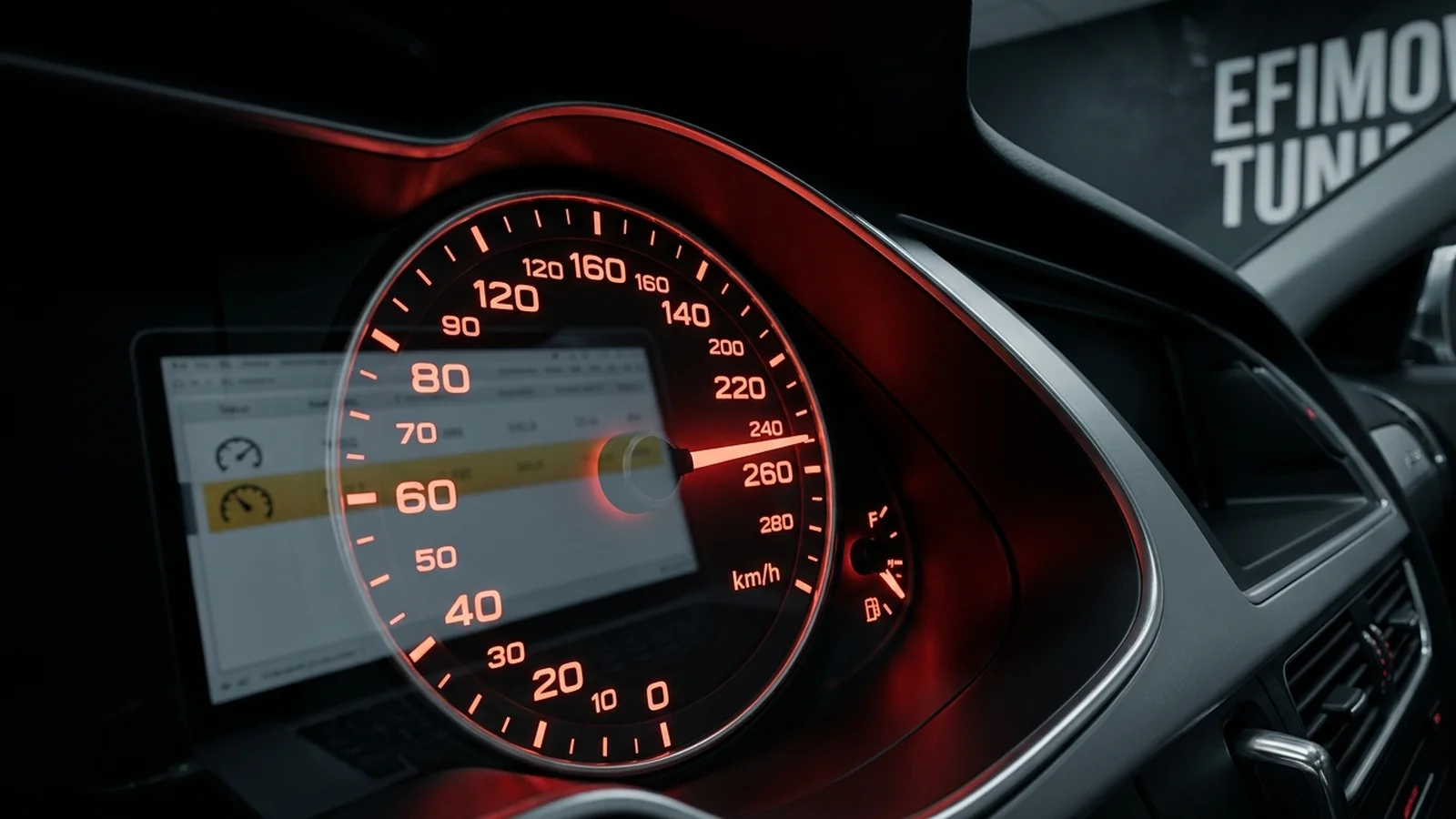
- Voluntary agreement: many German premium manufacturers have voluntarily limited their more powerful models to 250 km/h for decades.
- Tyres: the factory tyres are rated for the registered top speed. A car limited to 250 km/h may run on tyres with a matching speed index. Without the limiter a higher index would be needed.
- Chassis, brakes, aerodynamics: suspension tuning, brake cooling and axle lift are designed for the speed range the manufacturer approves.
- Vans and fleets: commercial vehicles and company cars often have lower limits, sometimes from the factory, sometimes requested by the owner.
So the limiter is not just a power brake but part of an overall package that includes the approvals for components.
What Vmax removal changes technically and what it doesn't
When the limit is raised or removed, the artificial ceiling disappears. How fast your car actually gets is then determined by power, aerodynamic drag, gearing and rev limit. A car whose engine hits the rev limiter in top gear will not get faster just because the Vmax value is gone. And a car with modest power often never reaches its theoretical top speed because drag wins first.
Important: Vmax removal adds no power. It is often done together with a Stage 1 calibration but is a separate change with its own consequences. Power, torque and everyday fuel consumption remain unchanged by it alone.
What must be registered
The design top speed is part of the vehicle data in the registration certificate. Changing it changes an approval-relevant characteristic. In Germany: every Vmax change, just like every power increase, requires an inspection and registration under § 19 (2) StVZO, for example via a parts certificate or an individual approval. Without registration the type approval (Betriebserlaubnis) lapses.
The inspection typically covers these points:
| Point | What matters |
|---|---|
| Tyres | speed index must match the new top speed |
| Brakes | brake system must be adequate for the higher speed |
| Chassis and body | stability, spoilers, add-on parts |
| Proof of speed | the new top speed has to be documented |
| Papers | the change is entered in the registration certificate |
Which proof the inspector requires depends on the vehicle and the testing organisation. Clarify this with your inspection body before having the software changed. And inform your insurer about the change. That is part of it too.
Tyres: the point most often forgotten
The speed index on the sidewall states the speed a tyre is rated for, for example V for 240 km/h, W for 270 km/h and Y for 300 km/h. If you raise top speed, the tyres must cover the new value. That does not only apply to your summer set: if you run winter tyres with a lower index, the rules that apply to them must be observed. Especially on cars rated just for V or W tyres from the factory, Vmax removal often means new tyres. More on high-speed tyres in the glossary under UHP tyres.
Common misconceptions
A few assumptions about Vmax removal persist that are not true:
- "The speedometer shows more afterwards, so I'm faster." From the factory a speedometer may read high, never low. What it shows is not measured speed. For registration, proof counts, not the needle.
- "Without the limiter every car reaches the figures of its sister model." A more powerful sister model often has different gearing, tyres or aerodynamics. Same engine does not mean same top speed.
- "Nobody will notice." The modified software is stored in the ECU and can be read out. After an accident or at an inspection at the latest, the question of registration comes up.
- "Removal harms the engine." The engine itself notices little; it does not rev higher than before. The load falls mainly on tyres, brakes and chassis, and only when you actually drive the higher speed.
With vans and company vehicles there is one more point: here the limiter is often intentional, for example for operational safety or insurance conditions. Before a change, check the leasing or insurance contract.
What the option costs
For cars of other brands (on site in Stödtlen or via a shipped-in ECU), Vmax removal can be added to the calibration as a software option for €20, provided it is approved for your ECU. For some ECU families, such as certain Denso diesels, we check this against the file first. For BMW the configurator shows directly which extras are available for your ECU and what they cost. You usually receive the file there within 48 hours.
Legal framework
For any change to the engine software: the type approval lapses, and our software is intended exclusively for motorsport. Anyone who wants to drive a vehicle with modified software on public roads needs the inspection and registration and is responsible for it themselves. Details are in the motorsport notice; the registration process is explained under the glossary term Eintragung.
Conclusion
The Vmax limiter is one parameter and removing it is technically trivial, but it adds no power, it only removes a ceiling that tyres, brakes and papers depend on. If you want it, check tyre index and brakes, agree the registration with the inspector beforehand and inform your insurer. Whether the option is approved for your ECU is shown in the configurator once you have selected your vehicle.