
Tuning Box or Software? The Comparison for Every Brand
Tuning box or software tuning on VW, Mercedes, Ford, Fiat & co.: how both work, what happens to protective functions and when each makes sense.
October 25, 2026 by Leo Efimow
If you search the internet for more power for your car, you quickly come across two offers: a plug-in tuning box and a software tune of the ECU. Both promise more horsepower and torque, both are available for almost every brand. Technically, though, they work in fundamentally different ways. Here we compare both routes across brands, without sales promises.
How a tuning box works
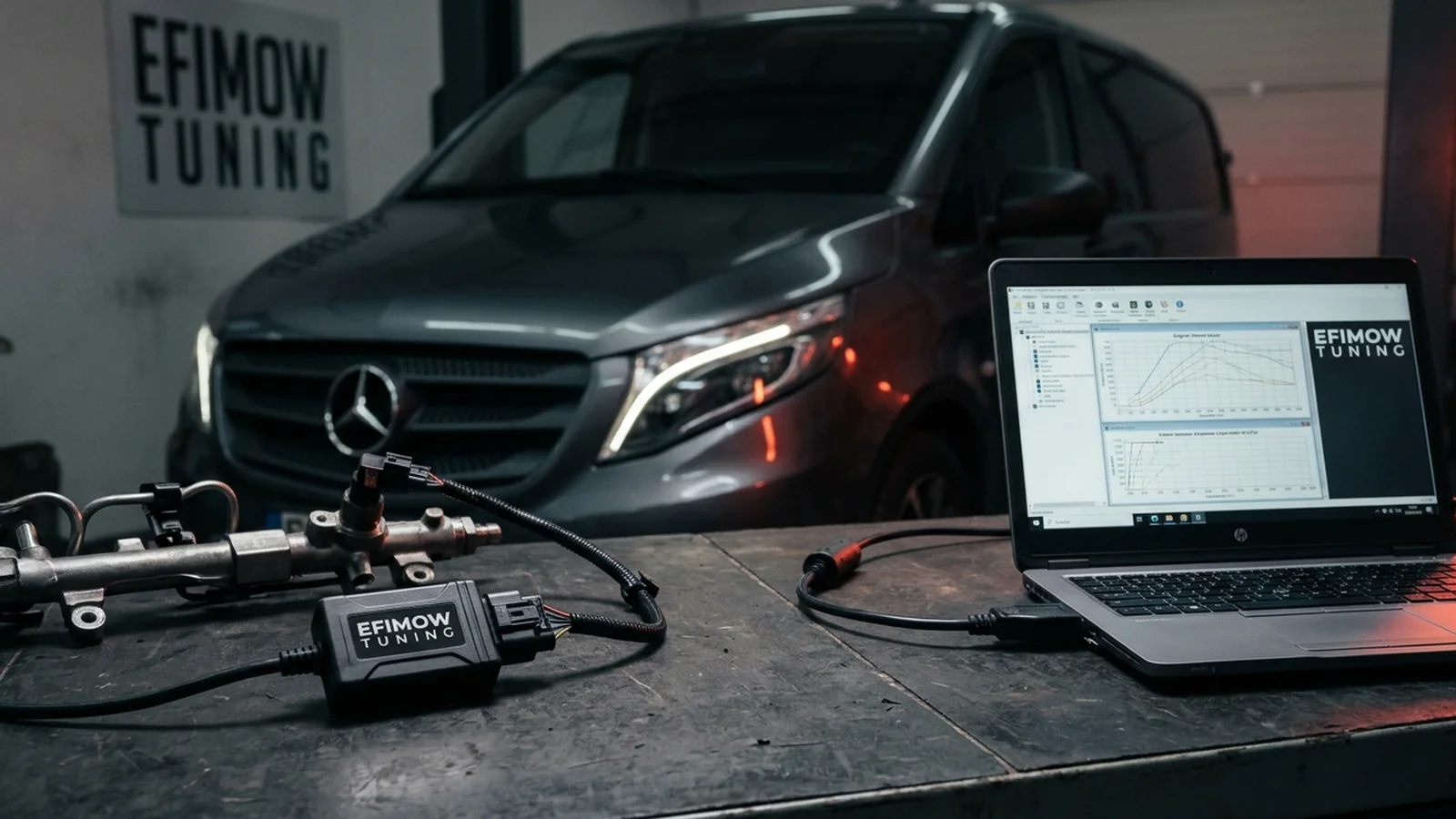
A tuning box is a small add-on control unit. It is plugged in between a sensor and the wiring loom, on diesels usually at the rail pressure sensor, on turbo petrols at the boost pressure sensor. There it changes the signal before it reaches the engine ECU.
An example on a diesel: the box reports a slightly lower rail pressure to the ECU than is actually present. The ECU "believes" the pressure is too low and raises it. As a result there is more pressure, more fuel is injected and the engine produces more power. It works similarly with boost on a petrol engine.
The software in the ECU stays unchanged. Nothing is flashed.
How software tuning works
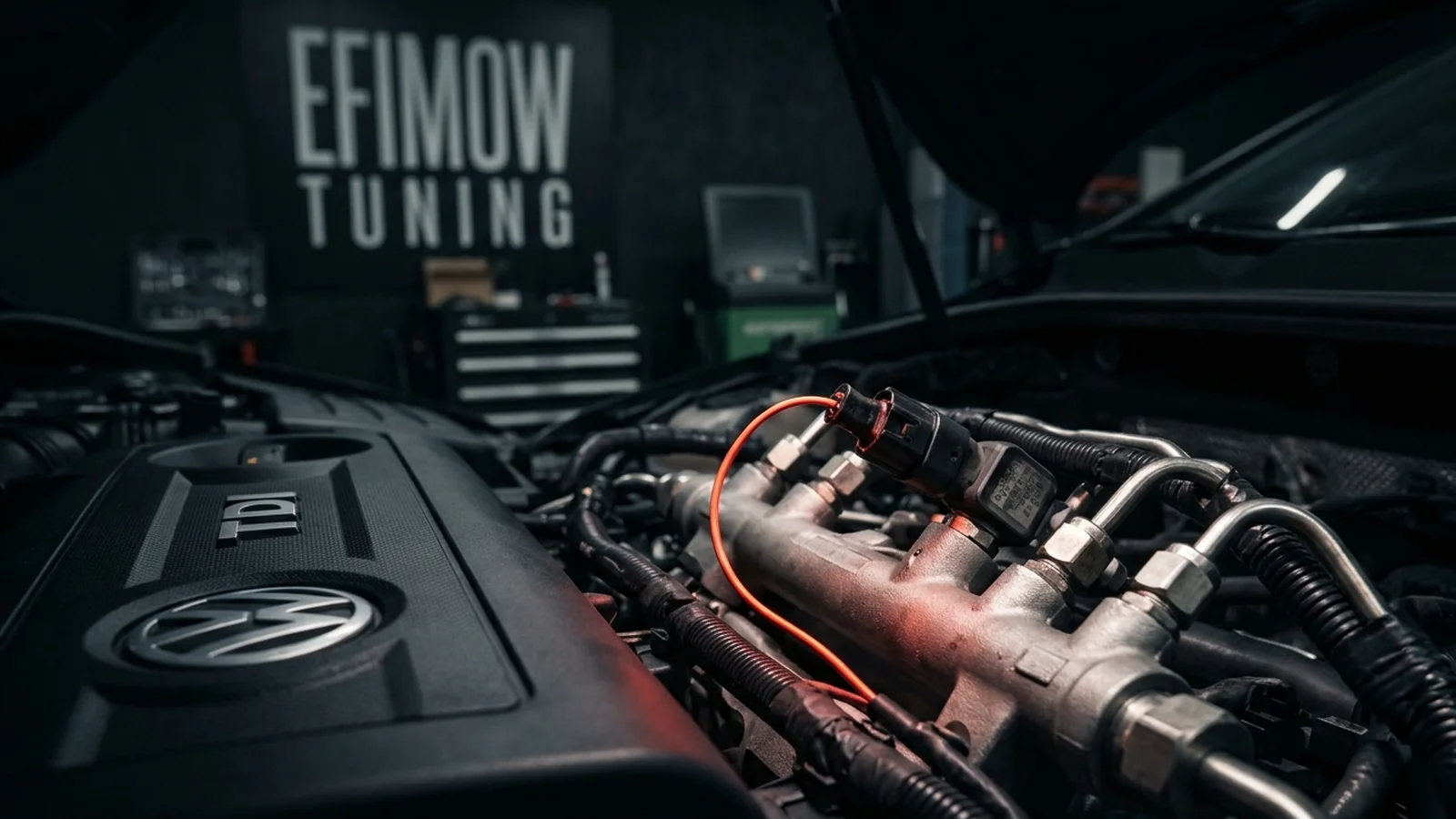
With software tuning, the ECU's data is read out, the maps are edited and the data is written back. The target values themselves are changed: boost, fuel quantity, rail pressure, ignition timing, torque request and the associated limits. Afterwards the ECU knows what it is supposed to do, and all measured values remain genuine.
Access to the ECU differs by generation: via OBD, in bench mode on the removed unit, or on locked ECUs in boot mode. That makes software tuning more involved, but also more precise.
The key difference: protective functions
Modern ECUs protect the engine with many functions: smoke limitation, exhaust temperature model, component protection for turbo and clutch, knock control on petrol engines, torque limitation for the gearbox. All of these work with measured values.
With a tuning box, exactly one measured value is wrong. The ECU calculates with a rail pressure or boost that does not match reality, so its protective functions work with false input data. How much that matters depends on the vehicle and the box. In principle, though, the ECU does not know what is really happening.
With software tuning all measured values stay genuine. The protective functions are matched to the new targets and keep working as from the factory, just from a different starting point.
Comparison at a glance
| Tuning box | Software tuning | |
|---|---|---|
| Intervention | sensor signal is falsified | target values in the ECU are changed |
| Installation | plugged in at the sensor | read and write via OBD, bench or boot |
| Protective functions | work with a false value | work with genuine values, recalibrated |
| Fine tuning | few parameters | many maps, including torque curve and limiters |
| Extra functions | none | depending on ECU e.g. ECO tuning, sharper throttle, Vmax |
| Failure risk | extra connector in the engine bay | no additional hardware |
| Reversal | unplug the box | flash back to original |
| Legal position | type approval void without registration | type approval void without registration |
The "box leaves no trace" myth
A common selling point of the box: just unplug it and everything is as before. Technically that is true for the software, since it was never changed. But in the meantime the box has altered values the ECU may have adapted to or logged, such as quantity deviations or fault memory entries. Software tuning can also be reversed by flashing back. Neither solution is completely invisible to diagnostics.
When a box might be considered at all
To be honest, there are cases where people choose a box: when an ECU cannot be written with reasonable effort, when the vehicle will only be kept briefly, or when someone deliberately does not want to change anything in the ECU. Then you should know what you are buying: a signal manipulation with limited control over the engine, not a calibration.
Across brands: what software achieves today
The range of ECUs is huge, from Bosch EDC17 and MED17 to Siemens/Continental SID and Simos, Delphi DCM, Magneti Marelli and Denso. For the vast majority of families there is a way into the ECU, though newer generations often only in bench or boot mode. Typical Stage 1 guide values depend heavily on engine and ECU family, for example around 20–30 % on many turbo diesels with EDC17 and only 3–8 % on naturally aspirated engines. The values for your vehicle are shown in the configurator; an overview of all vehicles is under tuning.
Process with us
For BMW you order online, flash it yourself via OBD and pay for the software only once it is finished; today you pay only for the hardware and a €5 deposit. For all other brands you come to Stödtlen on a date you choose or send in the ECU, both at the same price and bookable online. The price depends on the ECU generation; if the ECU has to be opened for access, €50 is added.
Legally both routes are the same: the power change voids the type approval unless it is inspected and registered. Our software functions are intended exclusively for motorsport; more in the motorsport notice.
Conclusion
A tuning box falsifies a sensor signal and leaves the ECU working with a wrong value. Software tuning changes the targets directly and recalibrates the protective functions to match. The box is quicker to install; the software is more precise, has more parameters and needs no extra hardware in the engine bay. For a clean calibration across all brands, software is the better route. More on the term in the glossary under map.