
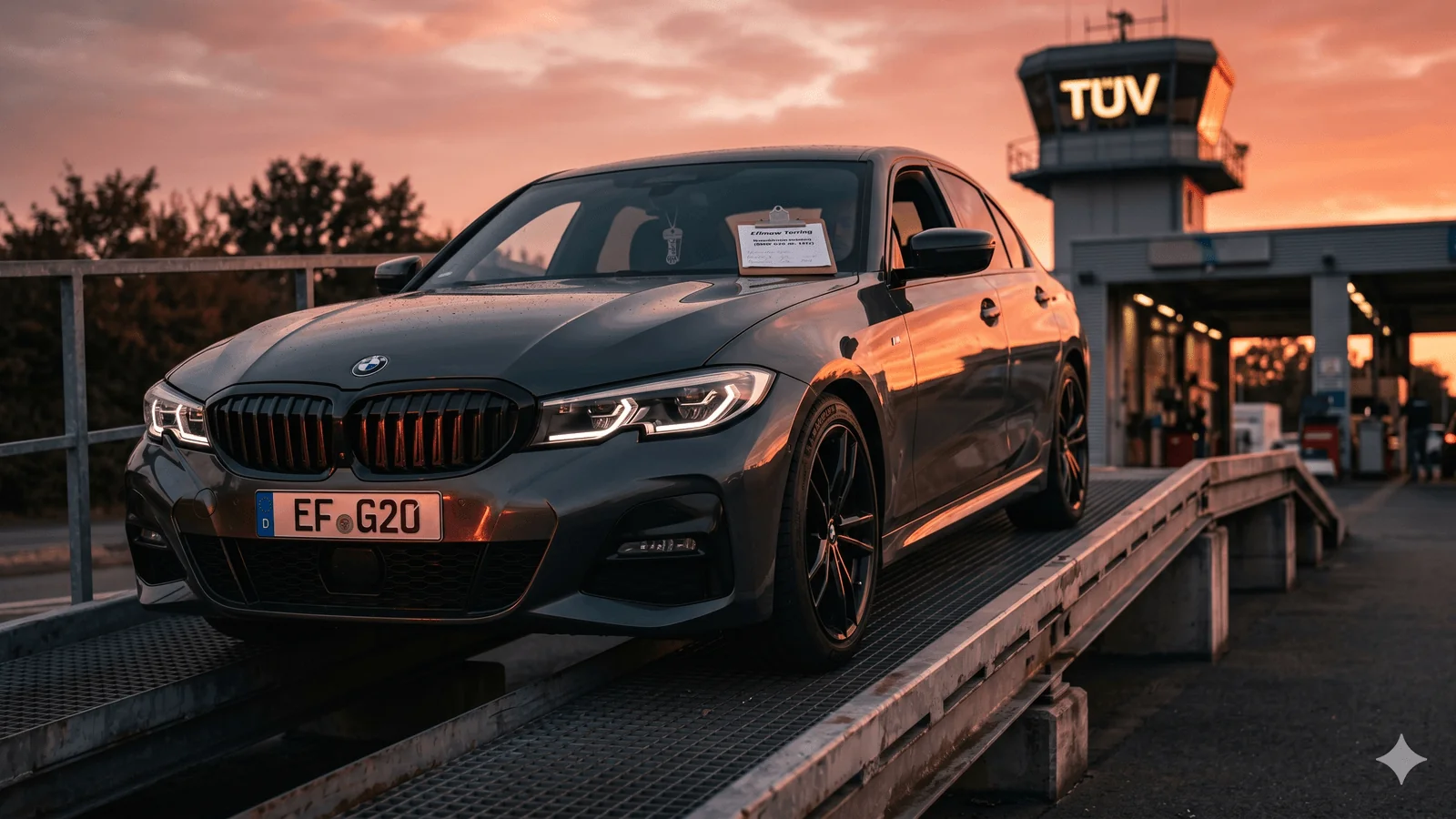
Step-by-Step TÜV Approval: From Tune to German Registration
Six concrete steps to legal road approval for your tune in Germany: what to bring, what gets tested, and the typical cost.
May 6, 2026 by Leo Efimow
A power upgrade is not finished until it shows up on the Fahrzeugschein (German vehicle registration document). Between a clean software file and a legally road-going car lies a chain of appointments, papers, and stamps in a specific order. Knowing the sequence before the first phone call saves weeks of waiting and awkward conversations at the dyno. Six steps lead from the freshly flashed ECU to the registered papers. On BMW models like the B47, B48, B58, or S58 the procedure is essentially identical, only the inspection emphasis shifts.
Step 1: Settle the Teilegutachten or ABE up front
Before you call to book a TÜV (German technical inspection authority) slot, the legal foundation has to be clear. Three paths exist: a Teilegutachten (parts approval document) from the tuner, an ABE (Allgemeine Betriebserlaubnis, general type approval) for the whole package, or an Einzelabnahme (individual inspection) under § 21 StVZO (German road traffic licensing regulations). For reputable software tunes, the standard case is the Teilegutachten: a PDF that documents the changed key figures (new rated output in kW, peak torque, revised rev limits) and conditions of use for one specific vehicle-engine combination.
Insist on the document as a PDF before the file is loaded. Verify that your exact variant (model year, engine code, transmission) is listed within its scope. Registering a 330i with a Teilegutachten written for an M340i is not permissible. Even though both carry the B58, the listed key figures differ. A casual "should be fine" at this stage walks you into a wall on test day.
Step 2: Book the appointment and pick the right shop
With the Teilegutachten in hand, choose an amtlich anerkannter Sachverständiger (aaS, officially recognised expert) or a Prüfingenieur (PI, inspection engineer). Both are authorised to register modifications; the difference is organisational, not jurisdictional. TÜV Süd, TÜV Nord, DEKRA (German technical inspection organisation), and GTÜ are the four major contacts, alongside certain certified independent workshops.
A workshop recommendation from your tuner is worth seeking. Inspectors who already know this specific tune save arguments over plausibility on the day. When booking, mention "Eintragung Leistungssteigerung mit Teilegutachten" (registering a power upgrade with a parts approval document) and the vehicle model. Realistic waiting times run one to three weeks, longer in metropolitan regions.
Step 3: The documents you must bring
On test day, the following paperwork should be complete:
- Fahrzeugschein (Zulassungsbescheinigung Teil I, vehicle registration document Part I): original, not a copy
- Fahrzeugbrief (Zulassungsbescheinigung Teil II, the title document): often required, sometimes only at the registration step itself
- Teilegutachten: original or officially certified copy, depending on the inspection organisation
- Receipt for the tuning service: proof of who carried out the modification
- HU report (Hauptuntersuchung, the German biennial main inspection): if your last HU is more than two years ago, a combined inspection can save a second visit
- Photo ID of the registered owner
A common mistake is presenting the Teilegutachten without the tuner's signed installation/flash protocol. Some inspectors insist on explicit evidence that the procedure described in the document was indeed carried out on this car.
Step 4: What actually happens during the inspection
The inspection itself takes between 30 minutes and two hours, depending on scope. It splits into three parts.
Visual check: The expert cross-references the vehicle identification (VIN, engine number) with the papers and verifies the hardware prerequisites named in the Teilegutachten, on a turbocharged diesel perhaps a specific intercooler, on an S58 possibly the unmodified factory exhaust.
Functional check: A short test drive or run to operating temperature, plus a review of the OBD fault memory. Active or stored codes related to the tune lead to rejection.
Dyno measurement: For higher stages or unusual configurations, the inspector calls for a chassis-dyno run. The figure must not deviate more than ±5 % from the document. Substantially above triggers refusal; substantially below also invites debate.
Step 5: Entry on the Fahrzeugschein
Once the inspection is passed, the expert issues a TÜV confirmation that serves as the basis for the registration. With this letter you proceed to your local Zulassungsstelle (vehicle registration office). At many inspection organisations the entry can be made on site, at others it cannot.
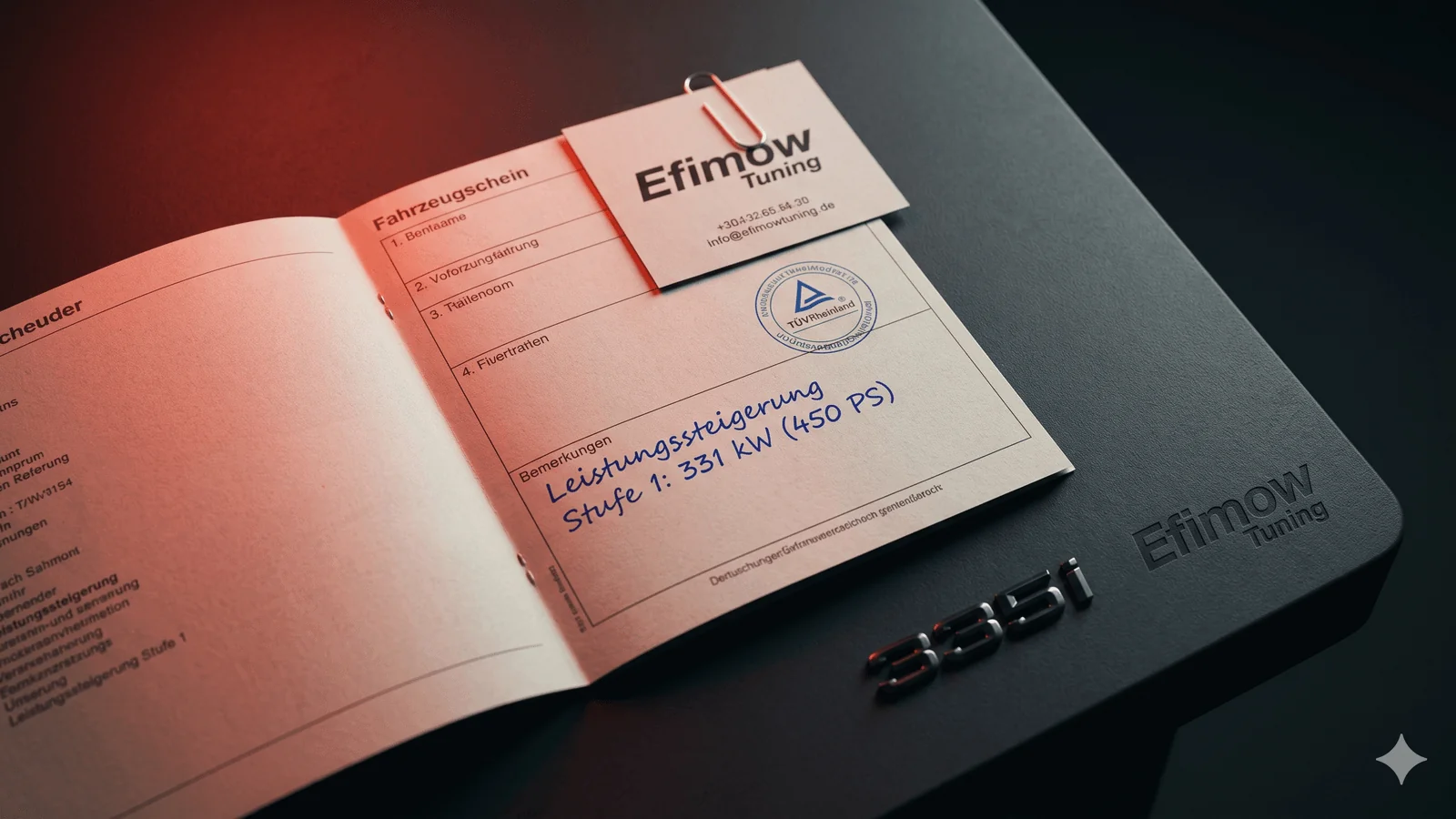
On the Zulassungsbescheinigung Teil I (colloquially the "gelber Schein", the yellow slip, though since 2018 printed on a greenish-grey background and therefore often called the "grüner Schein"), the new rated power in kW is added in the Bemerkungen (remarks) field, traditionally field 22 on older paperwork. Alongside it appears the inspection note "Eintragung gem. § 19 Abs. 3 StVZO" and the date. From that moment the modification is legally documented.
Step 6: Notify the insurer (the often-forgotten obligation)
With the entry on the Schein, your obligation toward the state is settled, toward your insurer it is not. Every registered power upgrade must be reported. The deadline is set by the insurer's terms, but immediate notification within a few days of the registration is the norm. An unreported power increase can lead to loss of cover in a claim, even when the damage has nothing to do with the tune.
In practice, a short email with a copy of the new Fahrzeugschein is enough. Premiums typically rise by 5–20 %, depending on power level and tariff. Building this into your cost calculation avoids the unpleasant discovery that an apparently cheap tune ends up more expensive across the policy term.
Typical costs at a glance
A realistic budget for a standard registration with a Teilegutachten:
- TÜV registration fee: 100–300 €
- Optional dyno measurement: 80–200 €
- Zulassungsstelle (paperwork update): 20–40 €
- Insurance premium adjustment: variable
For an Einzelabnahme these numbers multiply: between noise and emissions measurements and the expert's hourly rate, low four-figure totals are normal, with several thousand euros possible in unusual cases. A standard tune on a common BMW model, however, almost always stays inside the Teilegutachten budget.
Bottom line
A TÜV approval is not an obstacle but a predictable procedure. Put the Teilegutachten on the table before the flash, book a prepared appointment, arrive with complete paperwork, and notify the insurer immediately afterwards, and the sequence wraps up cleanly within two to three weeks. The tune is then not just technically finished but also legally sound, and that combination is exactly what separates professional chip tuning from a risky garage modification.