
Pops & Bangs: How They Actually Work
Pops & bangs are pure sound tuning, zero power. How the mechanism works, what it demands from your catalyst and exhaust, and why diesels can't have it.
July 27, 2024 by Leo Efimow
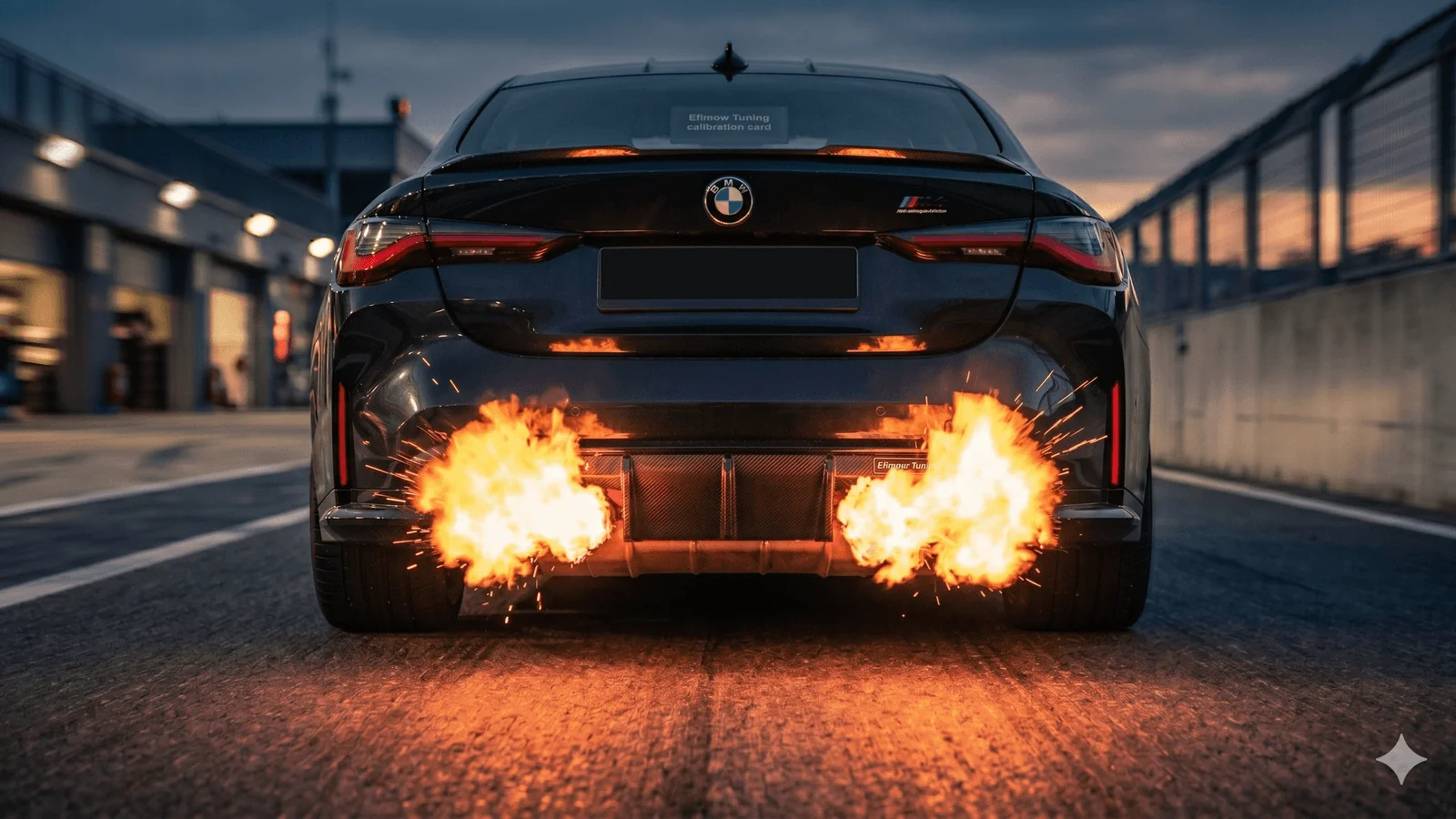
"Pops & bangs" (also known as overrun crackle or a "crackle map") is one of the most popular tuning features around, and one of the most misunderstood. It is not a performance feature. No horsepower, no Newton-meters, no quicker acceleration. What it delivers is acoustic drama on overrun: the audible pops, cracks, and burble out of the exhaust when the driver lifts off the throttle from high rpm. Buyers of pops & bangs are buying a sound effect: knowingly, with awareness of what it does to the engine, and with the right hardware on the exhaust side.
The mechanism: controlled combustion in the exhaust tract
In overrun (throttle lifted, transmission still in gear) a modern BMW engine normally does one thing: overrun fuel cut. The injectors close, no fuel enters the cylinders, the engine continues to rotate because the wheels are turning it, and the exhaust gas in the tract is essentially air. Pops & bangs change exactly this.
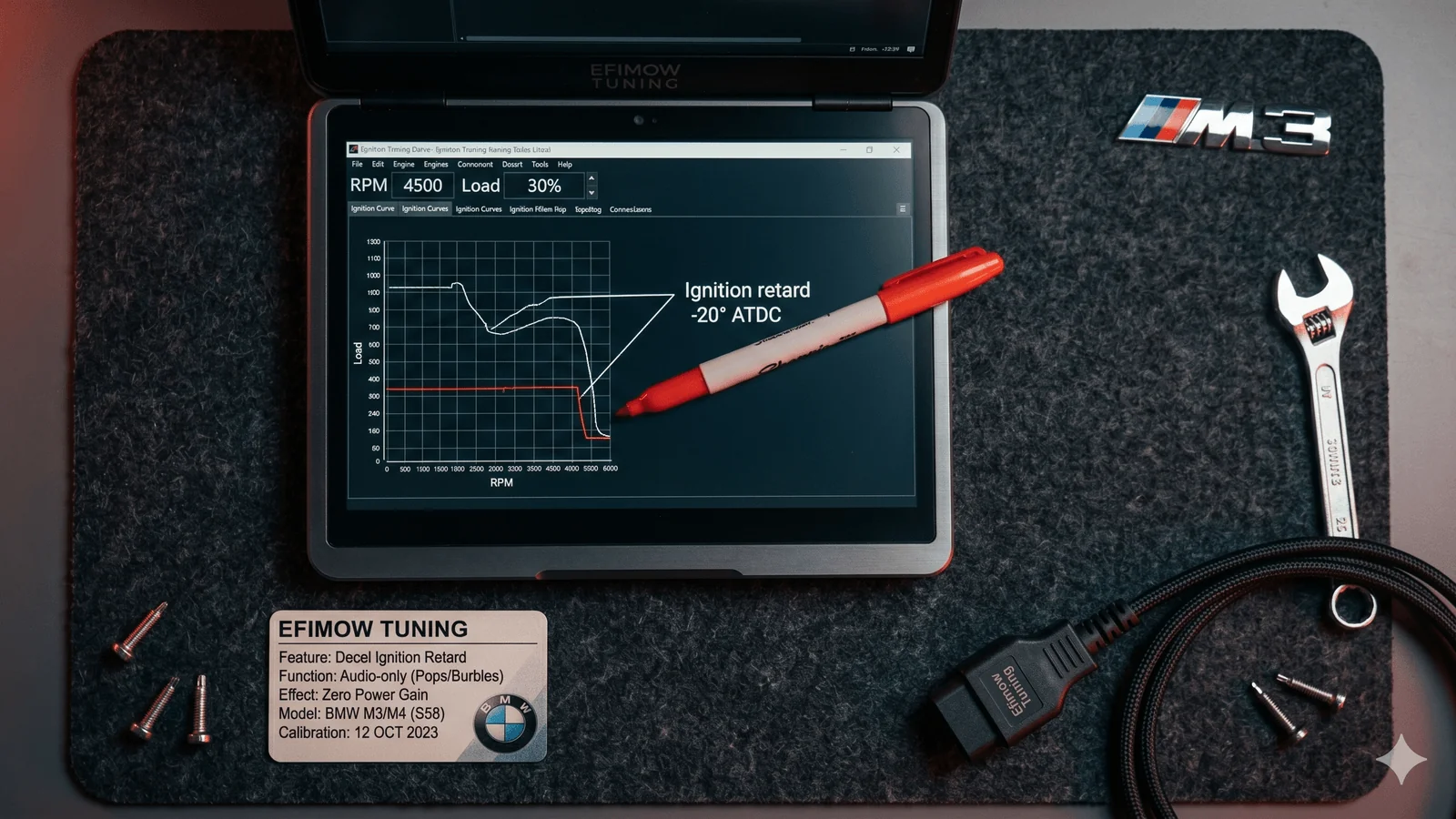
A crackle map consists of two coordinated changes: first, the fuel cut is delayed or suppressed: the injectors keep delivering a small amount of fuel even though the driver isn't accelerating. Second, ignition timing is shifted dramatically late, often to values like 20 to 30 degrees ATDC (after top dead center). The result: combustion begins when the exhaust valve is already nearly open. Part of the mixture still burns in the cylinder, part leaves the cylinder unignited or only partially burned.
In the hot exhaust manifold and ahead of the catalyst, that mixture meets near-ideal conditions for self-ignition: 700–900 °C ambient, fresh oxygen flowing through open exhaust valves, turbulent flow. It ignites, and exactly that delayed combustion outside the cylinder produces the audible pop. The volume and sharpness depend on injected quantity, ignition retard, and exhaust geometry.
Why only on gasoline engines
The "can I have this on my 320d" question keeps coming up. The answer remains no. A diesel runs without spark plugs; combustion happens via auto-ignition of fuel injected into hot compressed air. There is no ignition angle to retard. On top of that, in overrun a diesel is not throttled the way a gasoline engine is. It pulls air freely, the exhaust runs lean, and a secondary combustion in the manifold simply would not ignite. Pops & bangs are a gasoline-engine phenomenon.
Hardware prerequisite: what has to be right at the exhaust
This is the most important point a serious tuner raises before even calibrating: a stock catalyst will not survive pops & bangs long-term. The factory primary cat (typically 600 cells, mounted close to the turbine outlet) is engineered for normal load cycles, not for repeated combustion shock waves. What happens when you run pops & bangs on a stock cat: the ceramic substrate develops microcracks, individual cells fracture, and in the worst case the substrate disintegrates, and pieces of the substrate end up in the turbine wheel of the turbo. That is an engine failure people underestimate, because it doesn't happen on the first pop; it shows up weeks or months later.
The recommendation is therefore unambiguous: pops & bangs only in combination with a sport-cat downpipe (200- or 300-cell metallic substrate) or a catless downpipe for track use. A metal substrate handles pressure shocks far better than ceramic. That makes pops & bangs effectively a Stage 2 companion feature: anyone already building Stage 2 with a sport-cat downpipe can add pops & bangs without raising hardware risk much further. Anyone keeping factory hardware is being reckless.
What can be calibrated
A serious crackle map gives the driver control over the character of the sound. Three axes are common:
- Intensity: from "subtle burble" to "aggressive shots." Intensity follows primarily from the fuel quantity injected during overrun and the amount of ignition retard.
- RPM trigger window: pops & bangs are typically only enabled above a certain rpm (commonly 3,000 to 4,000 rpm). City driving stays quiet, but Sport-mode driving on a back road comes alive.
- Mode binding: serious calibrations bind pops & bangs to Sport or Sport+ mode. In Comfort mode the car is unobtrusive; in Sport mode the soundtrack is sharp. That is the difference between a car you can drive quietly when you need to and one that pops constantly.
Wear consequences
Even with a sport-cat downpipe, pops & bangs are not wear-free. What is loaded:
- Exhaust valves and valve seats: the repeated thermal shocks from unevenly burned mixtures raise peak temperatures at the valvetrain. On BMW engines with marginal exhaust-valve material to begin with (e.g. some early N20), it adds another factor.
- Turbine wheel of the turbo: pressure shocks in the manifold and on the turbine cost lifespan. Not dramatic, but measurable.
- Sport catalyst: the metal substrate also ages faster under pops & bangs. It is tougher than ceramic, but not made of stone. An honest budget treats the sport cat as a wear item every 60,000 to 100,000 km, depending on intensity.
These are not arguments against pops & bangs. They are the honest fine print. Anyone who knows them and still wants the feature can have it with a clear head.
Legality in Germany: short note
Pops & bangs are effectively not approvable in Germany for public-road use. They typically violate provisions on noise emissions, exhaust emissions, and tampering with the factory overrun fuel cut under the Allgemeine Betriebserlaubnis (ABE, the general type approval). A crackle map therefore lives in the territory of track use or "unofficial" private-property operation. Driving a car on the public road with audible pops & bangs risks the Betriebserlaubnis (operating permit) being declared void during a police or TÜV inspection. The Cluster F post on § 19 StVZO and the Betriebserlaubnis covers the full context.
Bottom line
Pops & bangs are a pure audio feature that meaningfully changes the character of a sporty BMW, without adding a single horsepower. Cleanly calibrated on appropriate exhaust hardware, it is a controlled effect that delivers a race-car soundtrack at the touch of the Sport button. Installed wrong on factory hardware, it is an expensive trap that kills the primary cat and, with bad luck, the turbo right behind it. Anyone who wants it should have it calibrated by someone who knows what they're doing (not copied from a YouTube tutorial) and treat it as what it is: an effect for the weekend strip or the track day, not the daily commute.