
Launch Control via Software: How It Works and What It Costs
Adding launch control without hardware: how the standing-start limiter works inside the ECU, which ECUs support it, what it stresses and what it costs.
October 25, 2026 by Leo Efimow
Launch control sounds like a race car feature, but technically it is a surprisingly small change: the ECU gets a second, lower rev limit that only applies while the car is standing still. You press the clutch, floor the throttle, the engine holds a fixed launch rpm, and the moment you let the clutch out, the software releases the full rev range. No add-on module, no wiring, just a few parameters and conditions in the engine software. Here is how it works in detail, what it does to your clutch and drivetrain, and what it costs.
What launch control does inside the ECU
Every engine ECU has a rev limiter. From the factory it is usually a soft limiter: shortly before maximum rpm the throttle closes, cylinder filling drops and the engine "runs out" gently. Launch control adds a second stage to this limiter, which is why motorsport people call it 2-step. Stage one is the launch rpm at standstill, stage two the normal limiter while driving.
To make sure the launch limit only kicks in when it should, the software checks several conditions at once:
- Vehicle speed close to zero: the function is only active at standstill.
- Clutch switch pressed on manual gearboxes, on some automatic variants the brake.
- Throttle pedal above a threshold, usually wide open.
- Optionally engine temperature in the operating range, so nobody launches on cold oil.
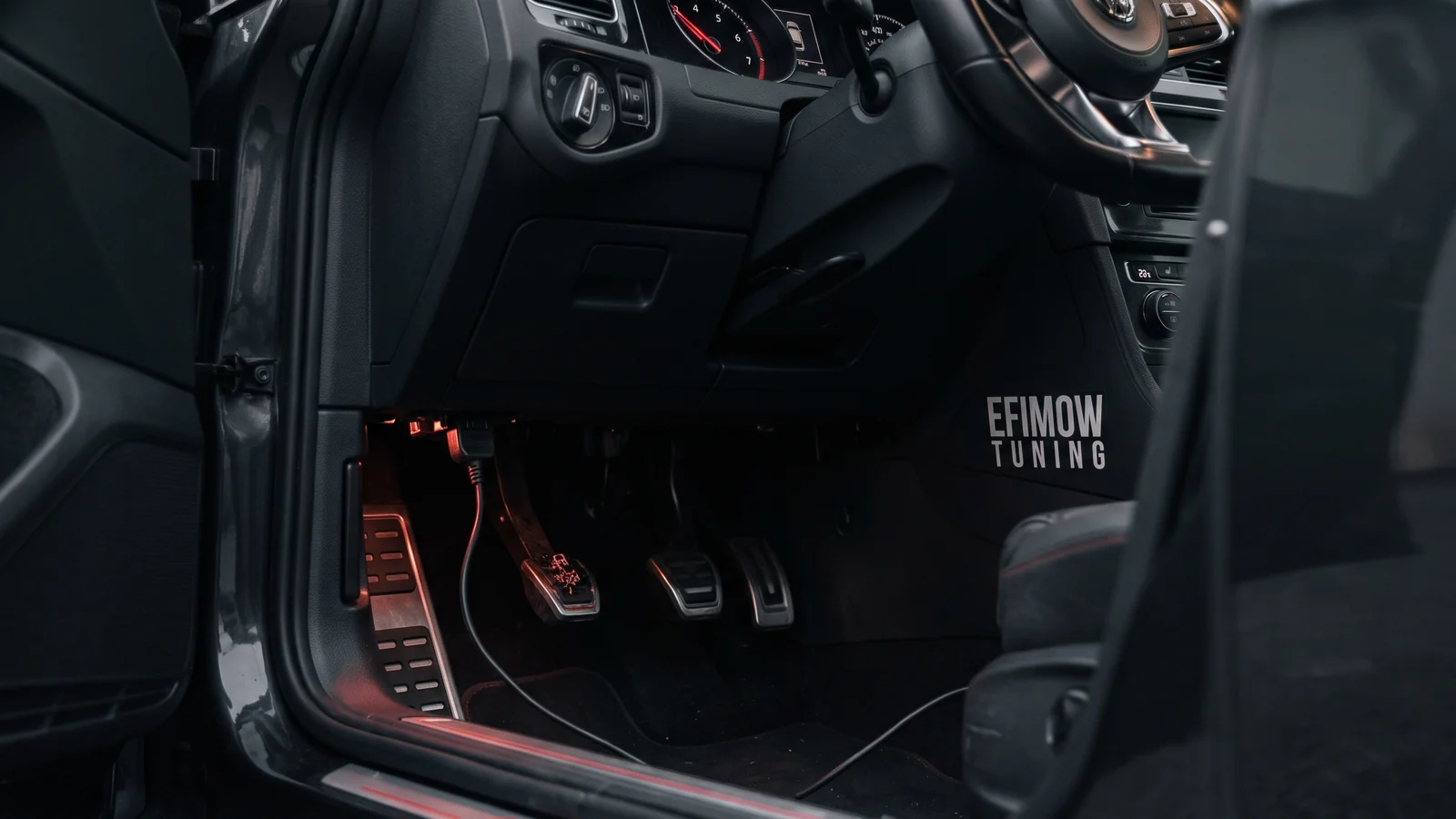
When all conditions are met, the ECU holds the rpm at the set value. As soon as one condition drops out (clutch comes up, car starts rolling), the launch limit is lifted immediately.
Turbo petrol: ignition retard and boost build-up
On a turbocharged petrol engine there is more to it than a rev limit. A turbo needs exhaust energy, and at standstill there is little of it. Launch control on turbo petrol engines therefore typically works with ignition retard: at launch rpm the ignition angle is moved well towards late. Combustion then delivers less torque to the crankshaft but more heat and pressure into the exhaust. The turbo spools, and part of the boost is already there when you pull away. In our ECU family data this reads simply: rev limiter at standstill with ignition retard and boost build-up.
That retard is also why launch control is not "free". Late ignition means high exhaust gas temperatures at the manifold, turbine and catalytic converter. Use it ten times in a row and you heat the exhaust system far more than any normal traffic-light start.
Diesel: 2-step without the boost trick
A diesel has no spark to retard. Launch control can only be implemented as an rpm or fuel-quantity limit at standstill: a plain 2-step without ignition retard and without the boost build-up you know from petrol engines. The benefit is correspondingly smaller: you launch at a defined rpm, but not with a pre-spooled turbo. At the same time the load on the dual-mass flywheel and clutch is high, because diesels deliver a lot of torque at low rpm. On many diesel ECUs the function is therefore only available on request or not at all.
Cars with a dual-clutch gearbox sometimes already have a launch function in the transmission control unit from the factory. In that case the TCU handles the start, not the engine software. An extra launch control in the engine ECU adds little there.
Which ECUs support it
Whether launch control is an option for your car depends on the ECU family, not the model name. The classification we work with looks roughly like this:
| ECU family | Launch control | Note |
|---|---|---|
| Continental Simos Turbo (e.g. Simos 18 on the EA888 Gen3) | yes | ignition retard and boost build-up |
| Bosch MG1 (turbo petrol) | yes | ignition retard and boost build-up |
| Bosch MED17 Premium (turbo petrol) | yes | ignition retard and boost build-up |
| other petrol families (MED17 VAG, MED9, ME7, Ford MED17 etc.) | partly | depends on software version |
| Bosch EDC17 / EDC16 / MD1, Siemens PCR | partly | diesel 2-step without boost build-up |
| many other diesel families (Delphi, Siemens SID, Denso) | no | - |
"Partly" means it depends on the exact software version, which we can only confirm once the read file is available. In the configurator such options are therefore shown as "on request". We check them against your file before anything is charged.
What the function does to your drivetrain
Launch control makes starts repeatable, not gentler. The load peaks end up here:
- Clutch: engaging at raised rpm creates friction work and heat. A stock clutch that is already at its limit with Stage 1 torque does not cope well with frequent launches.
- Dual-mass flywheel: the sudden load change stresses the springs and bearings of the DMF.
- Driveshafts, joints, differential: on a grippy surface with wide tyres the shock goes straight into the drivetrain instead of dissipating as wheelspin.
- Exhaust on petrol engines: late ignition means high exhaust temperature, with repeated use also for the catalytic converter.
A moderate launch rpm that suits tyres, surface and clutch makes sense. "As high as possible" is almost never the right setting.
Launch rpm and setup
The most important setting is the launch rpm. Too low, and the engine drops into a torque hole when the clutch engages, on a turbo without meaningful boost. Too high, and the wheels spin or the clutch slips for a long time and gets hot. Where the right value lies depends on drivetrain, tyres, surface and clutch. An all-wheel-drive car on grippy tarmac tolerates more than a front-wheel-drive car on a cold surface. On turbo petrol engines there is also the question of how much ignition retard is used: more retard brings boost faster, but also more heat in the exhaust.
A sensible calibration starts with a moderate value. If you use the function on track, you quickly notice whether the launch is clean or whether slip and judder dominate. A good launch value is the one that gets the car away repeatably, not the one that sounds loudest at standstill.
What launch control costs
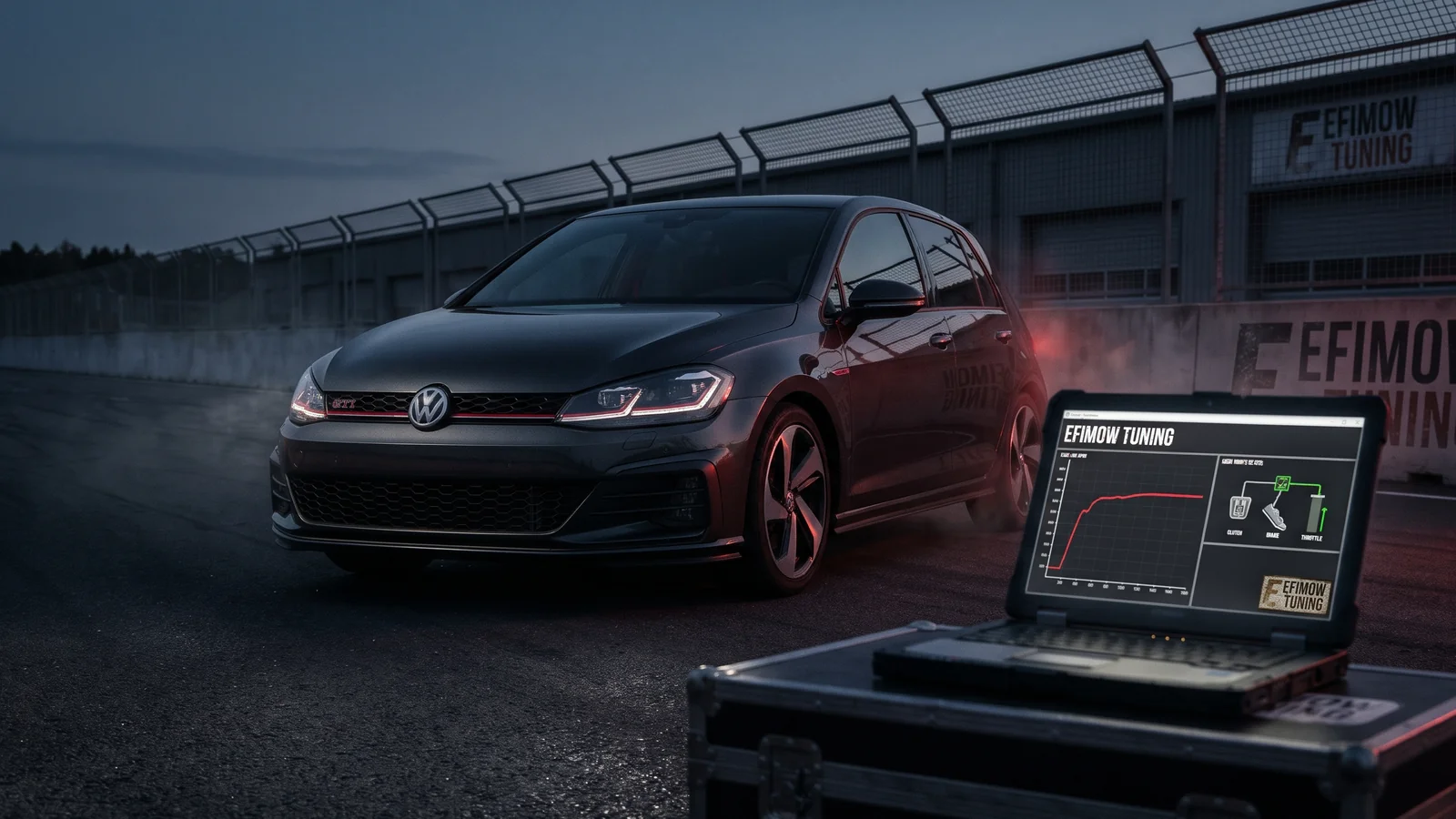
For cars of other brands, which we tune on site in Stödtlen or via a shipped-in ECU, launch control is a software option for €50, bookable online where the ECU family reliably supports the function. One example is the VW Golf 7 GTI with Simos 18: there you can add the option straight to the calibration. For ECUs marked "partly" you request the option, and we tell you after checking the file whether it works. The price of the calibration itself depends on the ECU generation and is the same on site and when shipping the ECU.
With BMW everything runs online: you order, read your ECU yourself and flash the finished file. Which extras are available for your ECU and what they cost is shown directly in the configurator as you select them.
Legal framework
Launch control is a motorsport function: for drag racing, rally starts or track days on a closed course. For any change to the engine software the rule is: the type approval (Betriebserlaubnis) lapses, and our software is intended exclusively for motorsport. What that means for insurance and liability is explained in the motorsport notice.
Conclusion
Software launch control is a second rev limit for standstill, extended on turbo petrol engines with ignition retard for faster boost. On a diesel it remains a simple 2-step with high load on clutch and flywheel. Whether your ECU supports it depends on the family and often on the software version. To find out what works on your car, select it in the configurator. You will see whether launch control can be booked directly or is checked on request.